

If you've been working with Azure, Git, or software delivery pipelines, you've probably already encountered many technologies covered by the AZ-400 exam. However, connecting source control, CI/CD, security, deployment, monitoring, automation, and feedback is where the real challenge begins. In this guide, you'll learn what AZ-400 covers, which skills you need, how to prepare effectively, and how the certification can fit into a DevOps career.
What Is the AZ-400 Exam and What Does It Cover?
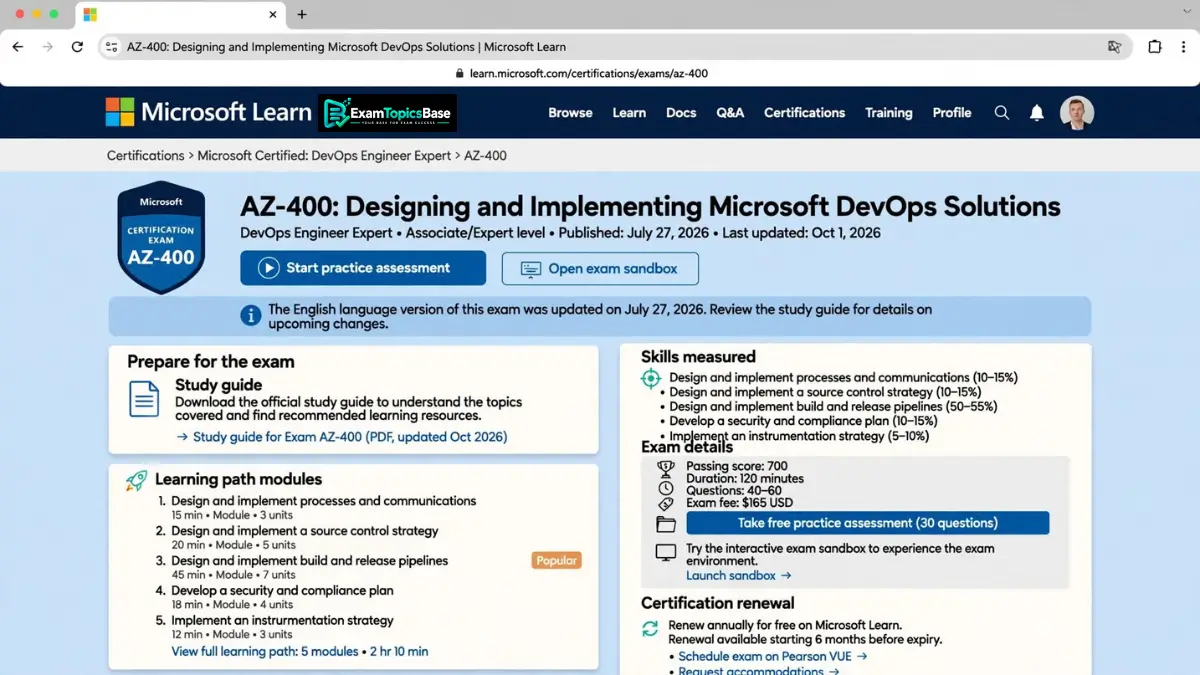
The AZ-400 exam is Microsoft's Designing and Implementing Microsoft DevOps Solutions certification exam, and it forms the examination requirement for Microsoft Certified: DevOps Engineer Expert. The current English version was updated on July 27, 2026, and Microsoft lists a passing score of 700.
First, the AZ-400 exam evaluates whether you can connect people, processes, and technologies to support continuous delivery. For example, a DevOps engineer might manage a Git repository, automate a build, run security checks, deploy an application, monitor production telemetry, and use feedback to improve the next release.
Moreover, Microsoft describes the DevOps Engineer role as working across developers, site reliability engineers, Azure administrators, and security engineers. The role therefore extends beyond knowing individual Azure DevOps features and requires an understanding of how engineering teams deliver software continuously.
For example, someone preparing only by memorizing Azure DevOps terminology may understand what a pipeline is but struggle to choose an appropriate deployment strategy for a production application. AZ-400 preparation should therefore emphasize decisions, workflows, automation, and practical implementation.
Furthermore, the current exam measures five broad areas, with build and release pipelines receiving by far the largest weighting. The five domains are processes and communications, source control, build and release pipelines, security and compliance, and instrumentation.
AZ-400 is Microsoft's exam for Designing and Implementing Microsoft DevOps Solutions and is the required exam for the Microsoft Certified: DevOps Engineer Expert certification.
Why Is the AZ-400 Certification Important for DevOps Engineers?
The AZ-400 certification is important because it validates a broad set of DevOps engineering capabilities across delivery, automation, security, and monitoring. The credential is especially relevant to professionals who already work across development and infrastructure responsibilities.
First, the certification connects technical skills with real delivery processes. For example, a DevOps engineer may need to turn source code changes into tested packages, pass security checks, deploy them safely, and monitor the resulting application.
In addition, the certification can provide a structured learning target for professionals who want to strengthen their Azure DevOps knowledge. Microsoft currently lists learning resources covering continuous integration, release strategy, secure continuous deployment, infrastructure as code, dependency management, continuous feedback, and security validation.
At the same time, certification should not be treated as a guarantee of employment or promotion. Practical experience remains important because DevOps work involves troubleshooting, collaboration, architecture decisions, automation, and production responsibilities.
DevOps certification validates knowledge, while hands-on engineering demonstrates how that knowledge is applied.
For example, an engineer who has built a multi-stage pipeline, configured approvals, managed artifacts, implemented Git branching policies, and investigated Application Insights telemetry will generally have a more useful preparation foundation than someone who has only read definitions.
What Are the Current AZ-400 Exam Topics and Objectives?
The current AZ-400 exam measures five domains covering processes, source control, pipelines, security, and instrumentation. Microsoft updated the English exam skills outline on July 27, 2026.
AZ-400 exam domain | Current weighting | Study priority |
Design and implement processes and communications | 10–15% | Medium |
Design and implement a source control strategy | 10–15% | Medium |
Design and implement build and release pipelines | 50–55% | Very high |
Develop a security and compliance plan | 10–15% | High |
Implement an instrumentation strategy | 5–10% | High |
First, build and release pipelines deserve the largest study allocation because Microsoft assigns this domain 50–55% of the exam.
Second, source control and process topics remain important because pipeline automation depends on reliable repositories, branching, pull requests, permissions, traceability, and collaboration. For example, a team might use trunk-based development with protected branches and automated validation before merging changes.
Third, security, compliance, and instrumentation should not be treated as optional topics. For example, a production pipeline may need secret protection, dependency scanning, deployment approvals, telemetry, alerts, and post-release monitoring.
Build and release pipelines account for 50–55% of the current AZ-400 exam, making CI/CD pipeline design the largest measured skill area.
Statistics: Build and release pipelines represent 50–55% of the current AZ-400 skills measured.
What Are the AZ-400 Certification Prerequisites?
The Microsoft Certified: DevOps Engineer Expert certification currently requires AZ-400 plus at least one prerequisite certification: Azure Administrator Associate or Azure Developer Associate. Microsoft lists AZ-400 as the required exam for the expert certification.
First, the certification prerequisite should be distinguished from exam readiness. Microsoft expects AZ-400 candidates to have experience administering and developing in Azure, with strong skills in at least one of those areas. Candidates should also have experience implementing GitHub and Azure DevOps solutions.
For example, an Azure administrator who already understands identity, networking, compute, storage, and governance may have a strong infrastructure foundation but still need to develop deeper Git, pipeline, testing, release, and automation skills.
Similarly, a developer may understand application development and Git but need more experience with Azure infrastructure, deployment environments, monitoring, security, and operational workflows.
The current certification page lists these prerequisite options:
Microsoft Certified: Azure Administrator Associate
Microsoft Certified: Azure Developer Associate
Is AZ-400 Suitable for Beginners?
AZ-400 is not primarily designed as a first-step certification for complete beginners because Microsoft expects Azure administration or development experience plus GitHub and Azure DevOps experience.
However, beginners can still build toward the exam by learning Azure fundamentals, Git, software development workflows, CI/CD, and basic infrastructure concepts first. For example, a new learner could start with Azure fundamentals, create a Git repository, build a small application, and gradually automate its testing and deployment.
Therefore, an AZ-400 study plan for beginners should focus on foundations before advanced pipeline design. The best beginner preparation is progressive: learn Azure, practice Git, build a simple pipeline, add testing and security, and then study advanced release strategies.
How Hard Is the AZ-400 Exam?
The AZ-400 exam can be challenging because it covers multiple connected DevOps disciplines rather than one isolated technology. Difficulty depends heavily on your existing Azure, Git, development, infrastructure, and automation experience.
For example, someone who regularly designs CI/CD pipelines may find pipeline questions familiar but need more preparation for governance or instrumentation. Conversely, an Azure administrator may understand infrastructure well but need additional practice with GitHub Actions, YAML pipelines, release strategies, and artifact management.
As such, difficulty should be measured by skill coverage rather than by a simple label such as easy or hard. A useful readiness indicator is whether you can explain why you would select a particular DevOps approach and implement a representative version of it.
How Do You Prepare for the AZ-400 Exam?
The best AZ-400 preparation combines the current Microsoft study guide, structured learning, hands-on projects, and practice assessments. Microsoft specifically directs candidates toward the current study guide, exam preparation videos, an exam sandbox, and practice assessments.
First, review the official study guide before choosing individual courses or practice materials. The study guide defines the current skills measured and should be your reference point whenever older training content conflicts with newer objectives.
Second, assess your existing knowledge across Azure, Git, development, infrastructure, security, pipelines, and monitoring. For example, write down whether you can independently create a repository, configure a CI workflow, publish an artifact, deploy an application, secure secrets, and investigate telemetry.
Third, follow a structured sequence:
Review the current AZ-400 study guide.
Map the five exam domains to your existing skills.
Strengthen Azure administration or development fundamentals.
Practice Git and source control workflows.
Master CI/CD pipelines.
Study release and deployment strategies.
Learn security and compliance practices.
Practice monitoring and instrumentation.
Build hands-on Azure DevOps and GitHub scenarios.
Take practice assessments and review weak areas.
Furthermore, Microsoft provides learning paths for areas such as CI with Azure Pipelines and GitHub Actions, release strategy, secure continuous deployment, infrastructure as code, dependency management, continuous feedback, and security validation.
Statistic: Microsoft lists multiple dedicated AZ-400 learning paths covering areas such as CI, release strategy, secure deployment, IaC, dependencies, feedback, and security.
Source: Exam AZ-400: Designing and Implementing Microsoft DevOps Solutions
What Should You Study for AZ-400 CI/CD Pipeline Topics?
The AZ-400 CI/CD section should receive the greatest study priority because build and release pipelines account for 50–55% of the current exam.
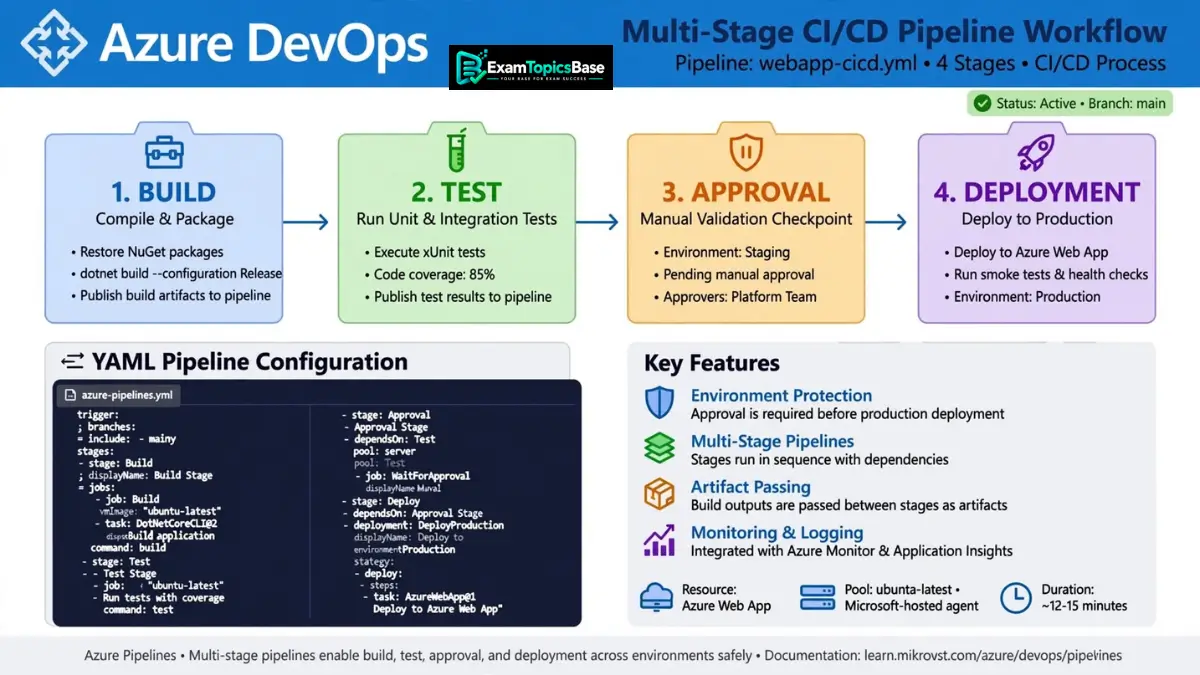
First, understand continuous integration as an automated process for building and validating changes. For example, a developer pushes code to a repository, a pipeline compiles the application, runs tests, performs checks, and produces an artifact.
Second, study continuous delivery and deployment as the processes that move validated software toward users. For example, a release pipeline can deploy an application to a test environment, require approval, and then promote the same artifact to production.
Key areas include:
Azure Pipelines
GitHub Actions
YAML pipelines
Build automation
Pipeline triggers
Agents and runners
Variables and templates
Multi-stage pipelines
Environments
Approvals and checks
Azure Artifacts and GitHub Packages
Dependency management
Automated testing
Code coverage
Deployment strategies
Feature flags
Secure files and secrets
Moreover, deployment strategies deserve practical attention because different applications require different release approaches. Blue-green deployment, canary deployment, ring deployment, progressive exposure, feature flags, rolling deployment, and deployment slots can solve different operational problems.
For example, a canary strategy can expose a new application version to a limited audience before broader rollout, while a blue-green strategy maintains separate environments so traffic can move between versions.
CI/CD pipelines are the operational backbone of modern software delivery, and AZ-400 gives them the largest exam weighting.
How Does AZ-400 Test Azure Pipelines and GitHub Actions?
Azure Pipelines and GitHub Actions are automation platforms that can implement continuous integration and delivery workflows covered by AZ-400. Microsoft specifically lists continuous integration with Pipelines and GitHub Actions among the skills associated with the certification.
First, practice creating a simple pipeline that checks out code, installs dependencies, runs tests, and produces an artifact. For example, a Node.js application could use a GitHub Actions workflow to run tests whenever a pull request is opened.
Second, repeat the same conceptual workflow with Azure Pipelines. This comparison helps you understand the underlying DevOps principles rather than memorizing one platform's interface.
What Source Control Skills Are Required for AZ-400?
Source control is the disciplined management of code changes, collaboration, history, and repository permissions throughout the software lifecycle. The AZ-400 source-control domain covers strategy and implementation rather than simply knowing Git commands.
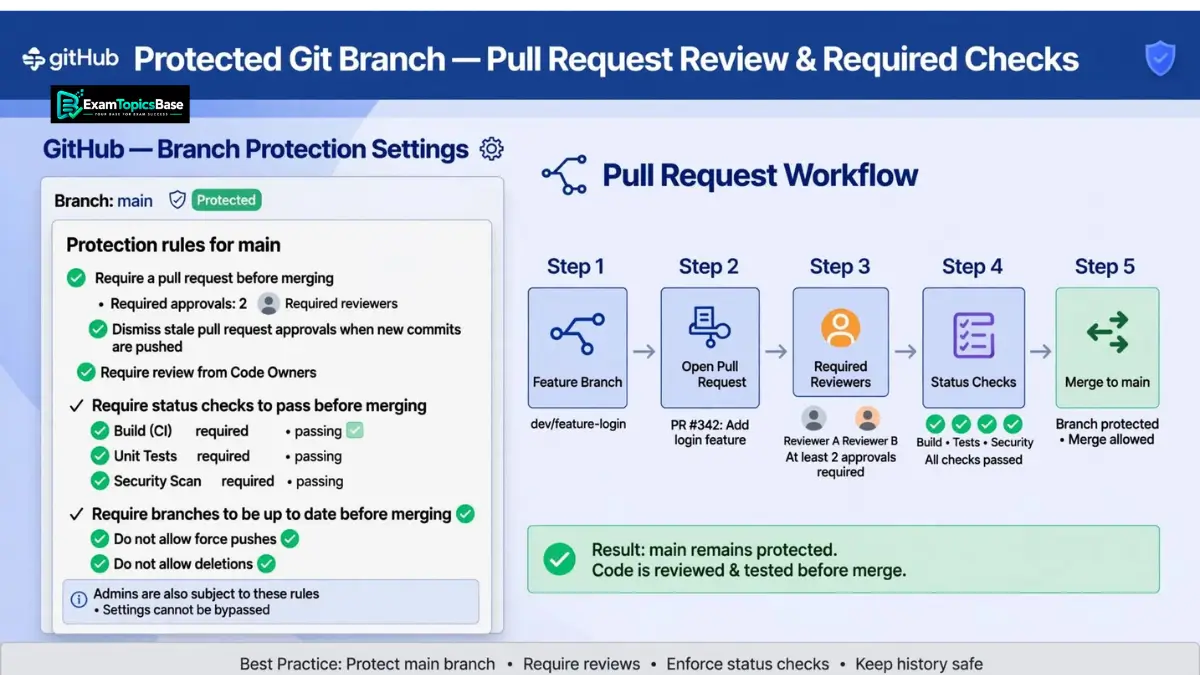
First, practice common branching strategies such as trunk-based development, feature branches, and release branches. For example, a team may protect its main branch and require pull-request reviews and automated checks before merging.
Second, understand pull requests, branch policies, permissions, tags, repository organization, and recovery concepts. These practices create traceability and reduce the chance that uncontrolled changes reach production.
Third, practice GitHub repositories and Azure Repos so that you understand the common principles across platforms. Git knowledge should include branching, merging, rebasing concepts, pull requests, conflict resolution, and repository security.
What Security and Compliance Topics Should You Study for AZ-400?
Security and compliance are DevOps practices that integrate security controls throughout development, testing, deployment, and operations. Microsoft includes security and compliance as one of the five current AZ-400 domains.
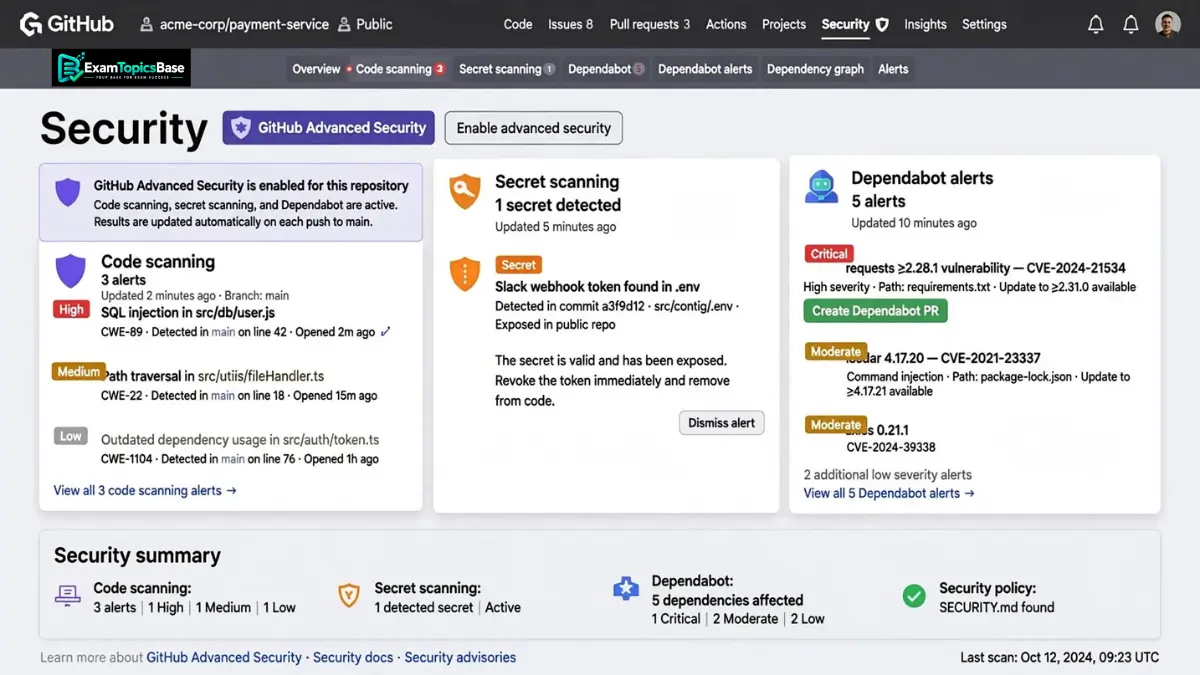
First, study secrets management, permissions, dependency security, code scanning, secret scanning, and licensing considerations. For example, a pipeline should not expose a production credential in a YAML file or commit a secret directly into a Git repository.
Second, understand DevSecOps as an integrated workflow rather than a final security inspection. Microsoft Learn's current AZ-400 security training covers secure DevOps concepts, continuous security validation, threat modeling, and automated analysis such as GitHub CodeQL.
Third, practice how security controls can be introduced into CI/CD without unnecessarily slowing delivery. Dependency scanning, code analysis, secret detection, approvals, and compliance checks can become automated quality gates.
How Does AZ-400 Cover Monitoring and Instrumentation?
Instrumentation is the collection and use of telemetry, metrics, logs, traces, and alerts to understand application and infrastructure behavior. The current AZ-400 instrumentation domain represents 5–10% of the exam.
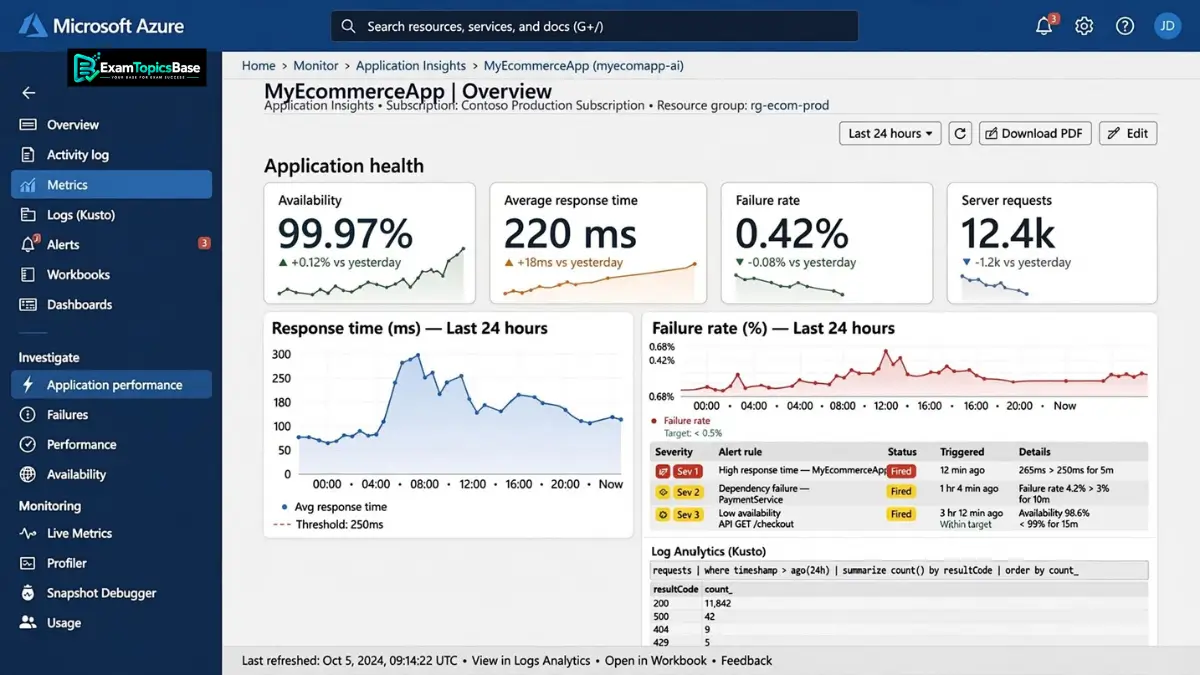
First, study Azure Monitor, Azure Monitor Logs, Application Insights, infrastructure insights, alerts, and telemetry concepts. For example, an application may send request duration and failure information to Application Insights while infrastructure metrics are collected through Azure Monitor.
Second, learn how monitoring connects to the DevOps feedback cycle. A deployment is not complete simply because a pipeline reports success; engineers also need to determine whether the application behaves correctly after release.
Third, basic query skills can help you investigate telemetry efficiently. For example, Kusto Query Language can be used to filter and analyze Azure Monitor data when troubleshooting application or infrastructure behavior.
What Azure DevOps Tools Should AZ-400 Candidates Practice?
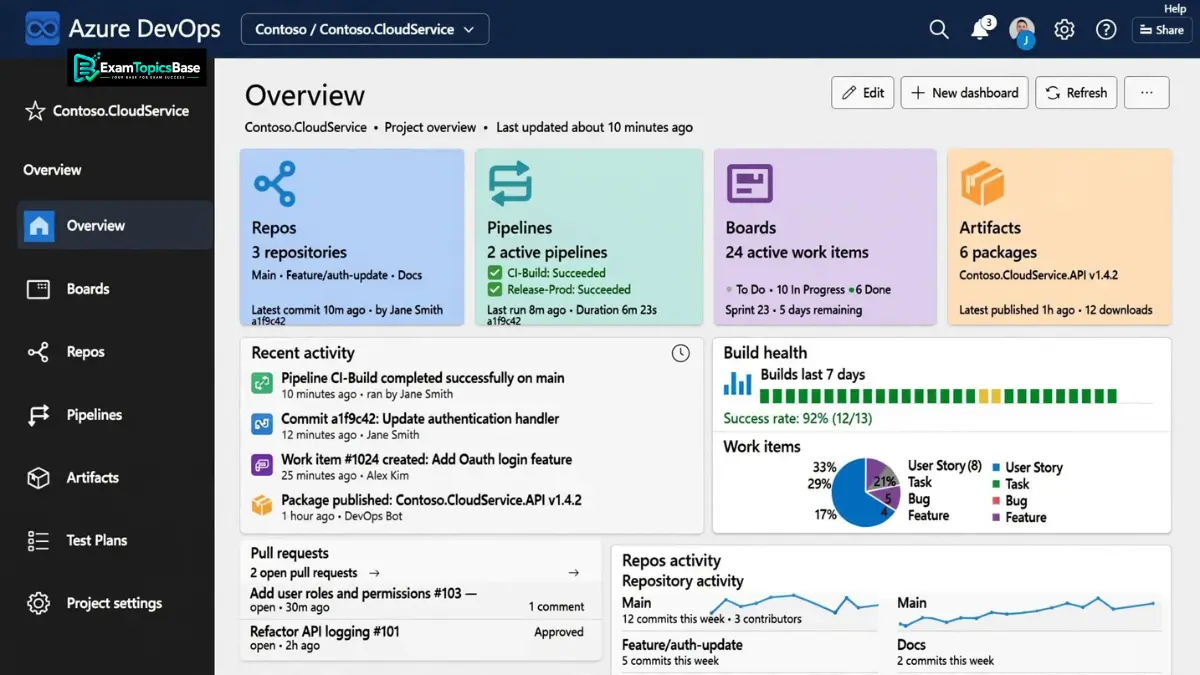
The most useful AZ-400 tools are those that let you practice the five exam domains as connected workflows. Microsoft specifically associates the certification with Azure DevOps, GitHub, pipelines, infrastructure as code, release management, and continuous feedback.
Tool or platform | What to practice | Example scenario |
Azure Repos | Git repositories and branch policies | Protect the main branch |
Azure Pipelines | CI/CD and multi-stage workflows | Build, test, and deploy |
Azure Artifacts | Package and artifact management | Publish application packages |
GitHub | Repositories and collaboration | Review pull requests |
GitHub Actions | CI/CD automation | Run automated tests |
Azure Monitor | Metrics, logs, alerts | Monitor production resources |
Application Insights | Application telemetry | Investigate failed requests |
Microsoft Entra ID | Identity and access | Control DevOps access |
First, practice each tool through a small project instead of studying each service in isolation. For example, create a repository, automate a build, publish an artifact, deploy it to a test environment, secure credentials, and monitor the deployed application.
Second, use free or low-cost learning options where appropriate, including Microsoft Learn modules and available Azure resources. The goal is not to create an expensive production environment but to gain repeatable experience with core workflows.
How Do AZ-400 Practice Questions Help With Exam Preparation?
AZ-400 practice questions help candidates identify knowledge gaps and become familiar with the style and reasoning required during exam preparation. Microsoft provides a free Practice Assessment for AZ-400, and its assessments provide score reports, rationales, and links to additional learning resources.
First, use practice assessments as diagnostic tools rather than as a substitute for learning. For example, if several questions reveal weak knowledge of deployment strategies, return to the relevant Microsoft Learn material and build a small deployment exercise.
Second, review incorrect answers carefully. A wrong answer can reveal a terminology problem, a conceptual gap, or difficulty selecting the best solution for a scenario.
Third, repeat practice after targeted study. Microsoft's Practice Assessments are available at no cost and can be attempted multiple times, while the score report provides rationales and links to additional information.
Statistic: Microsoft says its Practice Assessments are available at no cost and can be attempted as many times as desired.
How Can You Use an AZ-400 Practice Test to Find Weak Areas?
An AZ-400 practice test is most useful when you use its results to create a targeted study plan. A score by itself does not explain which engineering concepts need more work.
For example, repeated mistakes around YAML, pipeline environments, approvals, or deployment patterns indicate that you need more hands-on CI/CD work rather than simply reading additional general certification material.
Moreover, avoid relying on unauthorized or outdated question banks that claim to reproduce the live exam. Practice material should supplement the official Microsoft study guide and practical work, not replace them.
How Much Hands-On Azure DevOps Practice Do You Need for AZ-400?
Hands-on practice is essential for turning AZ-400 concepts into usable DevOps skills, especially because the exam covers interconnected processes and technologies. Microsoft expects candidates to have experience administering or developing in Azure and implementing GitHub and Azure DevOps solutions.
First, build at least one end-to-end project that represents a realistic delivery workflow. For example, place an application in Git, configure automated testing, publish an artifact, deploy it through multiple environments, add approvals, protect secrets, and monitor the deployed workload.
Second, deliberately introduce failure scenarios. Break a build, create a merge conflict, trigger a failed test, deploy an incorrect configuration, or generate an application error, and then practice diagnosing the problem.
Third, document what you learned after each exercise. A short record of the problem, diagnosis, solution, and DevOps principle involved can become a powerful revision resource.
Hands-on AZ-400 practice should simulate the decisions a DevOps engineer makes in a real delivery environment.
What Is the Best AZ-400 Study Plan for Beginners?
A practical AZ-400 study plan for beginners should progress from Azure and Git fundamentals toward pipelines, security, monitoring, and integrated DevOps scenarios.
Study period | Main focus | Practical goal |
Week 1 | Azure and DevOps foundations | Identify knowledge gaps |
Week 2 | Git and source control | Build and manage repositories |
Week 3 | CI/CD fundamentals | Create automated pipelines |
Week 4 | Release and deployment | Practice deployment strategies |
Week 5 | Security and monitoring | Add scanning and telemetry |
Week 6 | Practice and revision | Test readiness and fix weak areas |
First, spend the opening stage reviewing Azure fundamentals, Git, repositories, branching, and the current AZ-400 study guide. This stage gives you the vocabulary needed for later pipeline work.
Second, make CI/CD the central practical project during the middle of the plan. Build, test, package, and deploy an application while experimenting with triggers, variables, environments, approvals, and deployment strategies.
Third, finish with security, compliance, instrumentation, and practice assessments. For example, add secret protection, dependency checks, monitoring alerts, and a troubleshooting exercise to your project.
Get Free Microsoft Real Exam Questions & Answers of Here: https://examtopicsbase.com/vendors/microsoft
What Is the AZ-400 Azure DevOps Career Path After Certification?
The AZ-400 Azure DevOps career path can support roles that combine software delivery, cloud infrastructure, automation, security, and operational reliability. Microsoft identifies DevOps Engineer as the job role associated with the expert certification.
First, DevOps Engineer and Azure DevOps Engineer are natural targets for professionals who enjoy automation and delivery systems. For example, these roles may involve designing pipelines, managing repositories, automating deployments, improving release reliability, and monitoring applications.
Second, adjacent roles can include:
Cloud Engineer
Platform Engineer
Site Reliability Engineer
Release Engineer
DevSecOps Engineer
Cloud Architect
Third, your existing background can influence the most logical direction. An administrator may move toward platform engineering or cloud DevOps, while a developer may move toward release engineering, DevSecOps, or application platform work.
Furthermore, the expert certification can complement other Azure credentials rather than replacing practical experience. A broader certification roadmap may include an Azure administration, development, data, or specialty credential depending on your role.
The strongest AZ-400 career path combines certification evidence with demonstrable DevOps engineering projects.
What Should You Know Before Scheduling the AZ-400 Exam?
Before scheduling the AZ-400 exam, you should be able to demonstrate practical competence across all five current domains, with particular strength in CI/CD pipelines. Microsoft provides the current study guide, practice assessment, and exam sandbox as preparation resources.
Use this readiness checklist:
I have reviewed the current July 27, 2026 AZ-400 skills measured.
I understand all five exam domains.
I can work confidently with Git repositories and branching.
I understand pull requests and repository permissions.
I can design and explain CI/CD pipelines.
I can work with Azure Pipelines and GitHub Actions.
I understand artifacts, dependencies, tests, and pipeline environments.
I can explain common deployment strategies.
I understand DevOps security and compliance concepts.
I can protect secrets and understand security scanning.
I can use monitoring and application telemetry concepts.
I have completed hands-on Azure DevOps or GitHub exercises.
I have taken a current practice assessment.
I have reviewed my weak areas after practice.
I understand the certification prerequisite pathway.
Moreover, remember that Microsoft does not publish a guaranteed list of every possible interactive component for an individual exam because exam experiences can change. The official AZ-400 page currently directs candidates to the exam sandbox to familiarize themselves with the exam experience.
Statistic: Microsoft currently lists no retirement date for AZ-400 on the certification page.
What's Next for Your AZ-400 Preparation?
The next step for AZ-400 preparation is to convert the current exam objectives into a practical study schedule with measurable tasks. A strong plan should tell you not only what to read but also what to build, test, troubleshoot, and explain.
First, begin with the official Microsoft study guide and create five study categories based on the current domains. Then allocate the largest portion of your technical practice time to build and release pipelines because that domain represents 50–55% of the current exam.
Second, create a small DevOps project that grows throughout your preparation. For example, begin with source control, add CI, introduce automated tests, publish an artifact, create a release workflow, add security checks, and finish with monitoring.
Third, use practice assessments after meaningful study rather than immediately repeating questions without reviewing the underlying concepts. Microsoft's Practice Assessments are designed to help candidates assess knowledge, identify gaps, and review rationales for answers.
Finally, use resources such as ExamTopicsBase for additional practice and revision while keeping the current Microsoft study guide, official learning content, and hands-on work at the center of your preparation.
Conclusion
AZ-400 is a broad DevOps engineering exam that evaluates how well you can design and implement processes, source control, CI/CD pipelines, security, compliance, and instrumentation. The current English exam was updated July 27, 2026, and Microsoft assigns 50–55% of its weighting to build and release pipelines.
First, focus on the official skills measured rather than relying on older preparation material. Second, build practical experience with Git, Azure DevOps, GitHub Actions, pipelines, artifacts, security controls, deployment strategies, and monitoring. Third, use practice assessments to identify gaps and then return to targeted learning.
Ultimately, the best way to prepare for AZ-400 is to think like a DevOps engineer rather than simply memorize certification terminology. By combining Microsoft Learn, hands-on projects, current exam objectives, practice questions, and structured revision, you can build preparation that is useful both for the exam and for real-world DevOps work.
Frequently Asked Questions
1. What is the AZ-400 exam?
AZ-400 is the Microsoft exam for Designing and Implementing Microsoft DevOps Solutions. It evaluates skills related to DevOps processes, source control, pipelines, security, compliance, and monitoring.
2. Why is the AZ-400 exam considered difficult?
AZ-400 covers several technical areas and expects practical knowledge of Azure, GitHub, Azure DevOps, automation, pipelines, security, and deployment strategies. Microsoft recommends having experience administering and developing in Azure.
3. What topics are covered in the AZ-400 exam?
The exam covers processes and communications, source control, build and release pipelines, security and compliance, and instrumentation. Build and release pipelines have the largest weighting at 50–55%.
4. Do I need Azure experience before taking AZ-400?
Yes. Microsoft expects candidates to have experience with both Azure administration and development, along with experience implementing GitHub and Azure DevOps solutions.
5. How can I prepare for the AZ-400 exam?
Start by reviewing the official Microsoft study guide and exam objectives. Then build practical experience with Azure DevOps, GitHub, source control, CI/CD pipelines, infrastructure as code, security, and monitoring. Microsoft recommends training and hands-on experience before taking the exam.
6. Is AZ-400 suitable for beginners?
AZ-400 is designed for DevOps professionals rather than complete beginners. Candidates should already have relevant Azure administration or development experience before beginning serious exam preparation.
7. Does Microsoft provide AZ-400 practice questions?
Yes. Microsoft provides a free Practice Assessment that allows candidates to test their knowledge and identify areas that need additional study.
8. What is the passing score for AZ-400?
The current Microsoft exam information states that a score of 700 or higher is required to pass AZ-400.
9. What tools should I study for the AZ-400 exam?
Important technologies include Azure DevOps, GitHub, Git, Azure Pipelines, GitHub Actions, YAML pipelines, Azure Monitor, infrastructure as code, and security and compliance tools.
10. What certification is associated with the AZ-400 exam?
AZ-400 is part of the requirements for the Microsoft Certified: DevOps Engineer Expert certification. The exam focuses on designing and implementing DevOps solutions across development and infrastructure environments.
You may also like to read:
What Is the AZ-104 Exam and How Can You Prepare for It? | The Ultimate Guide
Is AZ-900 the Right Microsoft Certification for Your Career?
What Is the AZ-120 Exam and How Can You Prepare for It? The Ultimate Guide
Microsoft Certification Career Roadmaps | A Comprehensive Guide to Choosing the Right Career Path

Written by Julia Mercer
I’m Julia Mercer, a Microsoft Solutions Architect and technical contributor at ExamTopicsBase. Having navigated the evolving Microsoft certification roadmap throughout my career in enterprise IT, I focus on delivering accurate, scenario-tested practice questions and clear, blueprint-aligned explanations so you can walk into your test with total confidence.
Comments (0)
Leave a Reply
No comments yet. Be the first to share your thoughts!