

Many beginners start their Azure journey by searching for AZ-900 study guides, exam topics, and practice questions, but knowing what to study is only part of effective preparation. The bigger challenge is understanding which objectives matter most, how to organize your study time, and when you are genuinely ready for the exam. In this guide, you will learn how to prepare for AZ-900 step by step, understand the current exam structure, choose the right resources, and build a practical certification roadmap.
What Is the AZ-900 Certification?
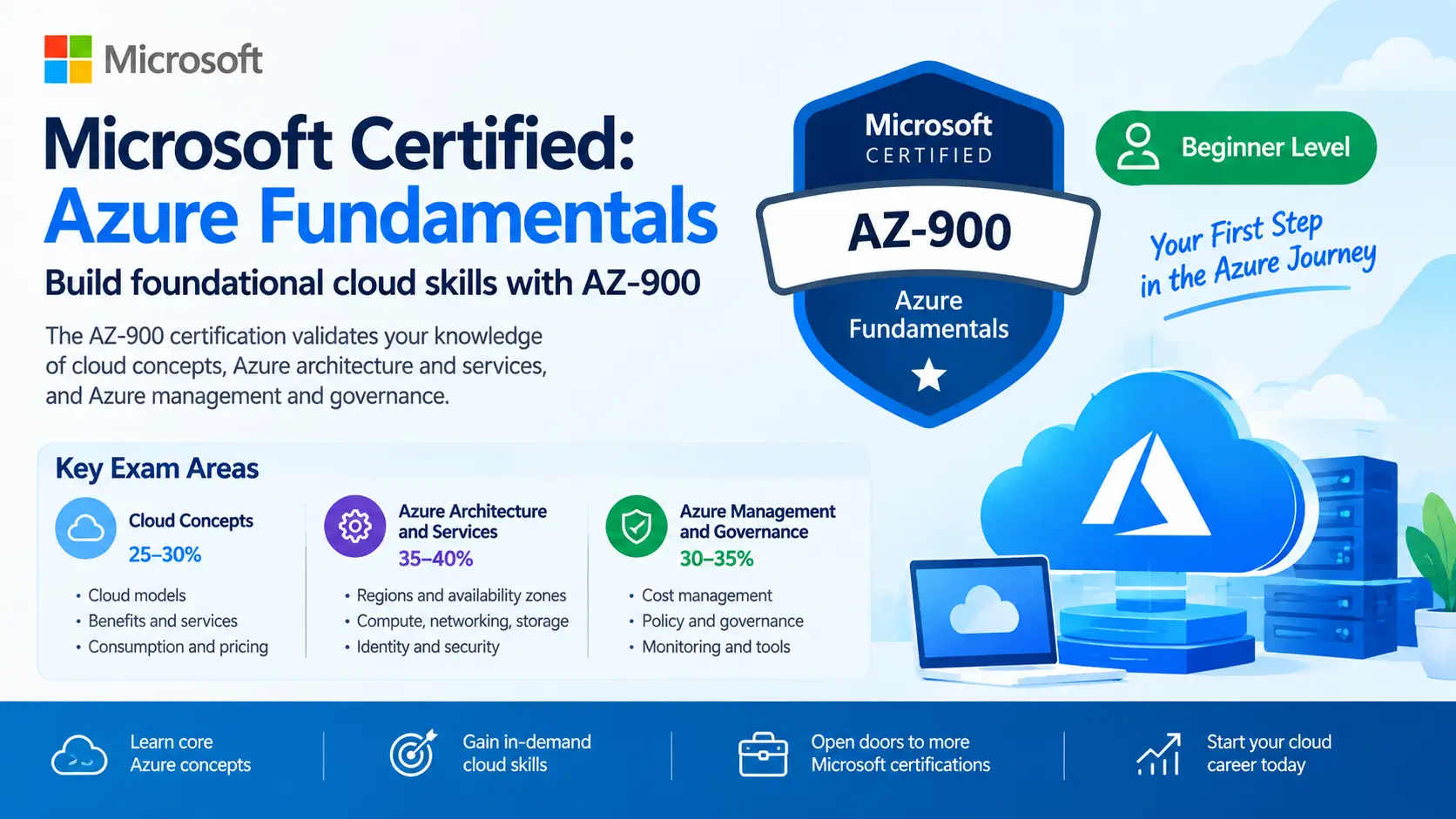
AZ-900 is the Microsoft Azure Fundamentals certification and is designed to validate foundational knowledge of cloud concepts, core Azure services, and Azure management and governance. Microsoft positions Azure Fundamentals at the beginner level and describes it as a common starting point for people building an Azure career.
First, AZ-900 certification is designed for learners who want to understand Azure without starting with advanced administration or development tasks. For example, a beginner can use AZ-900 to learn what virtual machines, storage, networking, identity, governance, and cloud service models mean before moving into a specialized Azure role.
Moreover, the certification does not require you to become an expert Azure administrator before taking the exam. Instead, the AZ-900 exam focuses on recognizing and explaining foundational concepts and understanding when different Azure services and management features are appropriate.
For example, you may need to distinguish between Infrastructure as a Service, Platform as a Service, and Software as a Service, or identify which Azure service is appropriate for a particular workload.
As such, AZ-900 is particularly useful for students, career changers, IT support professionals, junior administrators, business professionals, and aspiring cloud specialists who want a structured introduction to Microsoft Azure.
Why Is the AZ-900 Certification Important for Beginners?
AZ-900 certification matters because it gives beginners a structured foundation for understanding Azure before they pursue more specialized cloud roles. The certification can help learners organize their knowledge around Microsoft's core Azure concepts instead of studying disconnected cloud technologies.
First, Azure Fundamentals gives beginners a common vocabulary for cloud computing. For example, understanding concepts such as regions, availability zones, subscriptions, resource groups, compute, storage, networking, identity, and governance makes later Azure training easier to follow.
Second, the certification can support a broader Microsoft certification strategy. A learner interested in administration may eventually explore AZ-104, while someone interested in DevOps may work toward AZ-400 after developing the required experience and skills.
Moreover, AZ-900 is not a guarantee of employment or a replacement for hands-on experience. A certification demonstrates knowledge, while practical projects demonstrate that you can apply that knowledge.
For example, a beginner studying storage concepts can reinforce learning by creating an Azure storage account, reviewing redundancy options, and exploring how access controls affect resources.
A strong AZ-900 preparation plan connects certification knowledge with practical understanding rather than treating the exam as a memorization exercise.
What Are the Current AZ-900 Exam Topics and Objectives?
The current AZ-900 exam measures three primary knowledge areas: cloud concepts, Azure architecture and services, and Azure management and governance. The current Microsoft study guide lists the domains with the following approximate weightings.
AZ-900 Exam Domain | Current Weighting | What to Focus On |
Cloud Concepts | 25–30% | Cloud models, benefits, service types, consumption concepts |
Azure Architecture and Services | 35–40% | Regions, compute, networking, storage, identity, core Azure services |
Azure Management and Governance | 30–35% | Cost, governance, management tools, monitoring, security |
First, cloud concepts form the foundation of the AZ-900 exam. You should understand cloud computing, public, private, and hybrid cloud models, consumption-based pricing, shared responsibility, scalability, availability, reliability, and the differences between IaaS, PaaS, and SaaS.
For example, IaaS gives you greater control over infrastructure components, while SaaS provides a ready-to-use software application managed largely by the provider.
Second, Azure architecture and services currently represent the largest exam domain. This area includes Azure regions, region pairs, availability zones, resource groups, subscriptions, management groups, computer services, networking, storage, and identity.
For example, you should understand the difference between a resource group and a subscription and recognize the purpose of services such as virtual machines, containers, Azure Functions, virtual networks, and Azure Storage.
Third, Azure management and governance covers how organizations control, monitor, secure, and manage Azure resources. Topics include Azure Policy, resource locks, tags, Microsoft Entra ID, role-based access control, Azure Monitor, Service Health, Azure Advisor, and cost management.
For example, an organization can use Azure Policy to enforce governance requirements across resources rather than relying on administrators to check every resource manually.
What Should You Study for AZ-900?
You should study every current AZ-900 objective, with extra attention to Azure architecture and services because it has the highest current weighting. Your preparation should follow the official study guide rather than an outdated syllabus.
First, review the AZ-900 exam objectives before starting your study plan. This gives you a checklist of the concepts you are expected to understand and prevents you from spending excessive time on topics outside the exam scope.
Second, organize your notes into three sections: cloud concepts, Azure architecture and services, and Azure management and governance. For example, keep storage redundancy, storage accounts, and storage tiers together rather than scattering them across unrelated notes.
How Should Beginners Prepare for the AZ-900 Exam?
AZ-900 exam preparation should follow a structured process that moves from understanding objectives to studying concepts, practicing questions, reviewing weaknesses, and confirming readiness. A simple roadmap prevents beginners from jumping randomly between videos, articles, and practice tests.
Step 1: Review the Official AZ-900 Objectives
First, download or review the current Microsoft study guide and identify every objective. For example, create a checklist covering cloud concepts, Azure architecture and services, and Azure management and governance.
This first step is important because the exam objectives define what your preparation should prioritize. Avoid building your entire study plan around a third-party question bank without checking it against the official objectives.
Step 2: Build Your Azure Fundamentals
Second, learn the underlying concepts before attempting large numbers of practice questions. For example, understand what a virtual network does before trying to memorize questions about networking services.
Moreover, beginners should learn the difference between related services. Understanding why you would choose one service over another is more useful than memorizing isolated definitions.
Step 3: Use Microsoft Learn
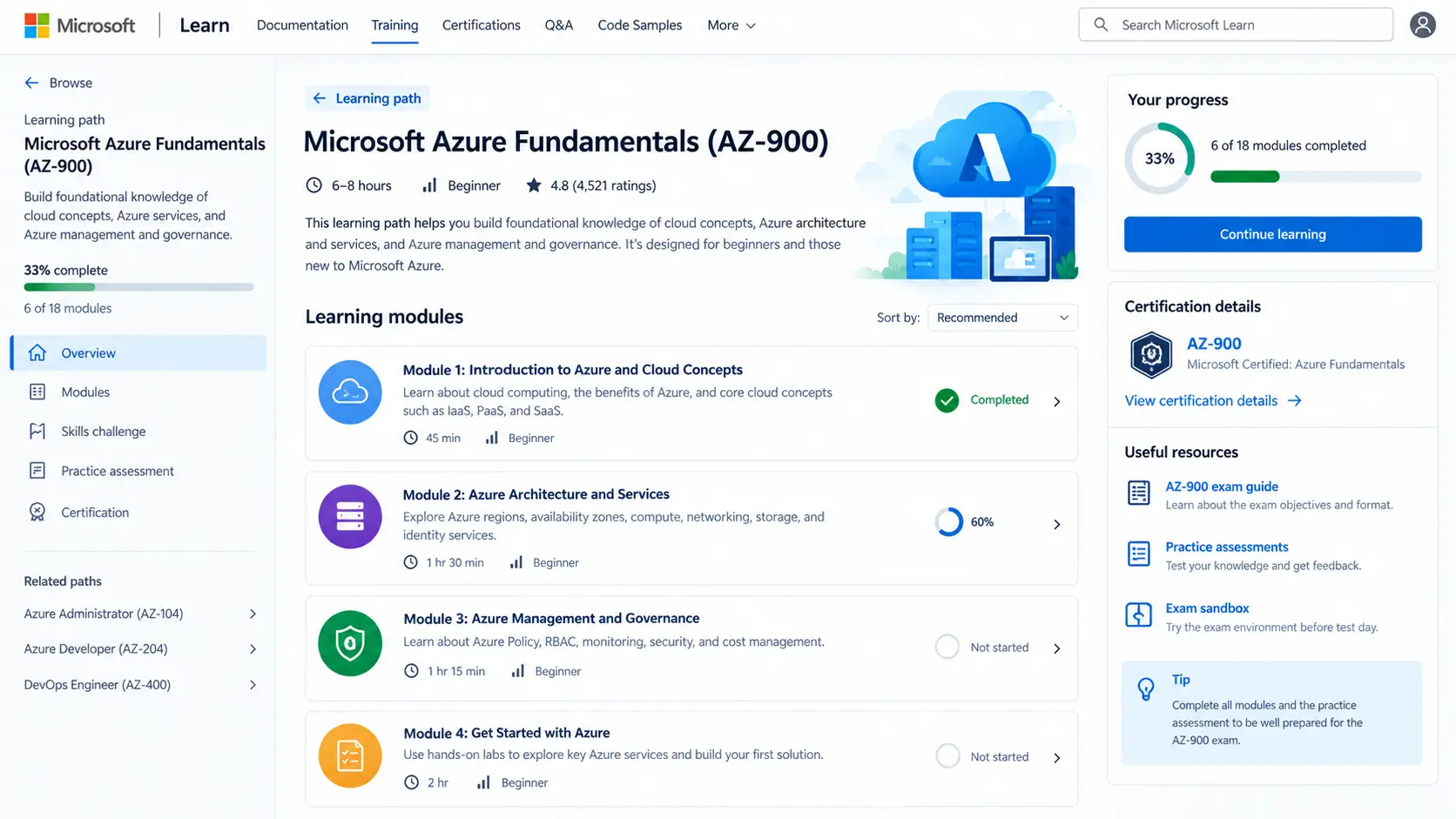
Third, use Microsoft Learn as the foundation of your AZ-900 preparation. Microsoft provides learning content covering cloud concepts, Azure architecture and services, and management and governance.
For example, complete the relevant learning modules and make short notes in your own words after each topic. This approach makes it easier to identify concepts that still feel unclear.
Step 4: Add Practice Questions
Fourth, use AZ-900 practice questions for beginners after learning each major domain. Practice should reveal what you understand and where additional study is required.
For example, if you consistently confuse Azure Policy with role-based access control, return to the relevant learning material before taking another practice test.
Step 5: Review Weak Areas
Fifth, turn incorrect answers into study opportunities. Instead of simply recording that an answer was wrong, write down why the correct answer works and why the other options do not.
This method makes your preparation more active. It also helps you recognize similar concepts when they appear in a different scenario.
Step 6: Use the Exam Sandbox
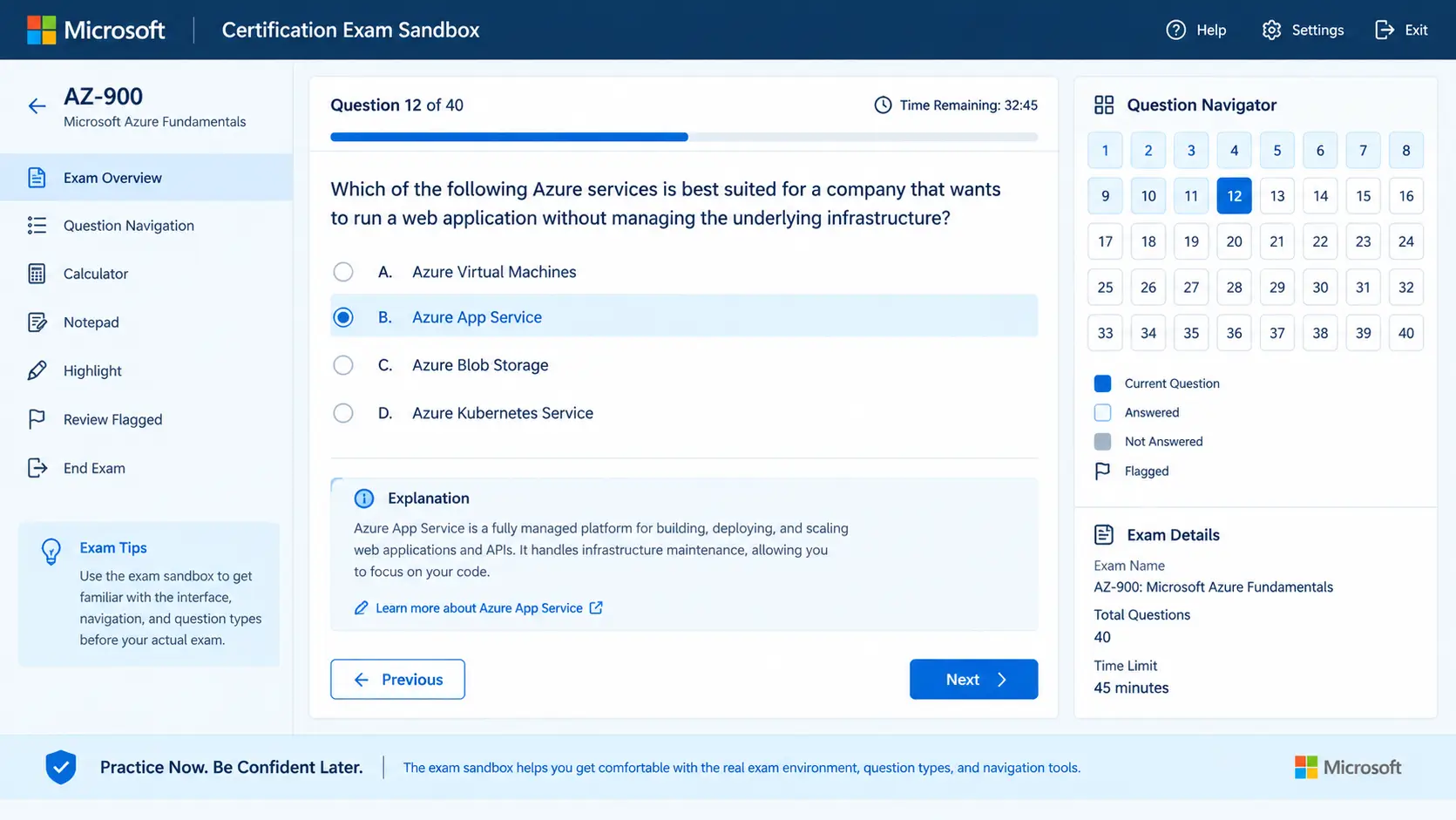
Sixth, become familiar with the exam environment before test day. Microsoft provides an exam sandbox so candidates can explore the interface and understand how the testing experience works.
Step 7: Schedule the AZ-900 Exam
Finally, schedule the exam when your knowledge is consistent across all three domains. Avoid scheduling solely because you have completed a particular number of study hours.
The best way to prepare for AZ-900 is to combine official objectives, structured learning, practice, and targeted review.
How Long Should You Study for the AZ-900 Exam?
Most beginners should plan several weeks for AZ-900 preparation, but the right study period depends on previous IT knowledge, cloud experience, and weekly study time. There is no single official number of hours that guarantees exam readiness.
First, beginners with little or no IT background may benefit from a four-to-six-week schedule. For example, studying for one hour each weekday plus a longer weekend session gives enough time to learn concepts without trying to absorb everything in a few days.
Second, learners with IT support, networking, infrastructure, or database experience may progress faster because many Azure concepts build on familiar technology principles.
Learner Profile | Suggested Preparation Approach | Main Focus |
Complete beginner | 4–6 weeks | Cloud concepts and Azure basics |
IT support professional | 3–5 weeks | Azure services and governance |
System/network administrator | 2–4 weeks | Azure architecture and service selection |
Experienced cloud professional | 1–3 weeks | Objective review and practice |
Moreover, your study schedule should include review days rather than only new material. For example, after studying storage and networking, use one session to compare the services and explain their purposes without looking at your notes.
How Difficult Is the AZ-900 Exam?
AZ-900 is a beginner-level exam, but it still requires you to understand Azure concepts and apply them to simple scenarios. The exam can feel difficult when learners attempt to memorize service names without understanding what each service does.
First, IaaS, PaaS, and SaaS can be challenging because the models overlap conceptually. For example, a virtual machine gives you more infrastructure control, while a platform service reduces the amount of infrastructure you need to manage.
Second, Azure architecture can feel broad because beginners encounter many terms at once. For example, regions, availability zones, subscriptions, resource groups, and management groups represent different levels of Azure organization and infrastructure.
Third, governance and management terminology can require careful study. For example, Azure Policy, RBAC, resource locks, tags, Azure Advisor, and Azure Monitor have different purposes even though they all appear within the broader management and governance area.
AZ-900 becomes easier when you learn the relationship between Azure services instead of memorizing isolated definitions.
What Are the AZ-900 Passing Score, Exam Cost, and Requirements?
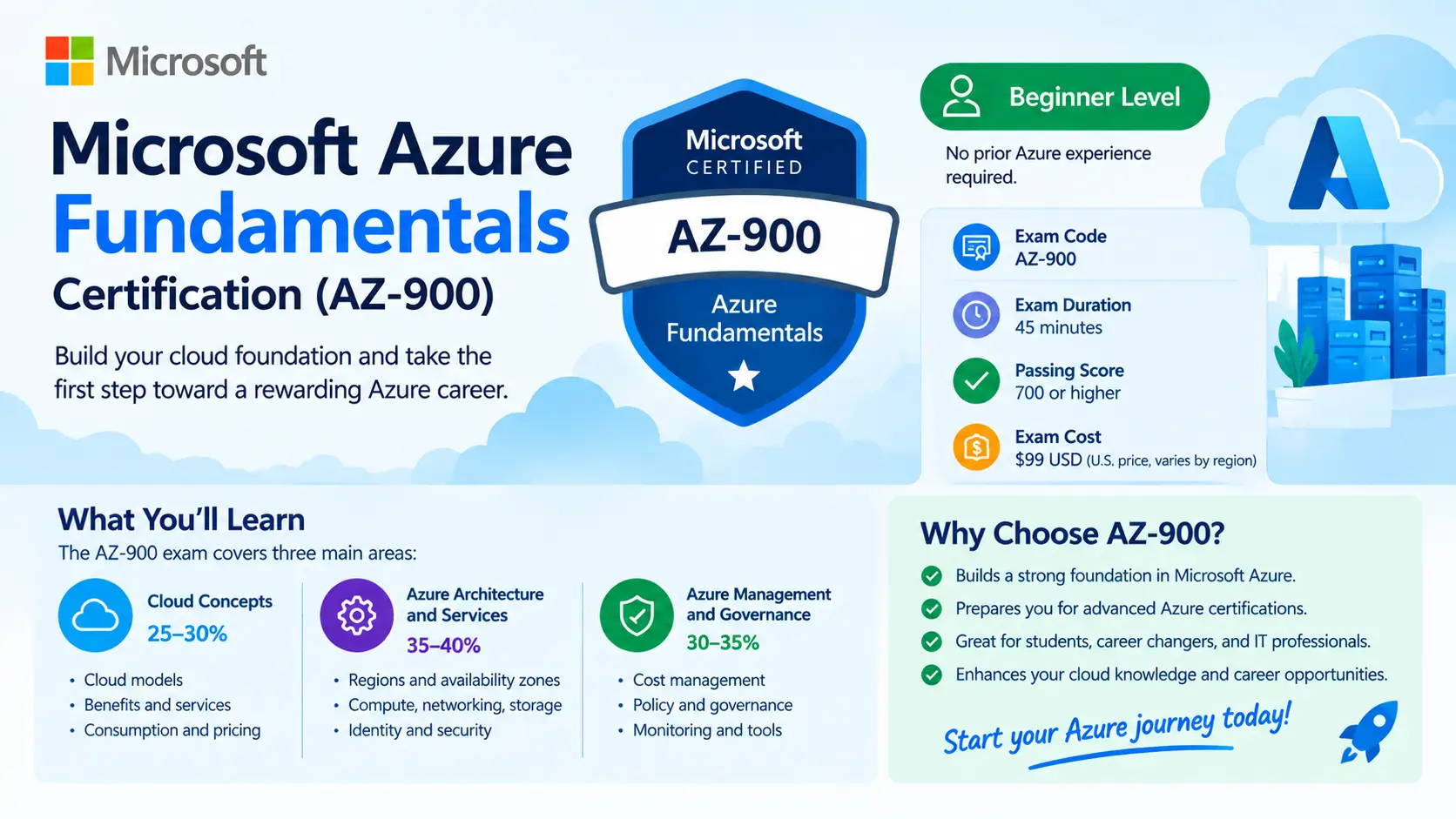
Microsoft currently requires a score of 700 or higher to pass AZ-900, while the exam price depends on the country or region where the exam is proctored. Microsoft currently lists the U.S. price as $99 USD on its certification page.
First, the AZ-900 passing score is 700 or greater. The passing score should be treated as an official threshold, not as a target for practice tests where a higher and consistent performance provides a stronger readiness signal.
Second, the AZ-900 exam cost varies by location. For example, Microsoft states that its displayed U.S. price is based on the country or region where the exam is proctored, so candidates should check the official certification page for their location before booking.
Third, the certification is positioned at the beginner level, and Microsoft does not present AZ-900 as requiring advanced Azure administration experience. However, basic familiarity with IT and cloud concepts can make preparation easier.
Exam Detail | Current Information |
Certification | Microsoft Certified: Azure Fundamentals |
Exam | AZ-900 |
Level | Beginner |
Passing score | 700 or higher |
U.S. listed price | $99 USD* |
Price variation | Depends on country/region |
Main domains | Cloud concepts; Azure architecture and services; Azure management and governance |
*Pricing can change, and regional pricing should always be verified on the official Microsoft certification page.
What Are the Best AZ-900 Study Resources and Practice Tools?
The best AZ-900 study resources combine the official Microsoft study guide, Microsoft Learn training, Practice Assessments, the exam sandbox, and focused practice. Using several resources is useful when each resource has a specific purpose.
Microsoft Learn
First, Microsoft Learn should form the foundation of your preparation because it provides official Microsoft training and documentation. Use it to understand the concepts before moving heavily into practice questions.
Microsoft AZ-900 Study Guide
Second, the official AZ-900 study guide should act as your exam checklist. Use it to verify that your study plan covers the current objectives and to identify official resources for individual topics.
Microsoft Practice Assessments
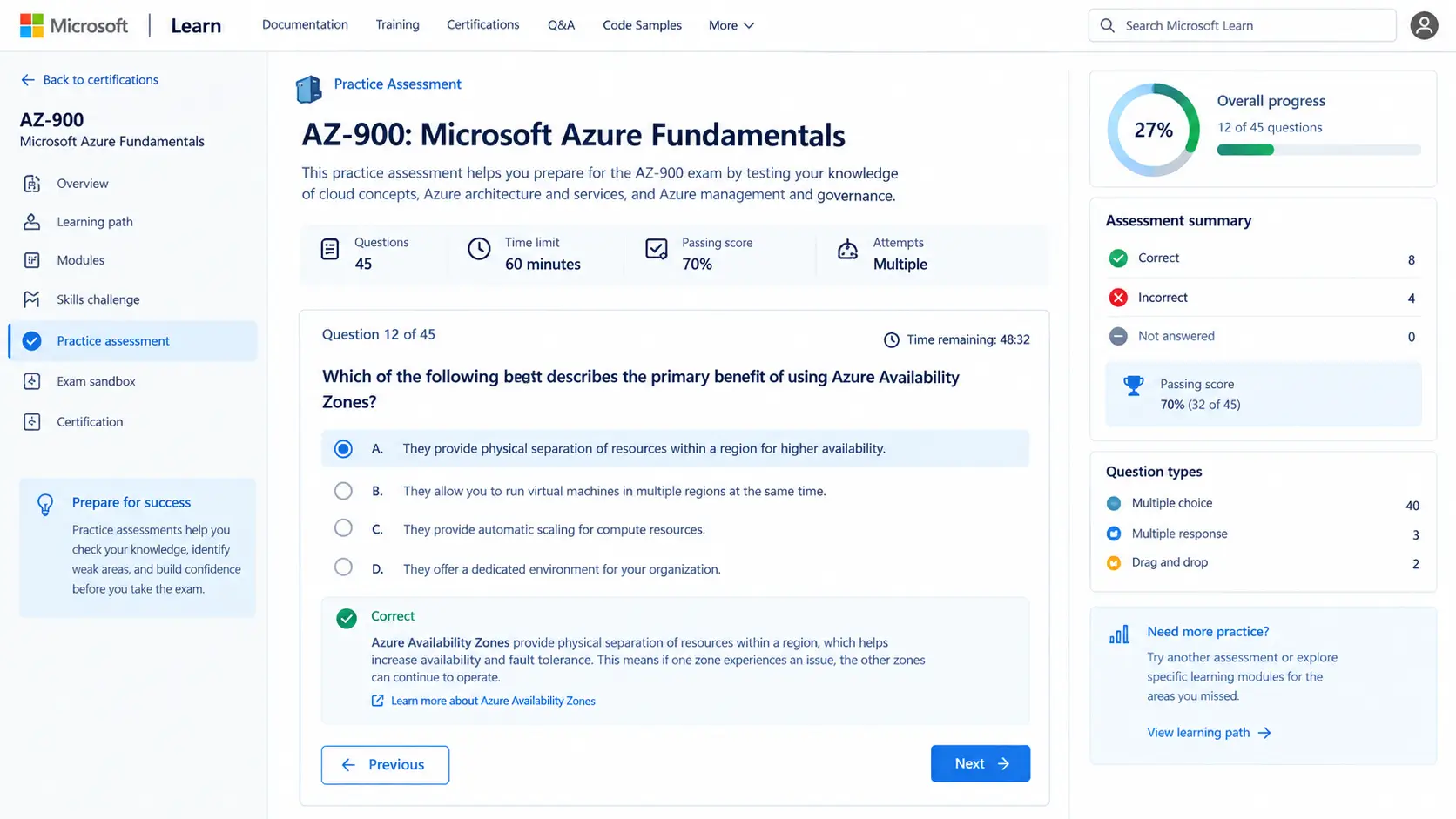
Third, Microsoft's Practice Assessments provide a useful way to measure knowledge. Microsoft states that Practice Assessments are available at no cost, can be attempted multiple times, and provide score reports with answer rationales and links to additional learning resources.
Azure Documentation
Fourth, use Azure documentation when you need a deeper explanation of a service or concept. For example, if you do not understand storage redundancy after completing a learning module, review Microsoft's documentation before returning to practice questions.
How Do AZ-900 Practice Questions Help With Exam Preparation?
AZ-900 practice questions help you identify knowledge gaps and become familiar with applying concepts to exam-style scenarios. Practice questions are most effective when you analyze the reasoning behind each answer rather than simply counting correct responses.
First, use practice questions after completing a topic. For example, study Azure networking and then answer networking-focused questions while the concepts are still fresh.
Second, record recurring mistakes. If you repeatedly confuse availability zones and region pairs, that pattern tells you exactly where to focus your next study session.
Third, use official Practice Assessments as a readiness check rather than assuming a single high score guarantees success. Microsoft explains that its Practice Assessments provide feedback and rationales that can help candidates identify areas for further study.
What Is the Best AZ-900 Certification Roadmap for Beginners?
The best AZ-900 certification roadmap starts with Azure fundamentals and then branches toward a career role rather than forcing every learner through the same certification sequence. AZ-900 can provide the foundation, but your next certification should reflect your career direction.
Career Direction | Starting Certification | Possible Next Direction | Best For |
Azure Administration | AZ-900 | AZ-104 | Cloud and Azure administrators |
DevOps | AZ-900 | AZ-104 or development experience → AZ-400 | DevOps and automation roles |
Data | AZ-900 | DP-900 | Data beginners |
Database Administration | AZ-900 → DP-900 | DP-300 | Database-focused learners |
First, AZ-104 certification is a logical direction for learners interested in managing Azure environments. Its focus moves beyond fundamentals into administration, including identity, governance, storage, compute, networking, and monitoring.
Second, AZ-400 certification fits learners interested in DevOps practices such as source control, automation, pipelines, security, and monitoring. However, AZ-400 is not simply the automatic next exam after AZ-900; candidates should develop the relevant Azure administration or development and DevOps skills first.
Third, DP-900 certification is useful for learners who want to explore data concepts and Azure data services. It can provide a foundation before moving toward more specialized data or database roles.
Fourth, DP-300 certification is more specialized and aligns with database administration. A learner interested in Azure SQL and database administration can use DP-900 fundamentals before progressing toward deeper database skills.
Your next Microsoft certification should be chosen according to the role you want to perform, not simply because it appears next on a certification list.
What Should You Do If You Score Low on an AZ-900 Practice Test?
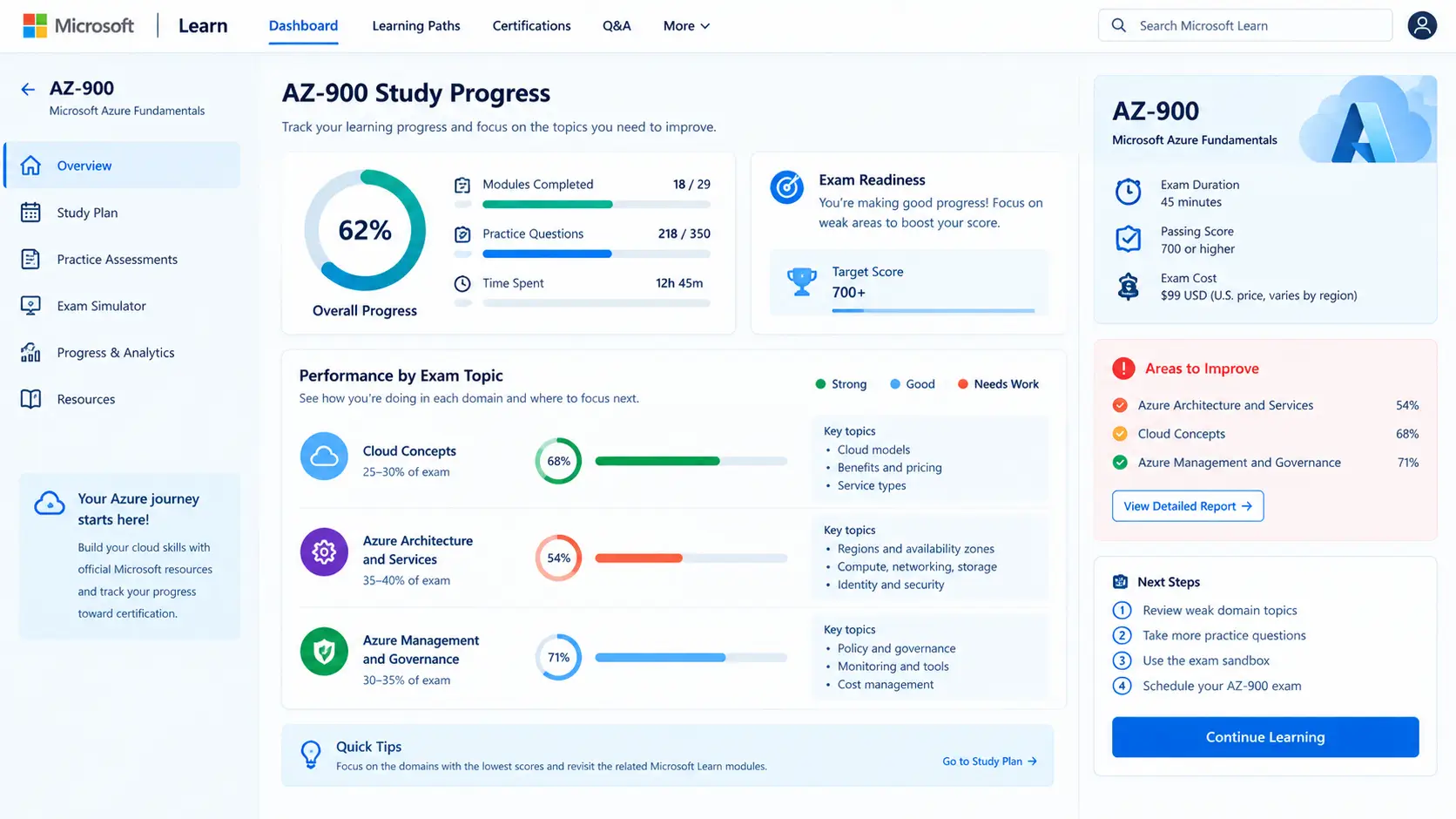
A low AZ-900 practice score is a study signal that identifies knowledge gaps rather than proof that you cannot pass the exam. The correct response is to analyze mistakes and return to the relevant objective.
First, categorize every incorrect answer by domain. For example, if most mistakes come from Azure management and governance, dedicate your next study session to policies, costs, monitoring, management tools, and security controls.
Second, review the explanation behind each incorrect answer. Understanding why an option is correct is more valuable than remembering that option's letter.
Third, repeat practice after targeted study. If your results improve consistently across all domains, your preparation is moving in the right direction.
What Should You Do Before Taking the AZ-900 Exam?
You should take the AZ-900 exam after reviewing every objective, practicing across all domains, and becoming comfortable with the exam environment. A final checklist can prevent avoidable mistakes.
Before scheduling or taking the exam, confirm that you can:
Explain the main cloud service models.
Describe Azure regions and availability zones.
Identify core compute, networking, and storage services.
Explain basic identity and security concepts.
Understand Azure governance and management tools.
Explain basic pricing and cost-management concepts.
Interpret common Azure scenarios.
Complete official practice assessments and review weak areas.
Navigate the exam environment confidently.
Moreover, check the official Microsoft certification page shortly before booking because exam information, pricing, languages, and policies can change.
What's Next After Passing the AZ-900 Exam?
After passing AZ-900, the next step is to turn foundational knowledge into role-specific Azure skills and practical experience. The certification should be treated as a starting point rather than the final destination.
First, choose a target role. For example, aspiring administrators can explore AZ-104, while data-focused learners can explore DP-900 and later consider DP-300.
Second, build hands-on experience. Create small Azure projects that demonstrate what you learned, such as deploying a virtual machine, configuring storage, creating a virtual network, applying a policy, or reviewing monitoring information.
Third, update your professional profile with the certification and relevant projects. A certification becomes more useful when employers can see how your knowledge connects to practical skills.
Finally, continue learning beyond the exam. Azure changes frequently, so a successful Azure certification journey requires ongoing learning rather than a one-time study cycle.
Conclusion
AZ-900 is a practical starting point for beginners who want to build foundational knowledge of Microsoft Azure and plan a longer cloud career. The most effective preparation combines the current Microsoft objectives, structured learning, practice questions, targeted revision, and hands-on understanding.
First, start with the official objectives and build your knowledge across all three domains. Second, use Microsoft Learn and Practice Assessments to strengthen your understanding and identify weak areas. Third, choose your next certification according to your career goal rather than following a universal sequence.
Most importantly, do not measure your AZ-900 preparation only by how many questions you can memorize. Measure it by whether you can explain Azure concepts, recognize appropriate services, and apply your knowledge to realistic scenarios.
If you are ready to organize your preparation, use an AZ-900 study guide, practice consistently, review your weak areas, and create a realistic schedule. With a focused approach, Azure Fundamentals can become the foundation for a broader Microsoft certification and cloud career journey.
ExamTopicsBase Practice Resources
Finally, ExamTopicsBase can be used as an additional exam-focused preparation resource for reviewing practice questions and organizing your revision. The best approach is to use exam-focused material alongside official Microsoft learning resources rather than treating any single resource as the complete preparation strategy.
Frequently Asked Questions
1. Is AZ-900 a good certification for beginners?
Yes. AZ-900 is a beginner-level certification designed to demonstrate foundational knowledge of cloud concepts, Azure services, and Azure management and governance.
2. Who should take the AZ-900 certification?
AZ-900 is suitable for students, aspiring cloud professionals, IT professionals, and others who want to build a basic understanding of Microsoft Azure.
3. Is AZ-900 useful for starting an Azure career?
Yes. Microsoft describes Azure Fundamentals as a common starting point for people beginning a career in Azure.
4. Do I need IT experience before taking AZ-900?
Advanced IT experience is not required. Microsoft recommends having experience in an IT area such as infrastructure, database management, or software development, but the certification focuses on foundational knowledge.
5. What topics are covered in the AZ-900 exam?
The exam covers three main areas: cloud concepts, Azure architecture and services, and Azure management and governance.
6. Is AZ-900 enough to become an Azure Administrator?
No. AZ-900 provides foundational knowledge, while administrator-focused certifications and practical experience cover more advanced Azure administration skills. It can, however, be a useful starting point.
7. Is the AZ-900 exam difficult?
For most beginners, AZ-900 is considered an entry-level certification. The difficulty depends on your familiarity with cloud computing and Azure concepts, so studying the official objectives is important.
8. How long is the AZ-900 exam?
Microsoft currently gives candidates 45 minutes to complete the assessment.
9. Does Microsoft provide AZ-900 practice resources?
Yes. Microsoft provides an official Practice Assessment and an Exam Sandbox to help candidates understand the question style and exam environment.
10. Is AZ-900 worth taking for a cloud career?
AZ-900 can be valuable if you want to establish a foundation in Azure before moving toward more specialized or role-based certifications. Microsoft also recommends Azure Fundamentals for early-career cloud professionals and aspiring student.
You may also like to read:
Microsoft Certification Career Roadmaps | A Comprehensive Guide to Choosing the Right Career Path
What Is the AZ-120 Exam and How Can You Prepare for It? The Ultimate Guide
How Hard Is the AZ-400 Exam? | A Complete Preparation & Study Guide
What Is the AZ-104 Exam and How Can You Prepare for It? | The Ultimate Guide

Written by Julia Mercer
I’m Julia Mercer, a Microsoft Solutions Architect and technical contributor at ExamTopicsBase. Having navigated the evolving Microsoft certification roadmap throughout my career in enterprise IT, I focus on delivering accurate, scenario-tested practice questions and clear, blueprint-aligned explanations so you can walk into your test with total confidence.
Comments (0)
Leave a Reply
No comments yet. Be the first to share your thoughts!