
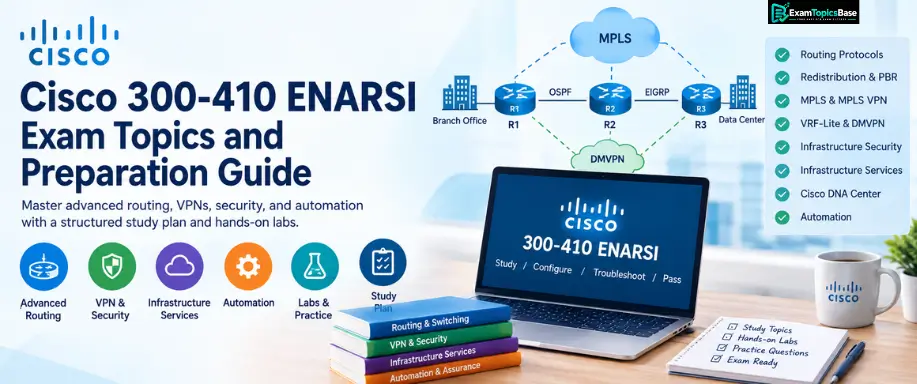
If you already understand enterprise networking, routing protocols, and Cisco IOS, the 300-410 ENARSI exam takes those skills into more advanced territory. At the same time, knowing the protocols is not enough because ENARSI emphasizes implementation and troubleshooting across routing, VPN services, security, infrastructure services, and automation. In this guide, you'll learn the Cisco 300-410 exam questions, topics, practical skills, study resources, labs, and preparation strategies you can use to build a structured study plan
What Is the Cisco 300-410 ENARSI Exam?
Cisco 300-410 ENARSI is a 90-minute certification exam that tests implementation and troubleshooting of advanced enterprise routing technologies and services. Cisco associates the exam with CCNP Enterprise and states that it covers Layer 3, VPN services, infrastructure security, infrastructure services, and infrastructure automation.
First, the full exam name is Implementing Cisco Enterprise Advanced Routing and Services, commonly shortened to ENARSI. For example, a candidate may troubleshoot an OSPF adjacency, redistribute routes between protocols, configure BGP path selection, or investigate a VPN forwarding problem.
Moreover, Cisco lists English and Japanese as the available exam languages, with a 90-minute duration and a US$300 price or the option to use Cisco Learning Credits.
At the same time, Cisco lists no prerequisite for the exam itself, although the expected knowledge is clearly beyond entry-level networking. The related CCNP Enterprise pathway combines a core exam with a concentration exam such as 300-410 ENARSI.
Furthermore, Cisco says the certification associated with passing ENARSI is the Cisco Certified Specialist – Enterprise Advanced Infrastructure Implementation, while the exam can also satisfy the concentration-exam requirement for CCNP Enterprise.
What Does the 300-410 ENARSI Exam Test?
The 300-410 ENARSI exam tests whether you can implement and troubleshoot advanced enterprise routing and services rather than simply recall networking definitions. Cisco's official training specifically focuses on installing, configuring, operating, and troubleshooting dual-stack enterprise networks.
For example, Cisco's training objectives include EIGRP, OSPFv2 and OSPFv3, route redistribution, policy-based routing, BGP, MP-BGP, MPLS, MPLS VPN architecture, VRF-Lite, DMVPN, DHCP, IPv6 first-hop security, router security, and DNA Center Assurance.
Therefore, your preparation should emphasize why a network behaves a certain way, how to verify that behavior, and how to correct a fault.
Why Is the Cisco 300-410 ENARSI Certification Important?
The Cisco 300-410 ENARSI certification matters because it validates advanced enterprise routing and services knowledge across implementation and troubleshooting scenarios. The exam is directly connected to the CCNP Enterprise concentration pathway and the Cisco Certified Specialist – Enterprise Advanced Infrastructure Implementation credential.
First, ENARSI extends the knowledge developed through enterprise networking fundamentals. Cisco describes its ENARSI training as expanding on topics covered in the ENCOR training and preparing candidates to work with dual-stack enterprise networks.
For example, someone who understands OSPF basics may know how to establish an adjacency, while an ENARSI-level engineer should also be able to investigate why two routers remain stuck in an unexpected neighbor state.
Second, the certification can demonstrate knowledge across several interconnected areas:
Advanced Layer 3 routing
Routing-protocol troubleshooting
VPN technologies
Infrastructure security
Infrastructure services
Network assurance
Infrastructure automation
Moreover, Cisco states that the exam is valid for three years and that results are graded pass/fail, with results available online within 48 hours.
What Are the Current Cisco 300-410 ENARSI Exam Topics?
The current Cisco 300-410 ENARSI blueprint organizes the exam around Layer 3 technologies, VPN services, infrastructure security, infrastructure services, and infrastructure automation. Cisco's published v1.1 exam topics assign 35% to Layer 3 Technologies, with the remaining objectives covering the other major service areas.
The following table provides a practical study map based on Cisco's published exam and training information.
Study area | Key topics | Recommended preparation |
Layer 3 Technologies | EIGRP, OSPF, BGP, redistribution, PBR, VRF-Lite, BFD | Configuration and troubleshooting labs |
VPN Services | MPLS, MPLS VPN, VRF-Lite, DMVPN | Understand forwarding and control-plane behavior |
Infrastructure Security | ACLs, IPv6 first-hop security, router security, uRPF | Configure and troubleshoot security controls |
Infrastructure Services | DHCP, network management, service troubleshooting | Practice verification and fault isolation |
Automation and Assurance | DNA Center Assurance and infrastructure automation | Learn monitoring, APIs, and operational workflows |
First, Layer 3 Technologies account for 35% of the published blueprint, making them the largest explicitly weighted area.
For example, this area includes troubleshooting administrative distance, route maps, redistribution, summarization, PBR, VRF-Lite, EIGRP, OSPF, and BGP.
Second, Cisco's ENARSI training adds practical objectives around MPLS, MPLS VPNs, DMVPN, DHCP, IPv6 first-hop security, router security, and DNA Center Assurance.
What Routing Protocols Should You Study for 300-410 ENARSI?
Routing protocols are central to ENARSI preparation because Cisco expects candidates to troubleshoot EIGRP, OSPF, and BGP rather than simply describe their definitions. Cisco's published objectives specifically include troubleshooting EIGRP, OSPF, and BGP.
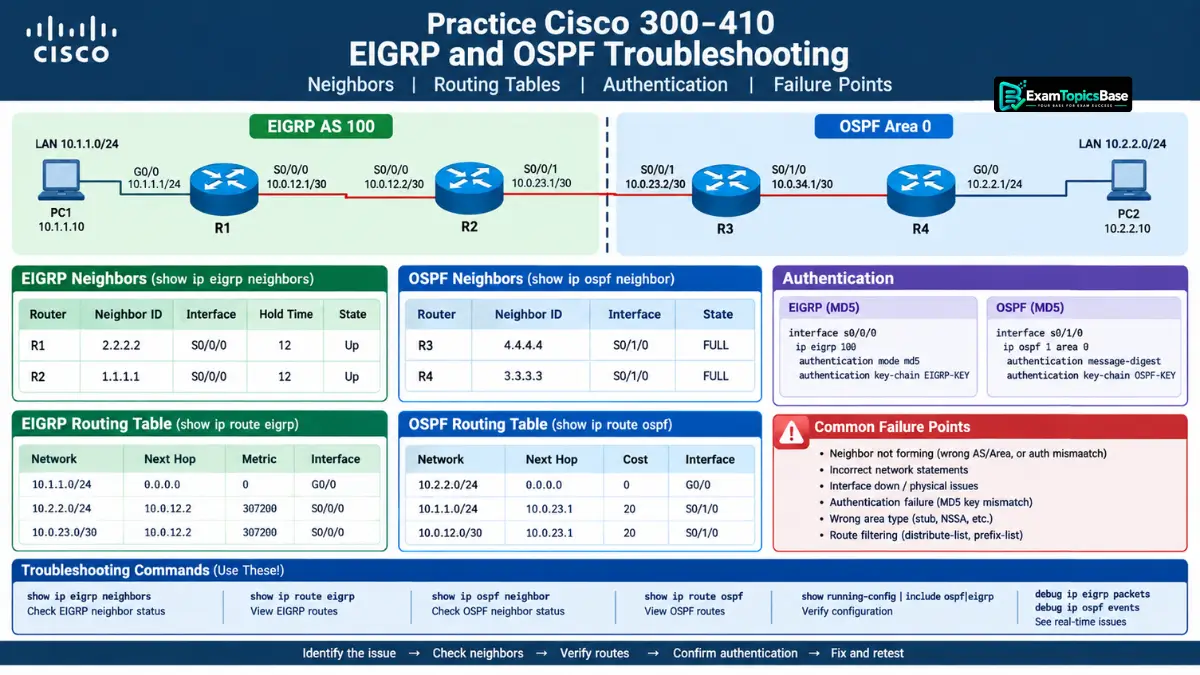
First, study EIGRP through neighbor relationships, authentication, metrics, feasible successors, stubs, summarization, and equal or unequal-cost load balancing. For example, build two routers with an EIGRP adjacency and deliberately introduce an authentication or addressing mismatch.
Second, study OSPF through neighbor formation, network types, areas, router roles, authentication, path preference, OSPFv2, and OSPFv3. For example, troubleshoot an adjacency that fails because the routers disagree about an OSPF parameter.
Third, study BGP and MP-BGP through internal and external peering, path selection, route reflectors, and IPv4/IPv6 address families. For example, compare multiple BGP routes and determine why one path becomes the selected route.
How Should You Study EIGRP and OSPF for ENARSI?
EIGRP and OSPF should be studied through a repeatable cycle of configuration, verification, failure injection, and troubleshooting. Cisco's official learning objectives and labs emphasize exactly this practical workflow.
First, configure a working topology before creating failures. For example, establish an EIGRP adjacency, verify the topology table, confirm routes in the routing table, and then change one parameter to observe the resulting behavior.
Next, practice troubleshooting systematically:
Verify interface status.
Check addressing and reachability.
Verify neighbor relationships.
Inspect protocol-specific tables.
Check the routing table.
Inspect authentication and filtering.
Confirm the final forwarding path.
Moreover, practice OSPF area types and router roles because troubleshooting becomes easier when you understand how LSAs and area boundaries affect route visibility.
What BGP and MP-BGP Concepts Are Covered in Cisco 300-410 ENARSI?
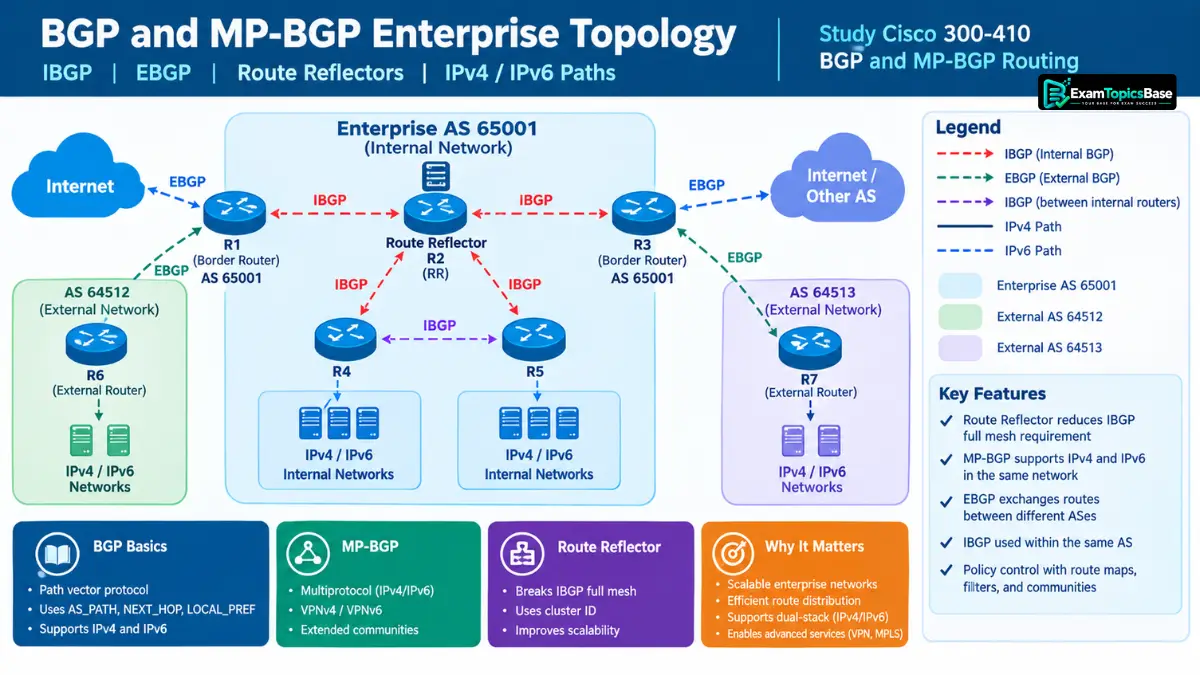
BGP and MP-BGP preparation focuses on implementation, path selection, advanced features, and troubleshooting across internal and external peering. Cisco's training includes IBGP, BGP optimization, MP-BGP, BGP troubleshooting, and route reflectors.
First, understand the difference between IBGP and EBGP and how their operational roles affect enterprise routing. For example, two routers in the same autonomous system can use IBGP while routers in different autonomous systems establish EBGP.
Second, study BGP path selection and route attributes as a troubleshooting process. For example, when two valid routes exist, determine which attributes influence the selected path rather than memorizing a single command sequence.
Third, learn MP-BGP for IPv4 and IPv6 address families. Cisco's Learning Labs include exercises for configuring MP-BGP for both IPv4 and IPv6.
How Does Route Redistribution Work in Cisco 300-410 ENARSI?
Route redistribution is the process of exchanging routes between different routing protocols or routing sources. ENARSI preparation should focus on both implementing redistribution and troubleshooting filtering, tagging, route maps, and loop-prevention behavior.
For example, an enterprise may use OSPF in one part of its network and EIGRP in another, requiring selected routes to cross the protocol boundary.
First, understand route filtering and tagging because redistribution can introduce duplicate routes or routing loops. A route map can control which routes enter the target protocol and modify relevant attributes.
Second, practice troubleshooting redistribution with deliberately broken configurations. For example, redistribute OSPF into EIGRP, verify the resulting routes, apply a filter, and determine why a previously visible route disappears.
Third, study summarization and loop prevention alongside redistribution. Cisco's exam objectives specifically include route maps, filtering, tagging, split horizon, route poisoning, and summarization.
What VPN Technologies Should You Study for Cisco 300-410 ENARSI?
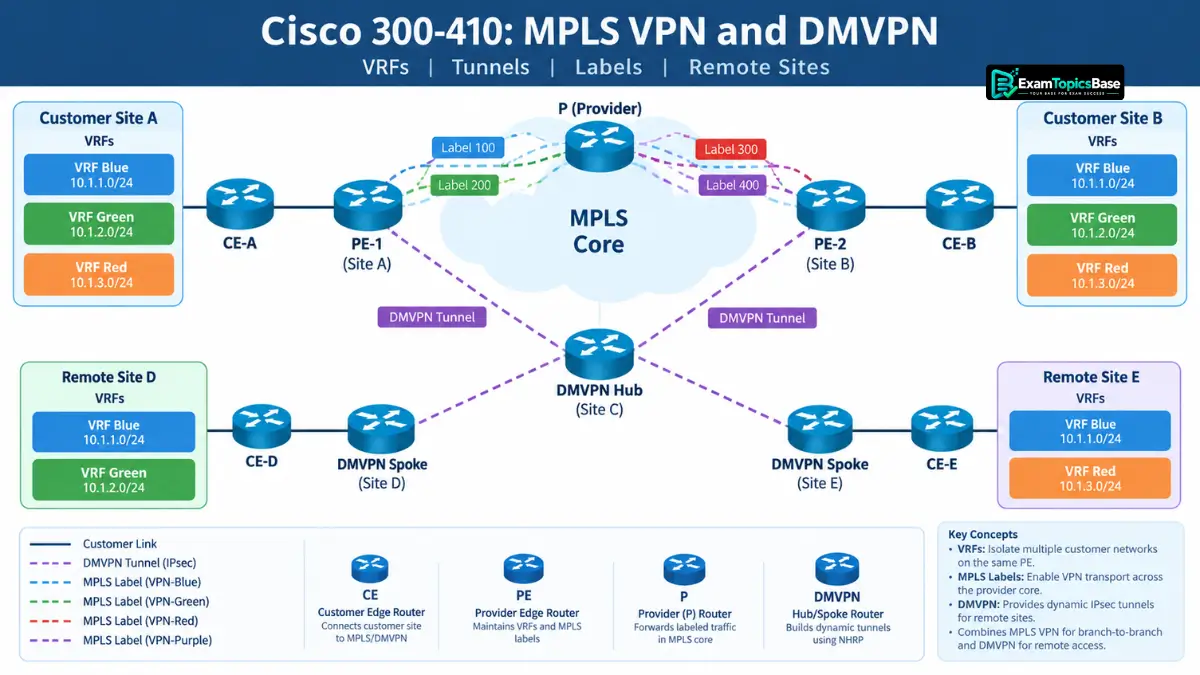
VPN preparation for ENARSI should cover MPLS, MPLS VPN architecture, VRF-Lite, and DMVPN because these technologies connect routing knowledge with enterprise connectivity requirements. Cisco's official training includes dedicated objectives for MPLS, MPLS L3 VPNs, VRF-Lite, and DMVPN.
First, understand VRF-Lite as a method for maintaining separate routing tables on a device. For example, two departments can use overlapping or independent routing environments without automatically sharing routes.
Second, study MPLS at an architectural level before moving into MPLS VPN forwarding. For example, understand how labels, provider routing, VRFs, and VPN routes work together to move traffic between customer sites.
Third, practice DMVPN implementation and troubleshooting. Cisco's official lab set includes a dedicated DMVPN exercise using Cisco IOS.
What Infrastructure Security and Services Topics Should You Practice?
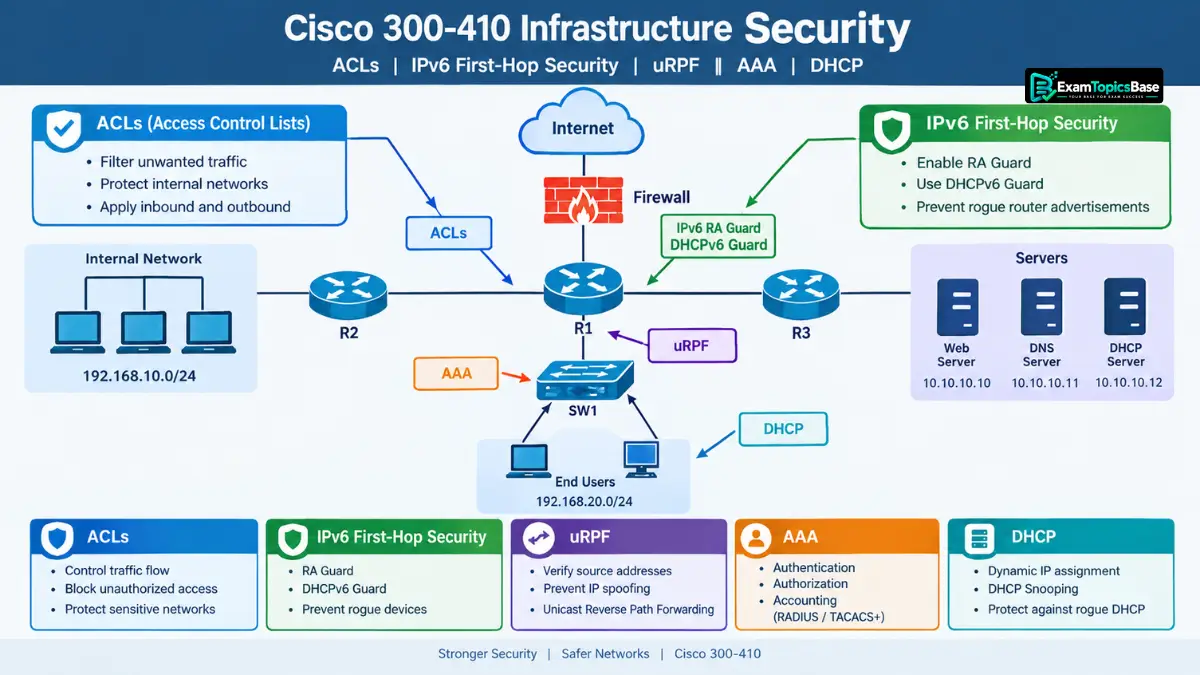
Infrastructure security and services preparation should cover ACLs, IPv6 first-hop security, router security, uRPF, DHCP, and network-management troubleshooting. Cisco's ENARSI training explicitly includes these areas in its objectives and lab activities.
First, practice IPv4 and IPv6 ACL troubleshooting rather than only writing access-control entries. For example, determine whether an ACL is blocking traffic because of direction, interface placement, protocol matching, or an implicit rule.
Second, study IPv6 first-hop security concepts and uRPF. For example, investigate how a router can validate the expected source path of incoming traffic.
Third, practice infrastructure services such as DHCP and network management. Cisco's Learning Labs include DHCPv4/DHCPv6 troubleshooting, ACL troubleshooting, uRPF, and network-management protocol troubleshooting.
How Should You Study Cisco DNA Center Assurance and Network Automation?
Cisco DNA Center Assurance and infrastructure automation should be studied as operational skills that complement traditional routing and troubleshooting. Cisco's ENARSI training specifically includes troubleshooting with DNA Center Assurance and infrastructure automation among the exam-related technology areas.
First, understand network assurance as the process of using operational information to identify and investigate network conditions. For example, an engineer can use assurance information to investigate connectivity or performance problems instead of relying only on individual device CLI output.
Second, connect automation concepts to repeatable network operations. For example, instead of manually checking the same configuration across dozens of devices, an automation workflow can collect structured information and help identify inconsistencies.
Third, do not isolate automation from troubleshooting. ENARSI preparation is stronger when you understand how automation, telemetry, configuration, and network operations work together.
What Tools and Labs Should You Use for Cisco 300-410 Preparation?
The most useful ENARSI preparation tools are Cisco Learning Labs, Cisco training resources, and hands-on Cisco IOS environments that allow you to configure and troubleshoot realistic network scenarios.
First, Cisco Learning Labs provides guided Cisco IOS exercises specifically designed around ENARSI preparation. The current ENARSI Learning Labs contain 29 guided labs covering routing, redistribution, PBR, BGP, MP-BGP, VRF-Lite, DMVPN, DHCP, ACLs, uRPF, and network-management troubleshooting.
For example, the lab sequence includes five EIGRP exercises, five OSPF-related exercises, redistribution labs, BGP labs, VRF-Lite, DMVPN, DHCP, ACLs, uRPF, and network-management troubleshooting.
Second, Cisco's official ENARSI training provides structured objectives and lab activities. Cisco describes the training as preparing candidates to install, configure, operate, and troubleshoot dual-stack enterprise networks.
Third, you can supplement paid resources with free documentation and your own lab scenarios. The important requirement is that your environment lets you configure, break, verify, and repair network behavior.
Resource | Best use | What to practice |
Cisco Learning Labs | Guided hands-on practice | EIGRP, OSPF, BGP, redistribution, VPNs, security |
Cisco ENARSI training | Structured learning | Concepts, configuration, troubleshooting |
Cisco IOS lab environment | Independent practice | Failure scenarios and verification |
Cisco documentation | Reference and troubleshooting | Commands, features, and behavior |
Third-party practice tests | Self-assessment | Question interpretation and knowledge gaps |
How Can Cisco 300-410 Practice Questions Help You Study?
Cisco 300-410 practice questions can help identify knowledge gaps and improve scenario-based reasoning when they are used alongside official learning and hands-on labs. Practice questions should supplement, rather than replace, configuration and troubleshooting work.
First, use questions after studying a topic. For example, complete an OSPF lab and then answer questions about adjacency states, area types, authentication, and route selection.
Second, analyze every incorrect response instead of simply recording the correct choice. A missed question about BGP may indicate a deeper problem with path selection, route attributes, neighbor relationships, or verification.
Third, avoid treating third-party question banks as official Cisco exam content. Cisco's published exam topics are the appropriate reference for determining what the exam covers.
How Should You Build a Cisco 300-410 ENARSI Study Plan?
A Cisco 300-410 ENARSI study plan should progress from routing fundamentals into advanced protocols, redistribution, VPNs, security, services, troubleshooting, and final assessment. Because Layer 3 Technologies represent 35% of the published blueprint, routing and troubleshooting deserve substantial study time.
First, use the following six-week structure as a starting point.
Week | Primary focus | Practical work |
Week 1 | EIGRP and OSPF | Build adjacencies, authentication, summarization, troubleshooting |
Week 2 | Redistribution and PBR | Route maps, filtering, tagging, redistribution failures |
Week 3 | BGP and MP-BGP | IBGP, EBGP, path selection, route reflectors, IPv6 |
Week 4 | VPN technologies | VRF-Lite, MPLS concepts, MPLS VPNs, DMVPN |
Week 5 | Security and services | ACLs, IPv6 security, uRPF, DHCP, management protocols |
Week 6 | Troubleshooting and review | Mixed labs, practice tests, weak-area revision |
Moreover, your study schedule should remain flexible. If you can configure EIGRP quickly but struggle with BGP troubleshooting, shift more practice time toward BGP instead of following the calendar mechanically.
What Should You Practice Each Week?
Each study week should contain concept review, configuration, verification, troubleshooting, and assessment. For example, spend one session learning OSPF behavior, another building an OSPF topology, another introducing failures, and a final session answering practice questions.
First, record the commands you use to verify each protocol. This creates a personal troubleshooting reference that becomes useful during revision.
Second, deliberately introduce faults. For example, change an authentication key, modify an area parameter, remove a route, alter a route map, or break a neighbor relationship.
Third, explain the failure in plain language after fixing it. If you can explain both the symptom and the underlying cause, you are developing stronger troubleshooting skills than memorization alone provides.
Source: Implementing Cisco Enterprise Advanced Routing and Services
How Long Should You Study for the Cisco 300-410 ENARSI Exam?
The appropriate ENARSI study period depends on your existing enterprise-routing experience, but a structured six-to-eight-week plan can provide a practical framework for many intermediate candidates.
First, candidates with strong EIGRP, OSPF, BGP, and Cisco IOS experience may spend more time on advanced troubleshooting and less time on basic protocol review.
Second, candidates who understand the theory but have limited hands-on experience should dedicate additional time to labs. For example, someone who can explain BGP path selection but has never troubleshooted a failed BGP session should prioritize practical configuration.
Third, candidates should measure progress by skills rather than calendar days. Being able to configure and troubleshoot a technology is more meaningful than simply completing a chapter.
How Can You Tell If You Are Ready for the Cisco 300-410 ENARSI Exam?
You are better prepared for ENARSI when you can explain, configure, verify, and troubleshoot the major technologies without depending entirely on memorized answers.
First, use this readiness checklist:
I can troubleshoot EIGRP neighbours and route problems.
I can troubleshoot OSPFv2 and OSPFv3.
I understand BGP path selection and peering.
I can explain MP-BGP for IPv4 and IPv6.
I can troubleshoot route redistribution.
I understand route maps, filtering, tagging, and PBR.
I can configure and verify VRF-Lite.
I understand MPLS VPN architecture.
I can explain and troubleshoot DMVPN concepts.
I can troubleshoot IPv4 and IPv6 ACLs.
I understand IPv6 first-hop security and uRPF.
I can troubleshoot DHCP and network-management services.
I understand DNA Center Assurance concepts.
I have completed practical ENARSI labs.
I have reviewed incorrect practice-question answers.
I can explain why a routing decision occurs.
Second, remember that the exam itself is only 90 minutes, so efficient reasoning matters during preparation.
Third, test yourself with unfamiliar scenarios. If you can troubleshoot a network you did not personally configure, you are practicing a skill that closely matches the implementation-and-troubleshooting focus of ENARSI.
Get Free Cisco Real Exam Questions & Answers of Here:https://examtopicsbase.com/vendors/cisco
What Should You Do Next for Cisco 300-410 ENARSI Preparation?
The next step for Cisco 300-410 ENARSI preparation is to compare your current skills against the official exam topics and turn weak areas into practical lab exercises. Cisco's official exam topics should remain the primary reference because Cisco notes that published topics are guidelines and can change.
First, download or review the current Cisco exam-topic document and mark each subject as strong, developing, or weak.
Second, prioritize Layer 3 technologies because the published blueprint assigns that domain 35%.
Third, build a complete troubleshooting lab that combines multiple technologies. For example, create an enterprise topology containing OSPF, EIGRP, BGP, redistribution, VRF-Lite, ACLs, and DHCP, then introduce several independent faults.
Fourth, use Cisco Learning Labs or another suitable lab environment to gain additional hands-on experience. Cisco's current ENARSI Learning Labs contain 29 guided exercises specifically aligned with relevant skills.
Conclusion
Cisco 300-410 ENARSI is an advanced routing and services certification exam focused on implementing and troubleshooting Layer 3 technologies, VPN services, infrastructure security, infrastructure services, and automation. Cisco lists the exam at 90 minutes and associates it with CCNP Enterprise and the Cisco Certified Specialist – Enterprise Advanced Infrastructure Implementation certification.
Moreover, successful preparation requires more than memorizing routing commands. EIGRP, OSPF, BGP, MP-BGP, redistribution, PBR, VRF-Lite, MPLS, DMVPN, security, infrastructure services, and assurance concepts should be practiced through configuration and troubleshooting scenarios.
At the same time, Cisco's official ENARSI Learning Labs provide 29 guided labs that can help turn theoretical knowledge into practical skills.
Finally, use the official exam topics as your study map, build realistic labs, analyze practice-question mistakes, and repeatedly troubleshoot unfamiliar scenarios. ExamTopicsBase can provide additional Cisco 300-410 study and practice resources, while Cisco's official documentation and training should remain the foundation for understanding the current exam objectives.
Cisco 300-410 ENARSI FAQs
1. What Is the Cisco 300-410 ENARSI Exam?
The Cisco 300-410 ENARSI exam is a 90-minute certification exam focused on implementing and troubleshooting advanced enterprise routing and services. It covers Layer 3 technologies, VPN services, infrastructure security, infrastructure services, and infrastructure automation.
2. Is 300-410 ENARSI Part of CCNP Enterprise?
Yes. The 300-410 ENARSI exam is a CCNP Enterprise concentration exam. Passing it can satisfy the concentration-exam requirement for CCNP Enterprise and earns the Cisco Certified Specialist – Enterprise Advanced Infrastructure Implementation certification.
3. What Topics Are Covered in Cisco 300-410?
The major topics include Layer 3 technologies, VPN services, infrastructure security, infrastructure services, and infrastructure automation. Routing preparation includes EIGRP, OSPF, BGP, redistribution, PBR, and VRF-Lite.
4. How Much of ENARSI Focuses on Layer 3 Technologies?
The published Cisco v1.1 exam topics assign 35% to Layer 3 Technologies, making it the largest explicitly weighted domain in that blueprint.
5. Should I Study EIGRP for the 300-410 Exam?
Yes. EIGRP is explicitly included in Cisco's ENARSI objectives, including neighbor relationships, authentication, metrics, stubs, summarization, and load balancing.
6. Does Cisco 300-410 Include BGP and MP-BGP?
Yes. ENARSI preparation includes IBGP, EBGP, BGP path selection, advanced BGP features, route reflectors, MP-BGP for IPv4 and IPv6, and BGP troubleshooting.
7. Are MPLS and DMVPN Included in ENARSI?
Yes. Cisco's ENARSI training includes MPLS, MPLS Layer 3 VPN architecture and routing, VRF-Lite, and Cisco IOS DMVPN.
8. How Many Cisco Learning Labs Are Available for ENARSI?
Cisco's current ENARSI Learning Labs contain 29 guided labs covering technologies such as EIGRP, OSPF, redistribution, PBR, BGP, MP-BGP, VRF-Lite, DMVPN, DHCP, ACLs, uRPF, and network-management troubleshooting.
9. How Long Is the Cisco 300-410 ENARSI Exam?
The Cisco 300-410 ENARSI exam is 90 minutes long. Cisco currently lists English and Japanese as available exam languages.
10. How Should I Prepare for the Cisco 300-410 ENARSI Exam?
The most practical approach is to combine the official exam topics with structured study, hands-on Cisco IOS labs, troubleshooting scenarios, and practice questions. Focus particularly on routing behavior and troubleshooting rather than memorizing isolated commands.
Related:
What Is the Cisco 200-901 Exam? | CCNA Automation Study Guide
What Is the Cisco 820-605 Exam? | Topics, Tips & Preparation Guide

Written by Marcus Vance
I’m Marcus Vance, a Cisco Solutions Architect and technical contributor at ExamTopicsBase. Having designed mission-critical enterprise backbones and navigated Cisco's certification tracks for over a decade, I focus on delivering accurate, real-world packet analyses and blueprint-aligned practice questions so you can pass your exam with total confidence.
Comments (0)
Leave a Reply
No comments yet. Be the first to share your thoughts!