
If you've been working with Cisco networking, Python, or basic automation, you've probably already encountered some of the technologies connected to the 200-901 exam. However, the exam combines software development, APIs, Cisco platforms, application security, infrastructure automation, and networking fundamentals. In this guide, we'll explain what the Cisco 200-901 exam covers, how it relates to CCNA Automation, what you should study, which tools to practice, and how to build a practical preparation plan.
What Is the Cisco 200-901 Exam?
Cisco 200-901 is the core exam associated with the CCNA Automation certification and is officially named Automating Networks Using Cisco Platforms. Cisco describes the exam as testing software development and design, APIs, application deployment and security, and infrastructure and automation on Cisco platforms.
Moreover, the current Cisco exam page lists the exam as 200-901 CCNAAUTO, with a duration of 120 minutes and a price of US$300 for Cisco Learning Credits. The page also lists English and Japanese as available languages.
For example, a candidate might need to understand how a Python script sends a REST request, interprets a JSON response, authenticates with an API, and uses Cisco platform information in an automation workflow.
At the same time, the exam is broader than Python programming alone. Cisco's blueprint covers software development and design, APIs, Cisco platforms and development, application deployment and security, infrastructure and automation, and network fundamentals.
Is Cisco 200-901 the Same Exam Associated With DevNet Associate?
Cisco 200-901 is now part of the CCNA Automation certification track, while older learning materials may still refer to DevNet Associate and DEVASC 200-901. Cisco announced that its DevNet certification track would transition to CCNA, CCNP, and CCIE Automation beginning February 3, 2026.
Therefore, older references to Cisco DevNet Associate 200-901, DEVASC 200-901, or the DevNet Associate exam can still be relevant when they match the current exam objectives. Cisco's current certification pages identify 200-901 CCNAAUTO as the core exam for CCNA Automation.
For example, you may find a Python or REST API learning resource labeled “DEVASC 200-901” even though the current certification name is CCNA Automation.
At the same time, candidates should verify older materials against the current Cisco blueprint because Cisco periodically updates product names, technologies, and individual objectives. Cisco's v1.1 release notes document updates to several product references and automation technologies while retaining the overall exam domains.
What Are the Basic Cisco 200-901 Exam Details?
The Cisco 200-901 exam is a 120-minute associate-level certification exam with no prerequisite certification requirement. Cisco lists the certification as valid for three years and states that results are provided online within 48 hours.
Exam detail | Current information |
Exam code | 200-901 CCNAAUTO |
Exam name | Automating Networks Using Cisco Platforms |
Certification | CCNA Automation |
Duration | 120 minutes |
Price | US$300 or Cisco Learning Credits |
Prerequisites | None |
Languages | English and Japanese |
Certification validity | 3 years |
Grading | Pass/fail |
Results | Available online within 48 hours |
Additionally, Cisco recommends learning through options such as Cisco U., instructor-led training, and practice exams, while its CCNA Automation certification page also highlights Networking Academy, Cisco Press, and Cisco Modeling Labs.
Why Does the Cisco 200-901 Certification Matter?
The Cisco 200-901 certification matters because it validates a combination of software development, API usage, Cisco platform knowledge, application security, and infrastructure automation rather than focusing only on traditional device configuration. Cisco describes CCNA Automation around software design and development, APIs, application deployment and security, scripting, workflow automation, and infrastructure as code.
For example, instead of manually configuring every device, an engineer can use Python, APIs, or automation tools to retrieve information, apply standardized changes, validate results, and repeat the process consistently.
Furthermore, the certification connects two skill areas that are increasingly used together: networking and software development. A networking professional can use automation to reduce repetitive configuration, while a developer can use networking knowledge to build applications that interact correctly with infrastructure.
At the same time, certification should be viewed as a structured validation of knowledge rather than a substitute for practical engineering experience. Hands-on work helps you understand how scripts, APIs, authentication, data formats, and network constraints behave outside a textbook example.
What Skills Does CCNA Automation Validate?
CCNA Automation validates knowledge across software development and design, APIs, Cisco platforms, application deployment and security, workflow automation, and infrastructure as code. Cisco explicitly lists these capabilities as central to the certification.
For example, a practical automation workflow might retrieve device information through an API, process JSON data in Python, run a validation test, and send the result to another system.
Moreover, the certification includes networking fundamentals because automation scripts still depend on basic networking behavior. Understanding IP addressing, VLANs, routes, DNS, DHCP, NAT, ports, and network planes helps you troubleshoot automation problems that are actually caused by connectivity.
What Are the Current Cisco 200-901 Exam Topics?
The current Cisco 200-901 blueprint contains six exam domains covering software development, APIs, Cisco platforms, application deployment and security, infrastructure automation, and network fundamentals. The published v1.1 exam-topics document assigns 15% to Software Development and Design, 20% to Understanding and Using APIs, 15% to Cisco Platforms and Development, 15% to Application Deployment and Security, 20% to Infrastructure and Automation, and 15% to Network Fundamentals.
Cisco 200-901 domain | Weight |
Software Development and Design | 15% |
Understanding and Using APIs | 20% |
Cisco Platforms and Development | 15% |
Application Deployment and Security | 15% |
Infrastructure and Automation | 20% |
Network Fundamentals | 15% |
Therefore, Understanding and Using APIs and Infrastructure and Automation represent 40% of the published blueprint combined.
What Should You Study in Software Development and Design?
Software Development and Design covers data formats, Python data structures, software development methods, code organization, design patterns, testing, and Git. Cisco's blueprint assigns this domain 15%.
For example, you should understand how JSON, XML, and YAML represent information and how those formats can be converted into Python structures for processing.
Moreover, Git knowledge includes common operations such as cloning, adding and removing files, committing, pushing, pulling, branching, merging, resolving conflicts, and using diff. These skills help you understand how automation code is developed and maintained.
In addition, study concepts such as test-driven development, Agile, Lean, Waterfall, functions, classes, modules, and common design patterns such as MVC and Observer. The goal is to understand why these practices are useful rather than memorize isolated definitions.
What API Concepts Should You Know for Cisco 200-901?
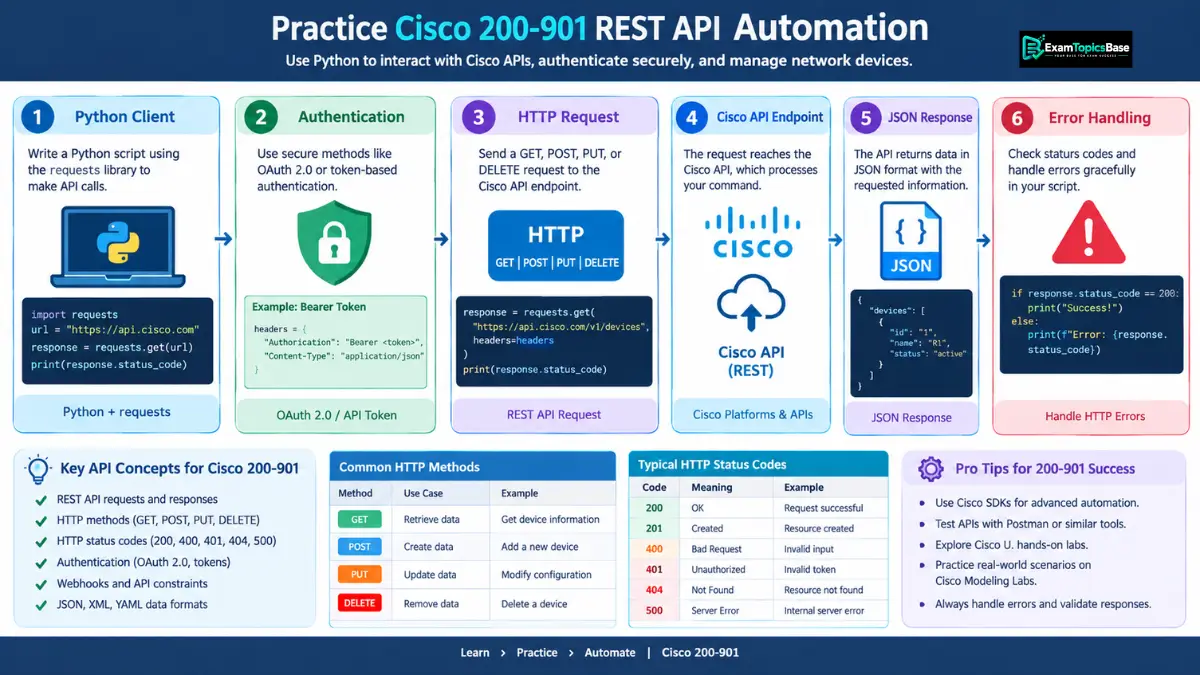
Understanding and Using APIs is a 20% domain that focuses on constructing REST API requests, webhooks, API constraints, HTTP response codes, authentication, API styles, and Python scripts using the requests library.
For example, a REST request might use a GET method to retrieve device information and return a JSON response containing interfaces, addresses, or status information.
Furthermore, you should know how to interpret HTTP response codes and troubleshoot requests using the response code, request details, and API documentation. Cisco's blueprint specifically expects candidates to understand response codes, headers, and bodies.
At the same time, authentication deserves practical attention. The blueprint includes basic authentication, custom tokens, and API keys, so you should understand how authentication information is supplied and why credentials must be protected.
How Do REST APIs Work in Cisco Network Automation?
REST APIs provide a structured way for software applications to communicate with network platforms and services. Cisco 200-901 preparation should therefore include HTTP methods, URLs, headers, request bodies, authentication, response codes, and JSON data.
For example, a Python program can use the requests library to send an HTTP request to a documented API endpoint, receive a JSON response, and process selected values.
Moreover, REST is only one API style covered by the blueprint. Cisco also expects candidates to understand differences involving RPC and synchronous versus asynchronous API behavior.
Therefore, your study should move beyond memorizing “REST means API.” Practice reading API documentation and determining which endpoint, method, authentication mechanism, parameters, and request body are appropriate.
What Should You Study in Cisco Platforms and Development?
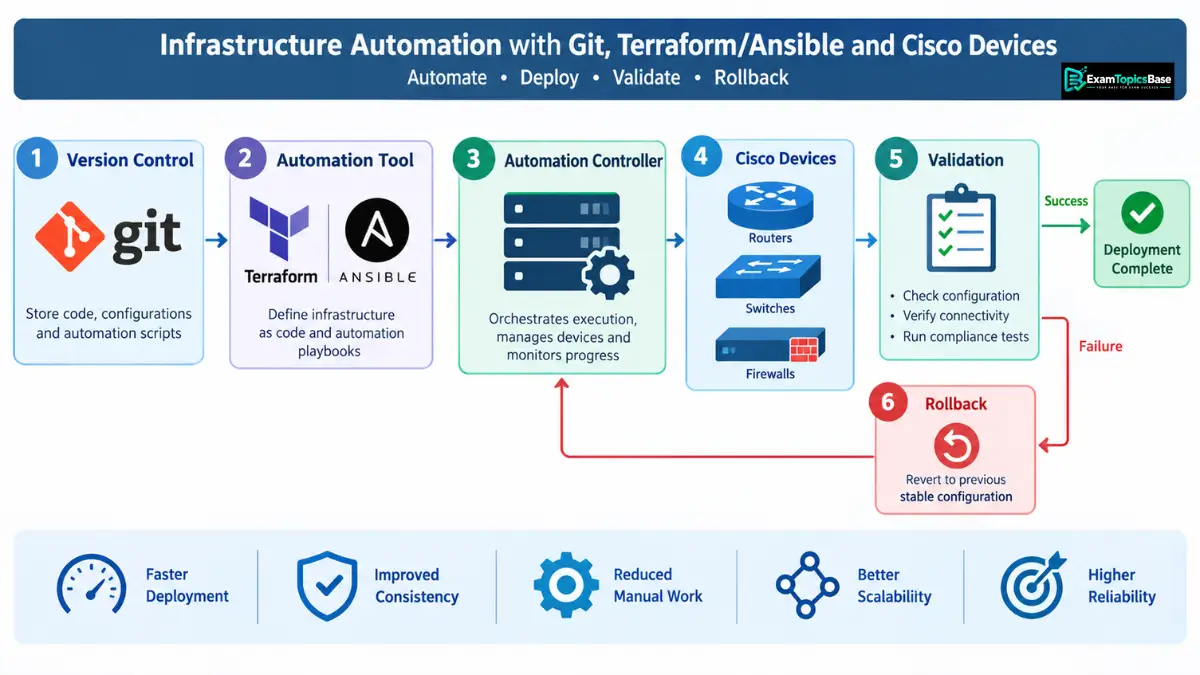
Cisco Platforms and Development focuses on using Cisco SDKs and understanding the capabilities of Cisco management platforms and APIs. Cisco's blueprint assigns this domain 15%.
For example, a Python script may use an SDK to communicate with a Cisco platform instead of manually building every HTTP request.
Additionally, candidates should understand how Cisco platforms expose capabilities through APIs and development interfaces. The current blueprint includes network, compute, collaboration, and security platform concepts, together with SDK usage and related development practices.
Furthermore, study model-driven concepts such as YANG and understand how API calls, sequence diagrams, code reviews, and unified diffs help developers work with automation code.
What Application Deployment and Security Topics Should You Study?
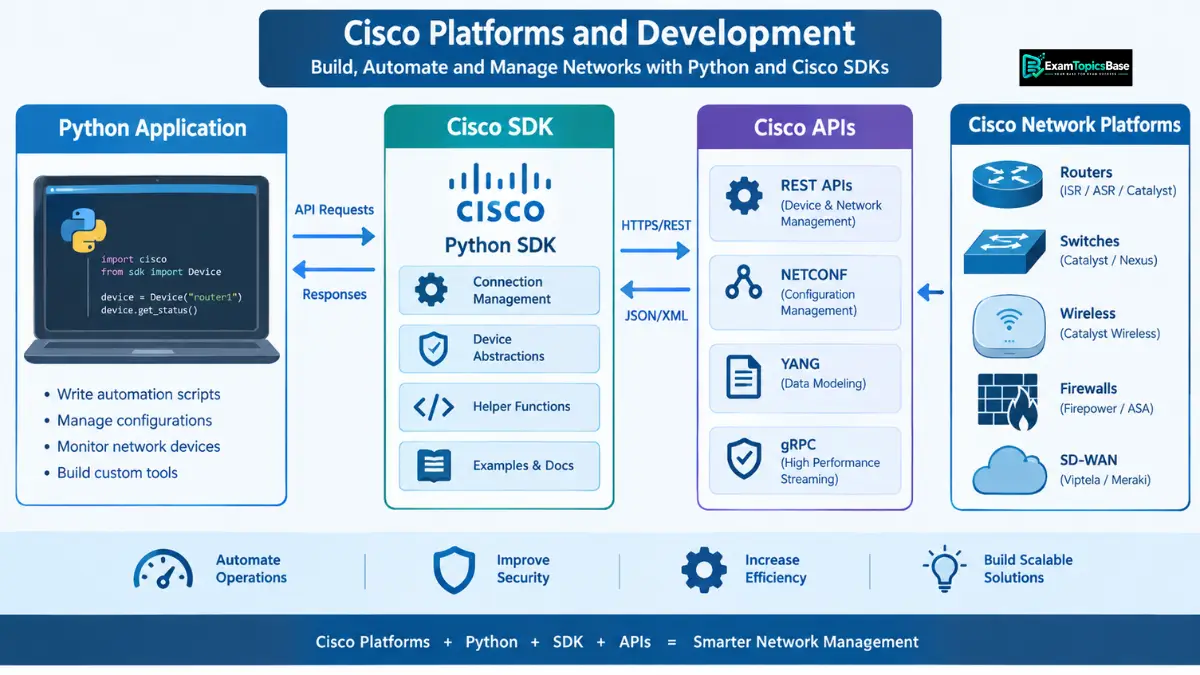
Application Deployment and Security covers the concepts needed to develop, deploy, and protect automation applications. This area includes deployment approaches, application security, testing, containers, and delivery concepts.
For example, a Python automation application can be packaged into a container, tested through a CI/CD workflow, and deployed while keeping API credentials outside the application source code.
Moreover, security should be integrated into the development lifecycle rather than added only after deployment. Protect secrets, validate input, understand common application risks, and separate application logic from credentials and configuration.
At the same time, learn the purpose of CI/CD because automated delivery connects source code, testing, security checks, artifacts, and deployment into a repeatable process.
How Does Infrastructure Automation Work in Cisco 200-901?
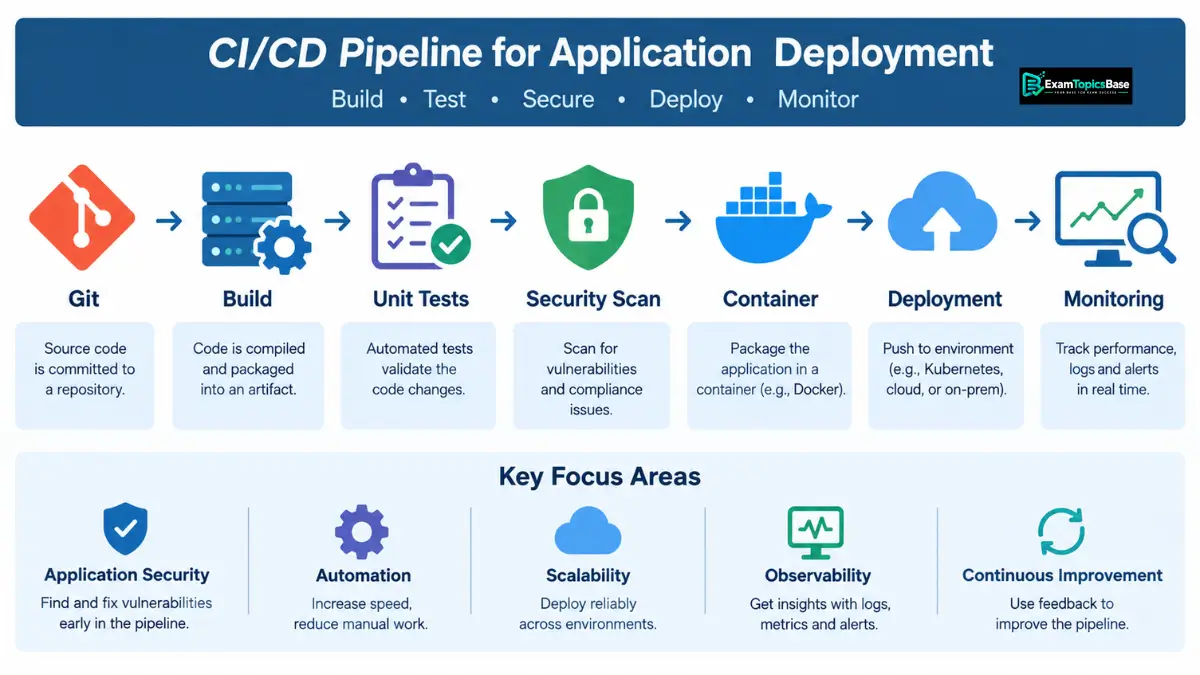
Infrastructure and Automation focuses on automating infrastructure through technologies, tools, models, and repeatable workflows. The published blueprint assigns this domain 20%, making it one of the two largest areas.
For example, an automation workflow can read a desired configuration, compare it with the current state, apply a controlled change, and validate the result.
Furthermore, infrastructure automation involves more than writing a script that sends commands. You should understand model-driven programmability, configuration management, infrastructure as code, automation workflows, and the role of tools such as Ansible, Terraform, and Cisco NSO where applicable to the blueprint. Cisco's release documentation specifically notes updated automation-tool references including Terraform.
Therefore, practice thinking about repeatability, idempotence, validation, version control, and controlled change. These principles help turn a one-time script into a maintainable automation workflow.
Why Are Network Fundamentals Included in a Network Automation Exam?
Network Fundamentals remain important because automation applications operate on real networks and must understand connectivity, addressing, services, and network behavior. The current blueprint allocates 15% to Network Fundamentals.
For example, a Python application may successfully construct an API request but still fail because DNS resolution, a firewall rule, proxy, VPN, or transport port prevents connectivity.
Moreover, review MAC addresses, VLANs, IP addresses, routes, subnet masks and prefixes, gateways, switches, routers, firewalls, load balancers, and management, control, and data planes.
In addition, study common IP services such as DHCP, DNS, NAT, SNMP, and NTP, along with common protocol ports and basic application connectivity troubleshooting.
How Should You Study Python, APIs, and Cisco Platforms for 200-901?
Python, APIs, and Cisco platforms should be studied together because the exam connects programming concepts with practical automation workflows. Reading Python syntax alone does not demonstrate how a script communicates with infrastructure.
For example, create a small Python program that loads a JSON object, extracts a value, sends an API request, checks the HTTP response, and prints a useful result.
How Much Python Do You Need for Cisco 200-901?
You need practical Python knowledge rather than advanced software-engineering expertise for Cisco 200-901 preparation. Focus on variables, strings, lists, dictionaries, loops, conditions, functions, modules, exceptions, file handling, JSON, and the requests library.
For example, a dictionary can store API response information while a loop can process multiple devices or interfaces returned by an API.
Furthermore, practice reading existing Python code because automation questions may require you to understand what a script does rather than write an entire application from scratch.
At the same time, learn how to handle errors cleanly. An automation script should not blindly assume that every API request succeeds.
How Should You Practice APIs?
API practice should involve reading documentation and constructing requests rather than memorizing endpoint names. Cisco's blueprint specifically expects candidates to construct REST API requests and Python scripts using the requests library.
For example, use a safe test API to practice GET and POST requests, authentication, headers, parameters, JSON bodies, and response handling before moving to Cisco-specific APIs.
Moreover, Postman or a similar API client can help you inspect requests and responses visually. Python can then reproduce the same request programmatically.
Source: Automating Networks Using Cisco Platforms
How Should You Prepare for Application Deployment, Security, and Infrastructure Automation?
Application deployment and infrastructure automation should be practiced as complete workflows rather than isolated technologies. A useful workflow connects source control, testing, security, deployment, automation, and validation.
For example, a project could store Python automation code in Git, run unit tests automatically, scan dependencies, build a container, deploy the application, execute an API-based task, and validate the result.
Furthermore, study infrastructure as code because it introduces a repeatable way to describe infrastructure and configuration. Terraform is one example of an infrastructure-as-code technology referenced in Cisco's updated automation material.
At the same time, configuration-management tools such as Ansible can help automate repeatable infrastructure operations. The important objective is understanding how these tools fit into a controlled automation process.
How Should You Practice Security?
Security practice should focus on protecting credentials, validating input, controlling access, and understanding common application risks. Automation systems can have broad access to infrastructure, so insecure code can create operational risk.
For example, storing an API key directly inside a public Git repository creates an avoidable credential exposure problem.
Moreover, use environment variables, secret-management systems, appropriate permissions, and secure development practices instead of embedding sensitive values directly into source code.
What Tools Should You Practice for Cisco 200-901?
Cisco 200-901 preparation benefits from a combination of Python, Git, API clients, Cisco learning platforms, Cisco Modeling Labs, and Cisco automation technologies. Cisco itself provides Cisco U. learning paths, practice exams, Networking Academy, Cisco Press, and Cisco Modeling Labs as preparation options.
Tool or resource | What to practice | Practical purpose |
Python | Scripts, functions, JSON, requests | Build automation logic |
Git/GitHub | Branches, commits, merges, diffs | Manage automation code |
REST API client | Requests, authentication, responses | Test APIs |
Cisco SDKs | API-based development | Interact with Cisco platforms |
Cisco U. | Guided learning and practice | Structured preparation |
Cisco Modeling Labs | Network simulation and automation | Hands-on network practice |
Networking Academy | Foundational learning | Build supporting knowledge |
Cisco Press | Technical reference material | Reinforce concepts |
How Can Cisco U. Help With 200-901 Preparation?
Cisco U. provides guided learning paths and assessments designed around Cisco certifications. Cisco's 200-901 exam page specifically points candidates toward a Cisco U. learning path and practice exam.
For example, you can use a guided path to identify knowledge gaps and then reinforce those areas with hands-on exercises.
Furthermore, Cisco says its Cisco U. learning paths include pre- and post-assessments that can help learners focus on areas where they need additional study.
How Can Cisco Modeling Labs Help?
Cisco Modeling Labs provides a way to design, build, and troubleshoot network environments through a graphical interface and API. Cisco specifically recommends CML as a hands-on learning option for CCNA Automation.
For example, you can create a small topology, test connectivity, automate configuration, and observe how changes affect the environment.
Moreover, hands-on simulation can help bridge the gap between reading an automation concept and understanding how it behaves in a network environment.
What Free Resources Can You Use?
Cisco Networking Academy provides free learning opportunities, while Cisco also offers certification communities and other learning resources. Cisco's CCNA Automation page identifies Networking Academy as a free learning option.
For example, you can use free foundational networking and programming resources before investing in more advanced training.
Additionally, Cisco's official exam page provides access to certification information and practice-exam resources, making the official Cisco ecosystem an important starting point for preparation.
How Can You Build a Cisco 200-901 Study Plan?
A Cisco 200-901 study plan should follow the six exam domains and combine theory, coding practice, API exercises, networking review, and hands-on automation. A structured plan prevents candidates from spending too much time on one familiar topic.
For example, a six-week schedule can gradually move from Python and Git fundamentals to APIs, Cisco platforms, deployment, infrastructure automation, and final practice.
Week | Primary focus | Practical activity |
Week 1 | Software development | Python, JSON, YAML, XML, Git |
Week 2 | APIs | REST requests, HTTP, authentication, webhooks |
Week 3 | Cisco platforms | SDKs, APIs, YANG, platform capabilities |
Week 4 | Deployment and security | Containers, CI/CD, testing, secrets |
Week 5 | Infrastructure automation | IaC, Ansible/Terraform concepts, network labs |
Week 6 | Network fundamentals and revision | Troubleshooting, practice tests, weak areas |
What Should You Study in Week 1?
Week 1 should establish the software-development foundation needed for the rest of the exam. Focus on Python basics, JSON, YAML, XML, functions, modules, testing concepts, and Git.
For example, build a Python script that reads JSON data, extracts selected fields, and stores the processed result in a new structure.
Moreover, practice Git commands such as clone, add, commit, push, pull, branch, merge, and diff because these are explicitly represented in the blueprint.
What Should You Study in Weeks 2 and 3?
Weeks 2 and 3 should focus heavily on APIs and Cisco platform development because APIs represent 20% of the blueprint and Cisco Platforms and Development represents another 15%.
For example, spend one session constructing REST requests and another session writing Python code that sends those requests and handles responses.
Furthermore, practice reading API documentation. You should be able to identify the endpoint, method, authentication requirement, parameters, request body, and expected response.
What Should You Study in Weeks 4 and 5?
Weeks 4 and 5 should cover application deployment, security, infrastructure automation, and network fundamentals. These areas help you understand how automation applications move from development into operational environments.
For example, create a small automation project that uses Git, Python, an API, testing, container concepts, and an infrastructure automation workflow.
At the same time, review networking fundamentals because a failed automation request may be caused by a network problem rather than faulty Python code.
What Should You Do in the Final Week?
The final week should focus on practice assessments, troubleshooting, revision, and closing knowledge gaps. Cisco provides practice exams through Cisco U. to help candidates check their readiness.
For example, maintain a list of every missed practice question and categorize each mistake as Python, API, Cisco platform, security, infrastructure, or networking knowledge.
Moreover, revisit the official blueprint before the exam so that your final revision reflects the current objectives rather than an outdated study guide.
How Can Cisco 200-901 Practice Questions Help You Study?
Cisco 200-901 practice questions can help you identify knowledge gaps and improve your ability to apply concepts to technical scenarios. Practice is most useful when you analyze why an answer works rather than simply counting correct responses.
For example, if you miss an API question involving a 401 response, review authentication, headers, credentials, and the request itself before attempting another question.
Furthermore, practice questions should supplement official Cisco documentation and hands-on work rather than replace them. Cisco provides official practice-exam resources through Cisco U. for candidates preparing for the exam.
At the same time, be careful with third-party resources that describe unofficial material as real exam questions. Unverified practice content should not be treated as an official representation of Cisco's exam.
Get Free Microsoft Real Exam Questions & Answers of Here:https://examtopicsbase.com/vendors/microsoft
What Should You Do Before Scheduling the Cisco 200-901 Exam?
Before scheduling the Cisco 200-901 exam, you should be able to explain the major domains and apply core concepts through practical exercises. Cisco lists no prerequisite certification for CCNA Automation, but practical preparation remains important.
For example, you should be comfortable reading a JSON response, constructing a REST request, understanding authentication, interpreting HTTP codes, explaining a Cisco SDK workflow, and troubleshooting basic network connectivity.
Moreover, use the following readiness checklist:
I understand all six 200-901 exam domains.
I can work with JSON, XML, and YAML.
I understand essential Python concepts.
I can use common Git operations.
I can construct and troubleshoot REST API requests.
I understand API authentication and HTTP response codes.
I understand Cisco SDK and platform concepts.
I understand application deployment and security concepts.
I understand infrastructure automation and IaC.
I can explain basic network fundamentals.
I have completed hands-on automation exercises.
I have reviewed practice-test mistakes.
I have checked the latest Cisco exam objectives.
What Should You Do Next for Cisco 200-901 Preparation?
The next step for Cisco 200-901 preparation is to map the official exam blueprint against your current skills and then turn each weak area into a practical study task. Cisco's official blueprint should remain the reference point because exam objectives and product terminology can change.
For example, if APIs are your weakest area, spend your next study sessions constructing REST requests, interpreting HTTP responses, practicing authentication, and writing Python requests-library scripts.
Furthermore, create at least one end-to-end automation project that connects several concepts. A useful project can include Git, Python, a REST API, JSON processing, authentication, testing, and a simulated or lab-based Cisco environment.
At the same time, use Cisco U. and other official Cisco learning resources to reinforce concepts that remain unclear. Cisco's current certification resources include Cisco U., Networking Academy, Cisco Press, and Cisco Modeling Labs.
Conclusion
The Cisco 200-901 exam is the core exam for the CCNA Automation certification and focuses on software development, APIs, Cisco platforms, application deployment and security, infrastructure automation, and networking fundamentals. Cisco currently lists 200-901 CCNAAUTO as the Automating Networks Using Cisco Platforms exam, with a 120-minute duration.
Moreover, effective 200-901 preparation requires more than memorizing technical definitions. Python, REST APIs, Git, JSON, Cisco SDKs, infrastructure automation, security, and networking concepts should be practiced together so you can understand how they operate in an actual automation workflow.
Furthermore, the published blueprint assigns 20% each to Understanding and Using APIs and Infrastructure and Automation, while the other four domains carry 15% each.
Finally, use the official Cisco blueprint as your study map, reinforce concepts through hands-on labs, and use practice questions to identify areas that need additional work. ExamTopicsBase can complement this preparation with structured study resources and practice material, while Cisco's official learning resources should remain the primary reference for current exam objectives.
Frequently Asked Questions
1. What Is the Cisco 200-901 Exam?
First, Cisco 200-901 is the Automating Networks Using Cisco Platforms exam associated with the CCNA Automation certification. Cisco lists the exam as 120 minutes and identifies it as the core exam for CCNA Automation.
2. What Certification Does Cisco 200-901 Earn?
Second, passing 200-901 earns the CCNA Automation certification. Cisco's current certification page identifies Automating Networks Using Cisco Platforms 200-901 CCNAAUTO as the required core exam.
3. Is 200-901 the Old DevNet Associate Exam?
Third, older resources may refer to the exam as DEVASC 200-901 or DevNet Associate. Cisco transitioned the DevNet certification track to the Automation certification track beginning February 3, 2026.
4. How Long Is the Cisco 200-901 Exam?
Fourth, Cisco lists the 200-901 CCNAAUTO exam duration as 120 minutes. Candidates should therefore practice solving technical scenarios efficiently within the available time.
5. Does Cisco 200-901 Have Prerequisites?
Fifth, Cisco currently lists no prerequisites for the CCNA Automation certification exam. However, candidates still benefit from networking, programming, API, and automation knowledge before beginning serious preparation.
6. What Topics Are Covered in Cisco 200-901?
Sixth, the published blueprint covers Software Development and Design, Understanding and Using APIs, Cisco Platforms and Development, Application Deployment and Security, Infrastructure and Automation, and Network Fundamentals.
7. How Much Python Should You Know for 200-901?
Seventh, you should understand practical Python concepts such as functions, data structures, modules, exceptions, JSON processing, and API calls using the requests library. Cisco's blueprint specifically includes Python scripts that call REST APIs and use Cisco SDKs.
8. Are REST APIs Important for Cisco 200-901?
Eighth, REST APIs are an important part of the exam because the API domain represents 20% of the published blueprint. Candidates should understand requests, responses, authentication, HTTP codes, webhooks, API constraints, and Python API calls.
9. Which Resources Can Help With Cisco 200-901 Preparation?
Ninth, Cisco provides Cisco U., practice exams, Networking Academy, Cisco Press, and Cisco Modeling Labs as preparation resources. These resources can be combined with hands-on Python, API, Git, and network-automation exercises.
10. How Should I Prepare for the Cisco 200-901 Exam?
Tenth, begin with the official blueprint, identify weak domains, learn the required Python and networking fundamentals, practice REST APIs and Cisco platforms, complete automation labs, and use practice assessments to measure progress. A practical study plan should combine knowledge review with hands-on application rather than relying only on memorization.
You may also like to read:
Cisco 200-201 Exam Topics | The Ultimate Study Guide for Smarter Preparation

Written by Marcus Vance
I’m Marcus Vance, a Cisco Solutions Architect and technical contributor at ExamTopicsBase. Having designed mission-critical enterprise backbones and navigated Cisco's certification tracks for over a decade, I focus on delivering accurate, real-world packet analyses and blueprint-aligned practice questions so you can pass your exam with total confidence.
Comments (0)
Leave a Reply
No comments yet. Be the first to share your thoughts!