

You've probably seen several Microsoft certification options but may still wonder which exam should come first and which certification should follow it. This guide explains Microsoft certification career roadmaps by exam code, with a special focus on the AZ-900 certification roadmap for beginners and different paths toward administration, DevOps, data, and database careers.
What Are Microsoft Certification Career Roadmaps by Exam Code?
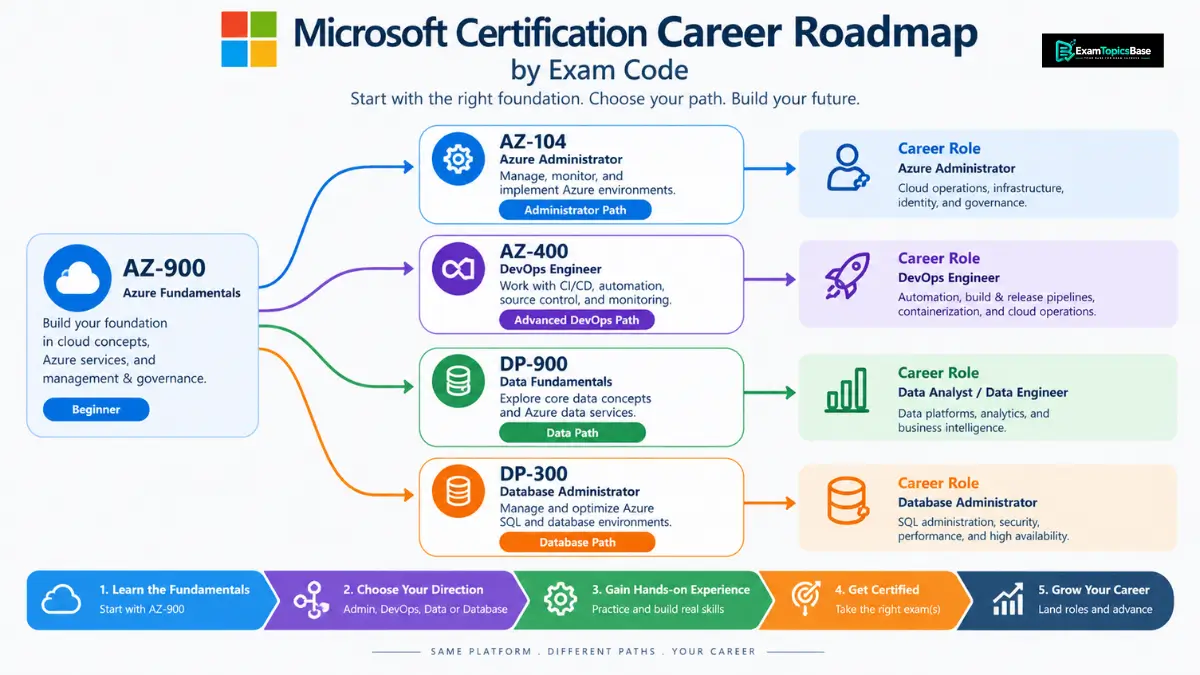
Microsoft certification career roadmaps by exam code are structured paths that connect individual Microsoft exams with the skills, roles, and learning directions they support. Instead of treating every certification as an isolated credential, a roadmap helps you understand where an exam can fit into your longer-term career plan.
First, the AZ-900 certification roadmap for beginners is primarily about building foundational cloud and Azure knowledge. Microsoft identifies Azure Fundamentals as a beginner-level certification and describes it as a common starting point for a career journey in Azure.
Second, role-focused exams can take you in different directions. For example, AZ-104 certification is associated with Azure administration, while DP-900 focuses on foundational data concepts and AZ-400 is associated with advanced DevOps responsibilities.
Moreover, these exams should not automatically be viewed as steps that everyone must complete in order. A career changer interested in Azure administration may move from foundational learning toward AZ-104, while someone interested in data may focus on DP-900 instead.
For example, a learner can think of the roadmap as:
Understand cloud → Build fundamentals → Choose a specialization → Develop practical skills → Prepare for the next certification → Build career experience
Why Do Microsoft Certification Career Roadmaps Matter?
Microsoft certification career roadmaps matter because they help learners choose certifications according to career objectives instead of simply following exam popularity. A roadmap gives your preparation a purpose and makes it easier to decide what to study next.
First, beginners often face too many certification choices. For example, searching for an Azure certification can quickly introduce you to fundamentals, administrator, developer, DevOps, data, security, and specialty credentials.
Second, a roadmap reduces unnecessary studying by connecting certifications to roles. If your goal is Azure administration, an AZ-104 certification roadmap makes more sense than spending months preparing for a data-focused credential.
Moreover, career roadmaps help career changers identify transferable skills. A system administrator may already understand servers and networking, while a database professional may have SQL knowledge that supports a data-focused path.
The best Microsoft certification path is the one that supports the role you want to perform.
What Is the AZ-900 Certification Roadmap for Beginners?
The AZ-900 certification roadmap for beginners is a learning sequence that starts with cloud fundamentals, progresses through Azure services and management concepts, and ends with exam readiness and selection of a suitable next path.
First, beginners should understand basic cloud concepts before attempting to memorize Azure services. The current AZ-900 objectives include cloud computing, shared responsibility, cloud models, consumption-based pricing, and IaaS, PaaS, and SaaS.
Second, learners should study Azure architecture and services. The current domain includes Azure regions, availability zones, resources, subscriptions, compute, networking, storage, identity, access, and security.
Third, learners should understand Azure management and governance. This includes cost management, Azure Policy, resource locks, management tools, monitoring, and related governance concepts.
The current AZ-900 weighting is:
AZ-900 Exam Area | Current Weight |
Cloud concepts | 25–30% |
Azure architecture and services | 35–40% |
Azure management and governance | 30–35% |
Passing score | 700+ |
What Should Beginners Learn Before AZ-900?
Before AZ-900 preparation, beginners should understand basic computing, networking, storage, databases, and general IT terminology. These are useful foundations rather than a requirement to become an Azure expert.
For example, knowing what a server does makes it easier to understand Azure virtual machines. Similarly, basic networking knowledge helps you understand virtual networks, connectivity, and endpoints.
Next, learn the difference between IaaS, PaaS, and SaaS. These concepts appear throughout cloud discussions and help explain why organizations choose different cloud service models.
What Topics Are Covered in the AZ-900 Exam?
The AZ-900 exam covers cloud concepts, Azure architecture and services, and Azure management and governance. Microsoft currently lists these three areas as the main skills measured.
First, cloud concepts account for 25–30% of the exam. Second, Azure architecture and services account for 35–40%. Third, management and governance account for 30–35%.
Source: Microsoft Learn
Therefore, an effective AZ-900 exam preparation guide for beginners should give substantial attention to all three domains rather than focusing exclusively on popular Azure services.
How Should Beginners Prepare for the AZ-900 Exam?
Beginners should prepare for AZ-900 by following the official objectives, studying each domain systematically, practicing concepts, reviewing weak areas, and checking readiness before scheduling the exam.
First, begin with Microsoft's current AZ-900 study guide. The study guide is the best reference for determining what Microsoft currently measures.
Second, organize your AZ-900 preparation into stages:
Learn cloud concepts.
Study Azure architecture.
Learn core Azure services.
Study identity and security concepts.
Review management and governance.
Practice exam objectives.
Identify weak areas.
Complete final revision.
Take a readiness assessment.
Schedule the exam when prepared.
Moreover, use the official Microsoft certification page to understand the current certification details and available preparation options.
For additional structured revision, learners can review the AZ-900 exam preparation resource while keeping Microsoft's official objectives as the primary source.
How Long Does AZ-900 Preparation Take?
AZ-900 preparation can take two to six weeks for many beginners, although the appropriate timeline depends on previous IT knowledge, study hours, and familiarity with cloud computing.
First, a learner with an IT background may be comfortable with a shorter study schedule. For example, an IT support professional who already understands networks and servers may spend more time learning Azure-specific terminology than basic technology concepts.
Second, someone completely new to cloud computing may need more time. A steady 30–90 minute daily schedule can provide a more manageable learning routine than occasional long study sessions.
Preparation Style | Suggested Time | Example Daily Study |
Fast | 1–2 weeks | 2–3 hours |
Balanced | 3–4 weeks | 60–90 minutes |
Comfortable | 5–6 weeks | 30–60 minutes |
Beginner with limited time | 6+ weeks | Short daily sessions |
These are planning examples, not Microsoft requirements. Readiness should be measured by your understanding of the exam objectives rather than the number of days studied.
Which Microsoft Resources Are Best for AZ-900 Preparation?
The strongest resources for AZ-900 preparation are Microsoft Learn, the official AZ-900 study guide, Azure documentation, Exam Readiness resources, and Microsoft's Practice Assessment.
First, Microsoft Learn provides structured training for beginners. The official AZ-900 study guide also links learners to documentation, training, videos, Microsoft Q&A, and Exam Readiness resources.
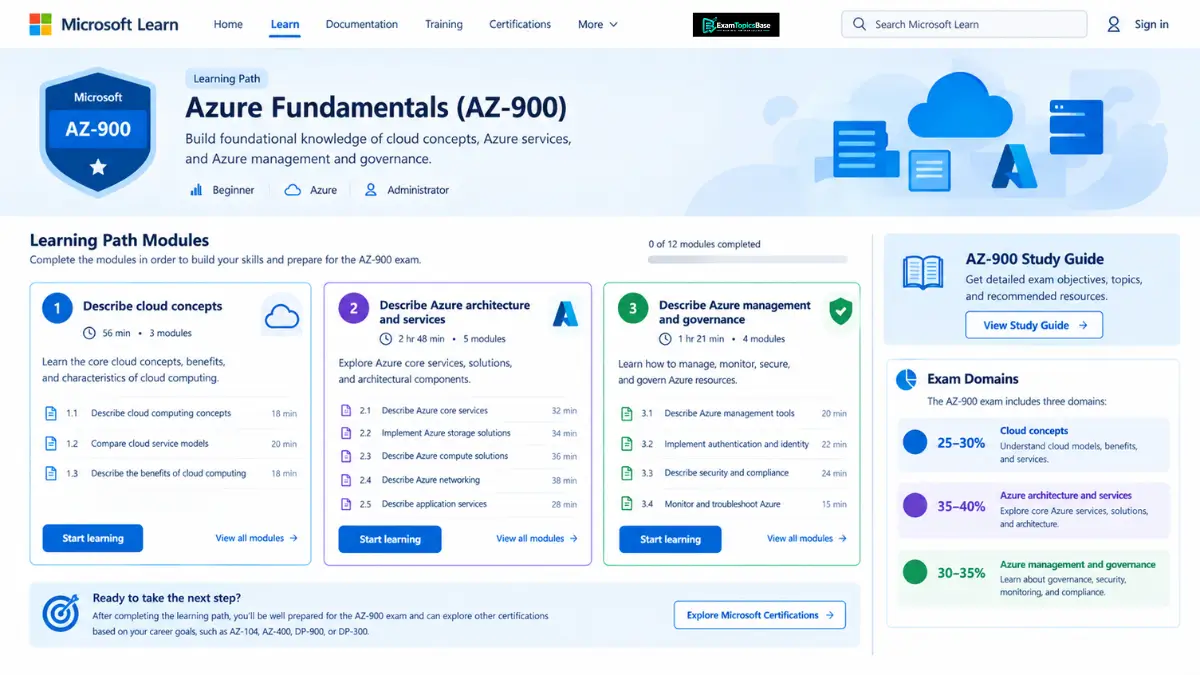
Second, Microsoft's Practice Assessment can help identify knowledge gaps. Use it after studying the main objectives rather than using practice questions as your only learning method.
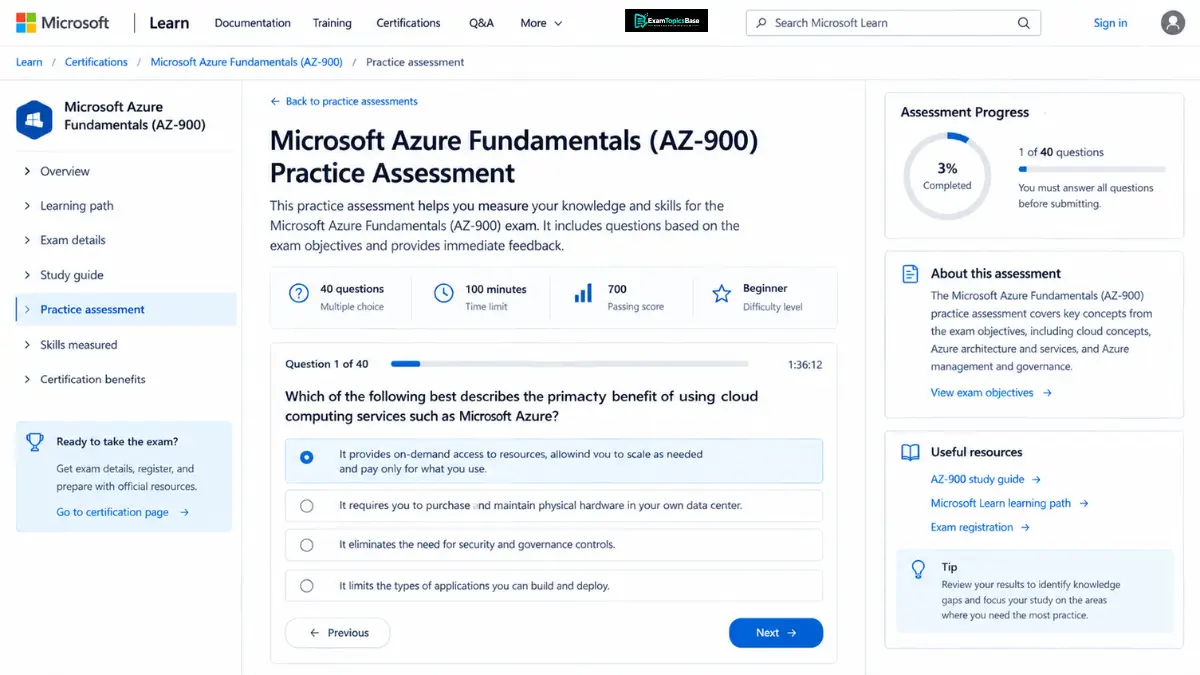
Third, use the AZ-900 practice questions and AZ-900 practice test resources as supplementary revision tools.
Official Microsoft objectives should remain the source of truth for exam preparation.
How Do AZ-104, AZ-400, DP-900, and DP-300 Fit Into the Roadmap?
AZ-104, AZ-400, DP-900, and DP-300 fit into different Microsoft Azure career directions rather than forming one mandatory sequence.
Exam | Career Direction | Roadmap Role | Typical Learner |
AZ-900 | Azure fundamentals | Starting foundation | Beginner |
AZ-104 | Azure administration | Administrator path | IT/cloud administrator |
AZ-400 | DevOps | Advanced DevOps path | Developer/infrastructure professional |
DP-900 | Data fundamentals | Data foundation | Data beginner |
DP-300 | Database administration | Database specialization | Database professional |
What Is the AZ-104 Certification Roadmap for Aspiring Azure Administrators?
The AZ-104 certification roadmap for aspiring Azure administrators focuses on developing the skills needed to implement, manage, and monitor Azure environments.
First, AZ-104 goes deeper than AZ-900 into identities, governance, storage, compute, networking, and monitoring. Microsoft identifies AZ-104 as an administrator-focused certification and expects familiarity with operating systems, networking, servers, virtualization, Azure tools, and Microsoft Entra ID.
Second, the current AZ-104 study guide assigns 20–25% to identities and governance, 15–20% to storage, and 20–25% to compute. — Source: [Microsoft Learn, 2026]
For learners choosing this path, the AZ-104 certification page can provide additional preparation support.
What Is the AZ-400 Certification Roadmap for DevOps Beginners?
The AZ-400 certification roadmap for DevOps beginners is a progression toward advanced DevOps skills involving source control, automation, continuous integration, delivery, deployment, security, and monitoring.
First, AZ-400 should not normally be treated as an immediate beginner exam. Microsoft states that candidates should have experience administering and developing in Azure and experience implementing GitHub and Azure DevOps solutions.
Second, build and release pipelines currently represent 50–55% of the AZ-400 measured skills.
Therefore, a sensible DevOps progression can look like:
Azure fundamentals → Azure administration or development → practical DevOps skills → AZ-400
The AZ-400 certification resource can be used for additional exam-focused preparation.
What Is the DP-900 Certification Roadmap for Data Beginners?
The DP-900 certification roadmap for data beginners introduces core data concepts and Microsoft Azure data services.
First, DP-900 is appropriate for learners who enjoy data more than infrastructure administration. For example, a student interested in databases, analytics, and data engineering can use DP-900 to develop foundational knowledge.
Second, Microsoft's current DP-900 objectives include core data concepts, relational data, non-relational data, and analytics workloads. The current weighting is 25–30%, 20–25%, 15–20%, and 25–30%, respectively.
For additional preparation, learners can review the DP-900 certification resource.
What Is the DP-300 Certification Roadmap for Aspiring Database Administrators?
The DP-300 certification roadmap for aspiring database administrators moves from general data knowledge toward deeper Azure database administration skills.
First, DP-300 is better suited to learners with relevant database or SQL knowledge than to someone completely new to data. The path can include foundational data concepts followed by more focused database administration learning.
Second, DP-300 covers areas such as securing database environments, monitoring and optimizing database resources, automation, and high availability and disaster recovery.
Therefore, a practical data-oriented path can be:
DP-900 fundamentals → SQL/database knowledge → Azure database administration → DP-300
The DP-300 certification resource can support focused exam preparation.
Which Microsoft Certification Path Is Best for Beginners?
The best Microsoft certification path for beginners depends on the learner's target role, existing skills, and preferred technology area.
Career Goal | Starting Certification | Possible Next Step | Main Focus |
Cloud beginner | AZ-900 | Role-based Azure certification | Cloud fundamentals |
Azure administrator | AZ-900 | AZ-104 | Azure operations |
DevOps | AZ-900 | AZ-104/development foundation → AZ-400 | Automation and delivery |
Data | DP-900 | Data role-based certification | Data services |
Database administration | DP-900 | DP-300 | Azure SQL/database management |
Career changer | AZ-900 | Role-specific certification | Broad Azure foundation |
First, the Microsoft certification roadmap for career changers should consider existing professional experience. A system administrator may already possess useful infrastructure knowledge, while a database professional may already understand SQL and relational databases.
Second, students and recent graduates can start with a fundamentals certification to explore a technology area before choosing a specialized role.
Third, learners should avoid collecting certifications without a career objective. A certification roadmap should answer the question, "What skill or role am I preparing for next?"
What Should You Do After Passing AZ-900?
After passing AZ-900, you should choose your next certification or learning direction based on your desired career rather than automatically taking another exam.
First, consider administration if you enjoy infrastructure, networking, identity, and resource management. In that case, investigate AZ-104 and its technical requirements.
Second, consider DP-900 if you prefer data concepts, analytics, and Azure data services. If database administration becomes your goal, DP-300 can provide a more specialized direction.
Third, investigate AZ-400 only after developing the broader Azure and DevOps experience expected by Microsoft.
Microsoft Azure Certification Path for Beginners
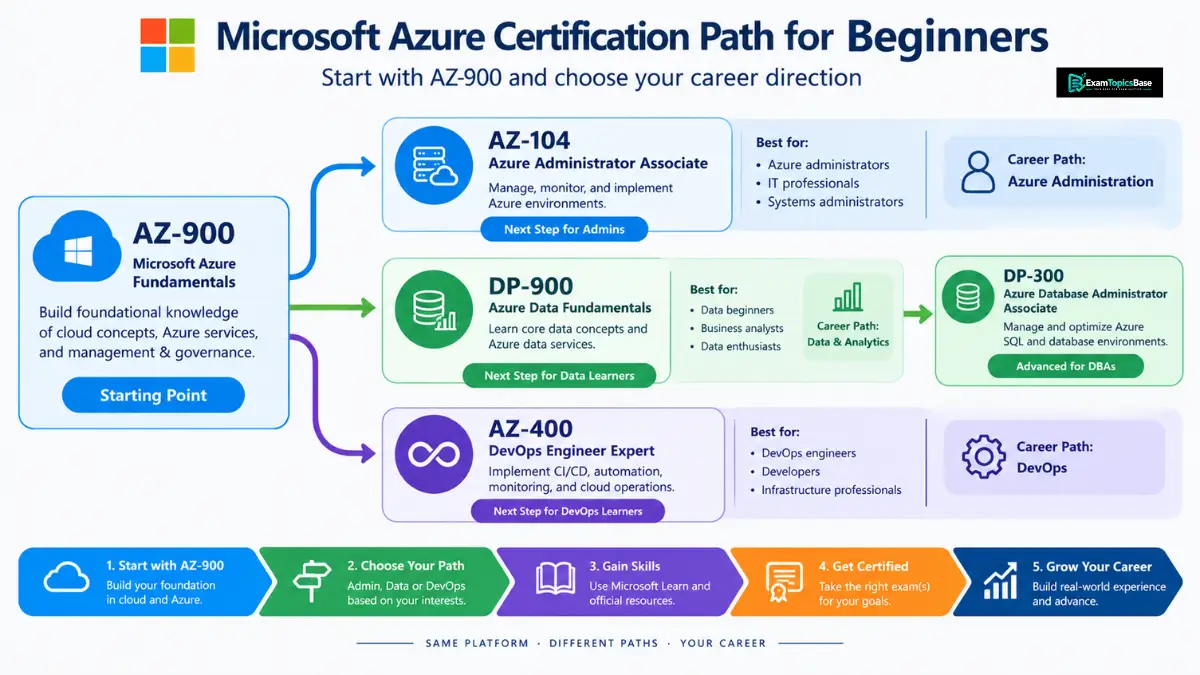
The Microsoft Azure certification path for beginners can branch in several directions:
AZ-900 → Azure administration → AZ-104
AZ-900 → Data fundamentals → DP-900 → database/data specialization
AZ-900 → Azure development or administration experience → DevOps → AZ-400
This branching model is more useful than presenting every exam as a fixed sequence.
How Can You Build a Practical Microsoft Certification Study Plan?
A practical Microsoft certification study plan should combine official objectives, structured learning, practice, review, and career-focused skill development.
First, choose one target exam and download or review its current Microsoft study guide. This establishes the boundaries of your preparation.
Second, divide the objectives into weekly study blocks. For example, an AZ-900 learner could spend the first week on cloud concepts, the second week on Azure architecture and services, and the third week on management and governance.
Third, use practice questions after each learning block. Practice should reveal what you understand and what still needs work.
Finally, complete a readiness review before scheduling the exam. Practice is most valuable when it tells you what to study next.
For broader preparation, the Microsoft certification exam preparation section can help learners explore additional exam-specific resources.
Conclusion
Microsoft certification career roadmaps by exam code make it easier to understand how individual certifications can support different professional directions. AZ-900 provides a beginner-friendly Azure foundation, while AZ-104, AZ-400, DP-900, and DP-300 move into different areas of administration, DevOps, data, and database technology.
First, use the current Microsoft study guide for the exam you plan to take. Microsoft regularly updates exam objectives, so relying on outdated information can weaken your preparation.
Second, choose your next certification based on the role you want rather than following a universal sequence. The right certification is the one that develops skills relevant to your next career step. After identifying your target role, you can use ExamTopicsBase to review exam-focused preparation resources and better understand what to study before moving to the next certification.
Frequently Asked Questions
What is the best Microsoft certification for complete beginners?
AZ-900 is one of the clearest starting points for beginners interested in Azure, because Microsoft classifies Azure Fundamentals at the beginner level and describes it as a common starting point for an Azure career.
What is an AZ-900 certification roadmap for beginners?
An AZ-900 certification roadmap is a structured sequence for learning cloud concepts, Azure services, management and governance, exam objectives, practice, and readiness before choosing a suitable next career path.
Is AZ-900 required before AZ-104?
AZ-900 is not a mandatory prerequisite for AZ-104. However, AZ-900 can provide useful foundational knowledge before moving into the deeper administration skills covered by AZ-104.
Should I choose AZ-104 or DP-900 after AZ-900?
Choose AZ-104 if you want Azure administration and infrastructure, while DP-900 is more appropriate if you are interested in data concepts and Azure data services.
Is AZ-400 suitable for beginners?
AZ-400 is not generally an immediate beginner certification. Microsoft expects candidates to have experience administering and developing in Azure and working with GitHub and Azure DevOps solutions.
Is DP-900 a good certification for data beginners?
DP-900 is designed for learners building foundational knowledge of data concepts and Azure data services. It can be a useful starting point for people exploring data-focused careers.
When should I take the DP-300?
DP-300 is most appropriate when you want to specialize in Azure database administration and have developed the necessary SQL and database knowledge.
How long does AZ-900 preparation take?
Many beginners can plan for two to six weeks of preparation, but the correct timeline depends on your existing IT knowledge, available study time, and understanding of the current objectives.
What resources should I use for Microsoft certification preparation?
Use Microsoft Learn, the official certification page, the relevant Microsoft study guide, Microsoft documentation, exam readiness content, and available Practice Assessments as your primary preparation resources.
What is the best Microsoft certification path for career changers?
The best Microsoft certification path for career changers depends on transferable skills and the target role. AZ-900 can provide an Azure foundation, after which you can move toward administration, data, DevOps, database, or another Microsoft technology area.
Finally, combine certification study with practical learning. Use official Microsoft resources, create a realistic study plan, practice consistently, and review weak areas before moving forward.
Your certification should be a milestone in your career roadmap, not the roadmap itself.
You may also like to read:
What Is the AZ-120 Exam and How Can You Prepare for It? The Ultimate Guide
Is AZ-900 the Right Microsoft Certification for Your Career?
How Hard Is the AZ-400 Exam? | A Complete Preparation & Study Guide
What Is the AZ-104 Exam and How Can You Prepare for It? | The Ultimate Guide

Written by Julia Mercer
I’m Julia Mercer, a Microsoft Solutions Architect and technical contributor at ExamTopicsBase. Having navigated the evolving Microsoft certification roadmap throughout my career in enterprise IT, I focus on delivering accurate, scenario-tested practice questions and clear, blueprint-aligned explanations so you can walk into your test with total confidence.
Comments (0)
Leave a Reply
No comments yet. Be the first to share your thoughts!