
If you've been working with SAP, Azure, or enterprise infrastructure, you've probably noticed that running SAP in the cloud requires more than basic Azure administration knowledge. In this guide, we'll explain the current AZ-120 exam topics, prerequisites, SAP migration concepts, HADR, hands-on preparation, practice resources, and career paths so you can build a focused study plan.
What Is the AZ-120 Exam and Azure for SAP Workloads Certification?
AZ-120 is the Microsoft exam for the Microsoft Certified: Azure for SAP Workloads Specialty certification, validating skills for planning, migrating, implementing, and maintaining SAP workloads on Microsoft Azure. Microsoft currently classifies the certification as intermediate and associates it with the Solution Architect role.
Moreover, the official exam title is AZ-120: Planning and Administering Microsoft Azure for SAP Workloads. The certification is designed for architects and engineers who design and manage SAP landscapes on Azure, including environments involving RISE with SAP.
For example, an AZ-120 professional might evaluate an SAP HANA workload, select an appropriate Azure VM configuration, plan storage and networking, design a resilient architecture, and establish monitoring and backup procedures.
Additionally, the certification currently has a 12-month renewal frequency, and Microsoft states that specialty certifications can be renewed by passing a free online renewal assessment on Microsoft Learn.
Why Is AZ-120 Important for SAP Professionals Working With Azure?
AZ-120 matters because it connects SAP expertise with Azure infrastructure and cloud architecture skills. A professional who understands both sides can make better decisions about migration, sizing, resiliency, networking, storage, monitoring, and ongoing operations.
For example, moving an SAP HANA environment to Azure involves more than selecting a virtual machine. The design must consider SAP-supported configurations, storage performance, network architecture, high availability, backup, disaster recovery, and operational requirements.
Furthermore, Microsoft describes the AZ-120 role around optimizing resiliency, performance, scale, provisioning, sizing, and monitoring. Candidates also work with cloud administrators, database administrators, and clients when implementing SAP solutions, including RISE with SAP.
Microsoft also maintains documentation covering SAP-certified configurations and supported Azure infrastructure. Its certification page explains that Microsoft continuously updates supported configuration information for SAP workloads.
For organizations considering RISE with SAP on Azure, this knowledge is increasingly relevant. SAP announced in May 2026 that its global RISE with SAP on Microsoft Azure initiative was expanding, with thousands of enterprise customers already using the approach.
What Are the Current AZ-120 Exam Topics and Objectives?
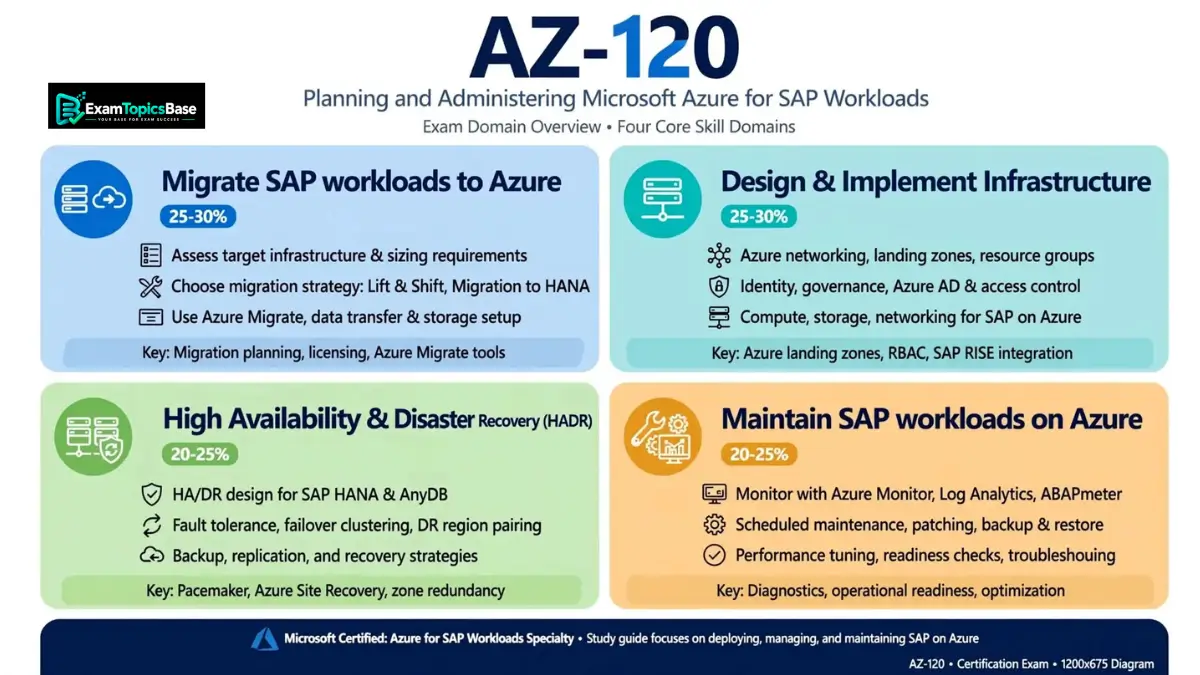
The current AZ-120 skills measured cover four major technical areas, with the percentages effective April 17, 2026.
AZ-120 exam domain | Current weighting | Preparation focus |
Migrate SAP workloads to Azure | 25–30% | Migration planning, assessment, strategy, and implementation |
Design and implement infrastructure to support SAP workloads on Azure | 25–30% | Compute, storage, networking, sizing, and architecture |
Design and implement high availability and disaster recovery | 20–25% | HA architecture, backup, recovery, and resiliency |
Maintain SAP workloads on Azure | 20–25% | Monitoring, performance, operations, and cost optimization |
Therefore, the two largest domains are SAP migration and infrastructure design, each carrying 25-30% of the exam. HADR and workload maintenance each account for 20-25%.
For example, a candidate who spends all study time on Azure virtual machines but ignores migration planning and HADR is leaving substantial exam coverage unprepared.
The current AZ-120 skills measured include migrating SAP workloads to Azure, designing infrastructure for SAP workloads, implementing high availability and disaster recovery, and maintaining SAP workloads on Azure.
What Does Each AZ-120 Domain Cover?
The migration domain focuses on moving SAP workloads to Azure while considering technical and operational requirements. The infrastructure domain focuses on creating the Azure foundation that supports SAP applications and databases.
At the same time, the HADR domain concentrates on keeping SAP systems available and recoverable, while the maintenance domain addresses ongoing monitoring, performance, and cost-related operations.
How Should You Allocate Your AZ-120 Study Time?
A practical study plan should give slightly more time to the two 25-30% domains while maintaining strong coverage of HADR and maintenance.
Study area | Suggested priority | Example preparation activity |
Migration | Very high | Build a sample SAP-to-Azure migration plan |
Infrastructure | Very high | Design compute, storage, and network architecture |
HADR | High | Compare HA and disaster recovery scenarios |
Maintenance | High | Practice monitoring and performance troubleshooting |
The percentages above are official exam weightings, while the study priorities are a practical recommendation rather than a Microsoft requirement.
What Skills Are Required Before Taking the AZ-120 Exam?
AZ-120 requires substantial SAP and Azure infrastructure knowledge, including SAP applications and databases, virtualization, cloud infrastructure, storage, networking, high availability, backup, disaster recovery, and data protection. Microsoft also strongly recommends Azure Administrator Associate knowledge.
First, you should understand technologies such as SAP HANA, SAP Business Suite, and SAP NetWeaver before beginning serious AZ-120 preparation. For example, you should understand how an SAP application tier interacts with its database and supporting infrastructure.
Second, you should be comfortable with Azure administration concepts. Microsoft specifically recommends Azure administration knowledge because AZ-120 requires you to understand how Azure resources support SAP workloads.
Microsoft's related AZ-120 training is classified as Advanced, is associated with the Solution Architect role, and has a listed duration of three days.
Is AZ-120 Suitable for Beginners?
AZ-120 is generally not a first Azure certification for someone with no SAP or cloud infrastructure experience. Microsoft describes the target candidate as an architect or engineer who designs and manages an SAP landscape on Azure.
However, an IT professional who is new to SAP on Azure can still use the AZ-120 objectives as a learning roadmap. For example, an experienced Azure administrator could first build SAP fundamentals before moving into SAP-certified infrastructure, migration, and HADR scenarios.
A better beginner route is to establish Azure administration and SAP fundamentals first, then progress toward the specialty material.
How Should You Prepare for the AZ-120 Exam?
AZ-120 preparation involves reviewing the current Microsoft study guide, strengthening SAP and Azure prerequisites, completing hands-on exercises, studying migration and HADR scenarios, taking practice assessments, and targeting weak areas.
First, review the current study guide before choosing your resources. Microsoft explicitly recommends training and hands-on experience before taking the exam.
Second, use a sequential preparation process:
Review the current AZ-120 study guide.
Assess your SAP and Azure knowledge.
Study each official exam domain.
Learn SAP-certified Azure configurations.
Practice migration scenarios.
Design SAP infrastructure on Azure.
Study HADR, backup, and recovery.
Practice monitoring and performance optimization.
Take practice assessments.
Recheck the current objectives before scheduling the exam.
For example, rather than reading about Azure networking for several hours, create a simple SAP architecture that includes virtual networks, subnets, security controls, connectivity, and workload separation.
What Should You Study for the AZ-120 Migration Domain?
SAP workload migration to Azure requires you to understand assessment, planning, infrastructure requirements, migration approaches, and post-migration operations. Microsoft's SAP planning guidance emphasizes careful architecture decisions because SAP deployments depend on the correct combination of Azure resources and services.
For example, a migration exercise could start with an existing SAP environment and ask you to determine its compute requirements, storage architecture, network connectivity, target Azure region, resiliency design, and migration approach.
Your migration checklist should include:
SAP workload discovery
Database and application dependencies
Sizing and performance requirements
Azure VM selection
Storage requirements
Network connectivity
Identity and security
Backup and recovery
High availability
Cost considerations
Cutover and validation planning
SAP migration is an architecture exercise, not simply a server-migration exercise.
How Does AZ-120 Cover SAP Infrastructure on Azure?
SAP infrastructure on Azure involves selecting and configuring compute, storage, networking, identity, and supporting services according to workload requirements. Microsoft describes the role as provisioning, sizing, monitoring, and adjusting Azure resources for SAP solutions.
For example, your study environment might include Azure Virtual Machines for SAP application and database tiers, managed disks for storage, virtual networks for connectivity, and monitoring services for operational visibility.
Microsoft also provides a dedicated collection of SAP certifications and supported configurations, which is useful when studying SAP-certified Azure VMs and supported deployment combinations.
What Should You Know About SAP High Availability and Disaster Recovery on Azure?
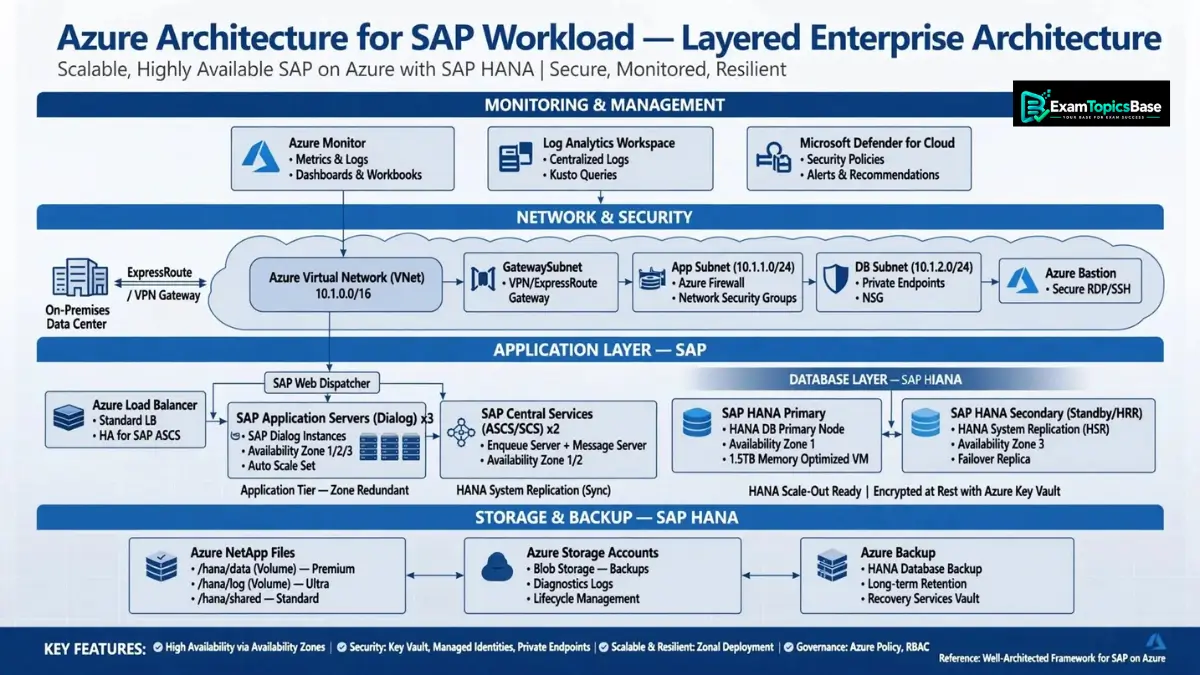
SAP high availability and disaster recovery are the practices used to keep critical SAP systems running and recover them when infrastructure or application failures occur. HADR represents 20-25% of the current AZ-120 exam.
For example, a high-availability design might distribute critical components across appropriate Azure infrastructure, while a disaster-recovery strategy addresses how the SAP environment can be restored or recovered after a major outage.
Your HADR preparation should cover:
High-availability architecture
Azure availability concepts
SAP database resilience
Backup strategies
Recovery objectives
Disaster recovery planning
Data protection
Failure scenarios
Recovery testing
Operational monitoring
Moreover, you should understand the difference between high availability and disaster recovery. High availability focuses on reducing service interruption during failures, while disaster recovery focuses on restoring operations after a significant disruption.
What Are Common AZ-120 HADR Practice Scenarios?
A strong HADR exercise should require you to choose an architecture based on a business requirement rather than memorize a definition.
For example, imagine a production SAP HANA workload where the business requires minimal interruption and a separate recovery strategy for a regional failure. You should be able to identify the Azure and SAP components that support those requirements and explain why they fit.
How Do You Practice SAP Workload Maintenance for AZ-120?
SAP workload maintenance involves monitoring, optimizing, protecting, and operating SAP systems after deployment. The current maintenance domain represents 20-25% of AZ-120.
For example, you might investigate an SAP workload experiencing unexpected performance degradation and determine whether compute, storage, networking, database, or configuration factors require attention.
A useful maintenance checklist includes:
Maintenance area | What to practice |
Monitoring | Review workload health, metrics, and alerts |
Performance | Identify compute, storage, and database bottlenecks |
Backup | Verify backup configuration and recovery procedures |
Security | Review identities, access, and infrastructure controls |
Cost | Identify opportunities to optimize resources |
Operations | Monitor system health and respond to issues |
Microsoft's AZ-120 course specifically includes monitoring, backup, networking, storage, VM scaling, identity, and operational scenarios.
How Can Microsoft Learn Help With AZ-120 Preparation?
Microsoft Learn is the primary official learning platform for AZ-120 preparation because the exam study guide links directly to Microsoft learning resources, documentation, training, and related SAP material.
First, start with the official study guide because it identifies the current skills measured and links to additional preparation resources. The guide also states that Microsoft recommends hands-on experience before taking the exam.
Second, use Microsoft's AZ-120 course and related learning paths for structured study. The official course includes learning around SAP workloads, IaaS foundations, identity and governance, deployment, business continuity, disaster recovery, and migration.
How Do AZ-120 Practice Tests and Practice Questions Improve Readiness?
AZ-120 practice tests and practice questions help identify knowledge gaps, improve familiarity with scenario-based questions, and measure readiness before the actual exam. Microsoft also provides exam preparation resources and an exam sandbox.
However, practice questions should supplement official study material rather than replace it. For example, if a practice test shows weak performance in HADR, return to the official HADR objectives and build a hands-on recovery scenario instead of simply memorizing more questions.
You can use third-party resources such as for additional practice, while keeping Microsoft Learn and hands-on experience as the foundation.
Similarly, an can be useful for readiness checks when its questions are treated as supplementary material rather than guaranteed representations of the live exam.
Practice tests measure readiness; they do not replace technical understanding.
How Much Hands-On SAP on Azure Practice Do You Need?
Hands-on practice should cover the major tasks represented by the AZ-120 objectives rather than focus on simple Azure portal navigation. Microsoft explicitly recommends training and hands-on experience before taking the exam.
For example, practice designing an SAP environment that includes compute, storage, networking, monitoring, backup, and high availability. Then explain why each component belongs in the architecture.
Microsoft's official training includes hands-on labs and scenarios involving Azure virtual machines, virtual networks, storage, backup, hybrid connectivity, identity, and monitoring.
What Azure Tools Should AZ-120 Candidates Know?
AZ-120 candidates should understand the Azure portal, Azure Marketplace, Azure Resource Manager, and Bicep, while also becoming comfortable with administration tools such as PowerShell and Azure CLI.
Tool or service | AZ-120 preparation use |
Azure portal | Configure and inspect Azure resources |
Azure Marketplace | Explore supported SAP solutions and images |
Azure Resource Manager | Understand resource deployment and management |
Bicep | Define Azure infrastructure as code |
Azure Virtual Machines | Host SAP application and database workloads |
Azure Monitor | Observe workload health and performance |
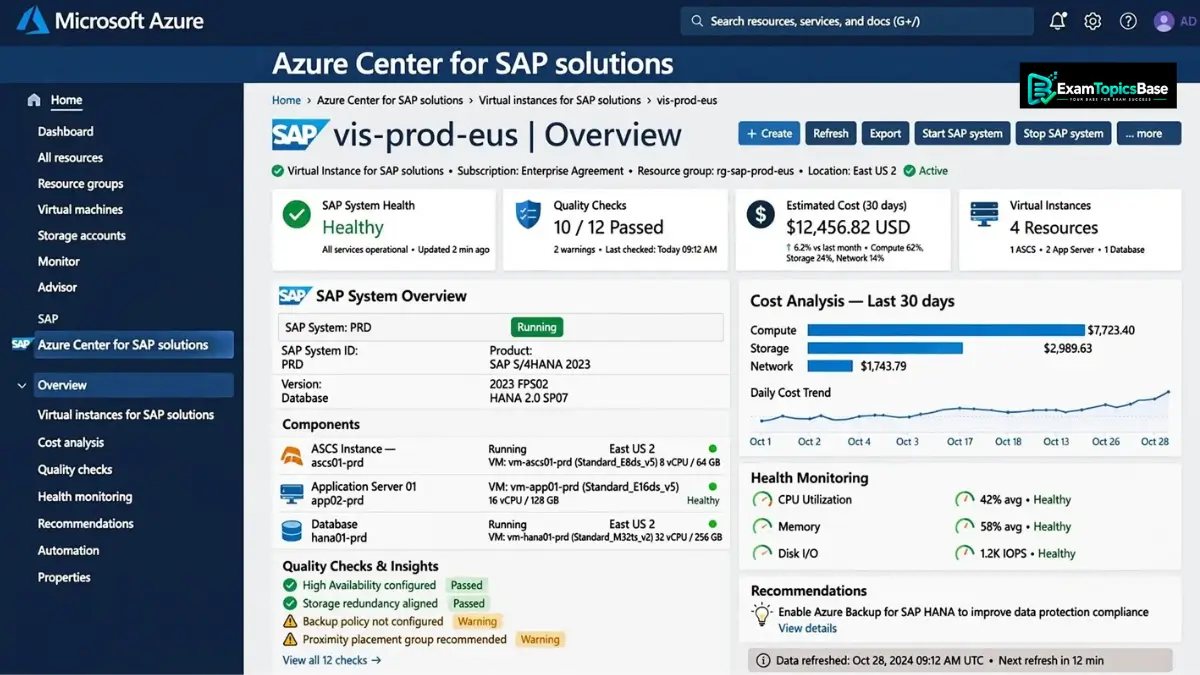
Azure Center for SAP solutions | Manage SAP workloads as unified Azure resources |
SAP Deployment Automation Framework | Automate SAP infrastructure deployment |
For example, Azure Center for SAP solutions provides SAP-aware management capabilities and can help create or register SAP systems while exposing system health and quality insights.
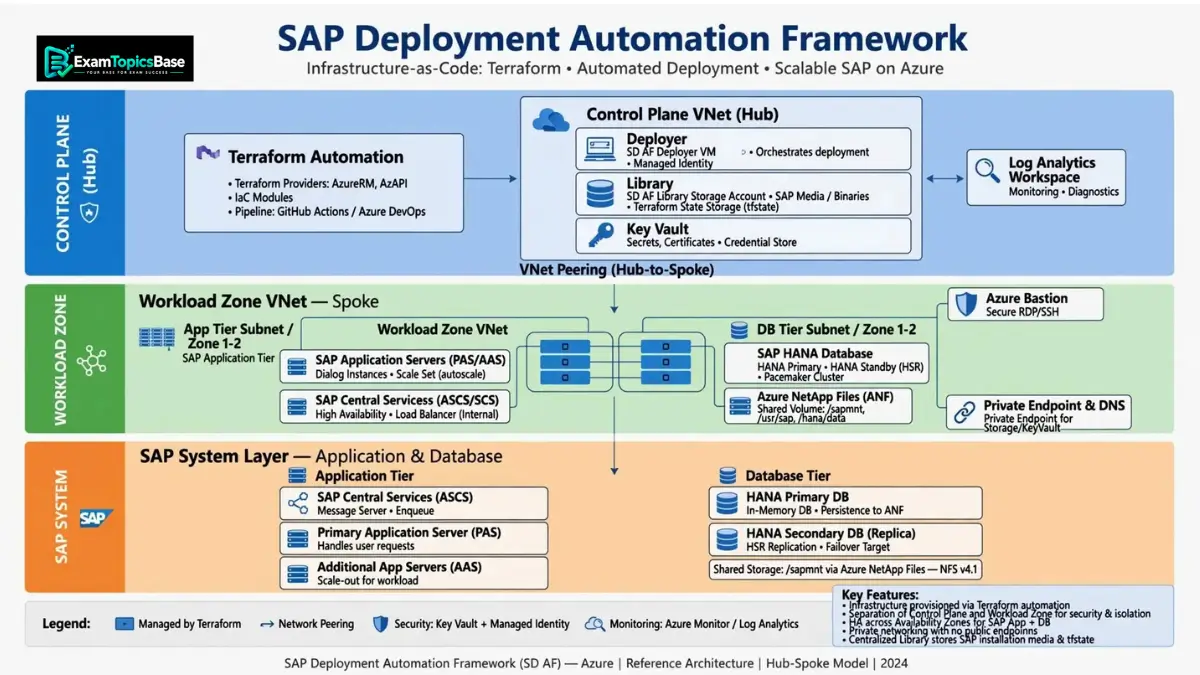
How Can SAP Deployment Automation Framework Help With Practice?
SAP Deployment Automation Framework is an open-source orchestration tool that can deploy, install, and maintain SAP environments on Azure using infrastructure automation technologies such as Terraform and Ansible.
For example, a practice environment can separate a control plane from the SAP workload zone and automate infrastructure deployment instead of creating every component manually.
Microsoft's current documentation describes deployment stages that include preparing the region, preparing the workload zone, and deploying the SAP system.
How Can You Identify Weak Areas During AZ-120 Preparation?
Weak areas become easier to identify when you compare practice results against the official AZ-120 domains and then verify the underlying technical skill through hands-on work. The current Microsoft study guide provides the authoritative domain structure for this comparison.
For example, if you repeatedly miss questions about storage performance, do not only review storage definitions. Build or analyze an SAP storage architecture and determine how the design affects the workload.
Use this simple review cycle:
Take a practice assessment.
Record the weakest domain.
Identify the underlying concept.
Read the relevant Microsoft documentation.
Perform a practical exercise.
Retest the concept.
Repeat until the weakness becomes consistent knowledge.
The best AZ-120 study plan turns every practice mistake into a practical learning task.
What Is the Best AZ-120 Career Path After Certification?
The AZ-120 career path can connect SAP experience with roles involving cloud architecture, SAP migration, Azure infrastructure, and SAP workload operations. The certification is especially relevant to professionals already working with SAP or enterprise cloud environments.
For example, an SAP Basis professional could use Azure skills to move toward SAP on Azure infrastructure roles, while an Azure administrator with SAP knowledge could move toward specialized SAP cloud administration.
Potential career directions include:
SAP on Azure architect
SAP cloud infrastructure engineer
SAP Basis and Azure specialist
SAP migration consultant
Azure solution architect
Enterprise cloud infrastructure engineer
SAP workload administrator
Cloud transformation specialist
Furthermore, AZ-120 can complement other certifications depending on your career direction.
Certification should be viewed as evidence of validated knowledge, not as a guarantee of employment or promotion.
What Should You Do Before Scheduling the AZ-120 Exam?
Before scheduling the AZ-120 exam, you should be able to explain the four domains and demonstrate practical understanding of SAP migration, Azure infrastructure, HADR, and workload maintenance.
Use this final readiness checklist:
Readiness check | Ready when you can... |
SAP fundamentals | Explain HANA, NetWeaver, and SAP workload architecture |
Migration | Build a logical SAP-to-Azure migration plan |
Infrastructure | Design compute, storage, and networking |
HADR | Explain HA and disaster recovery scenarios |
Maintenance | Monitor and optimize SAP workloads |
Azure tools | Work with core Azure management tools |
Practice | Explain why an answer is correct |
Hands-on | Complete representative administration tasks |
Study guide | Cover the current official objectives |
Exam readiness | Consistently perform well across all domains |
Moreover, Microsoft states that a score of 700 or greater is required to pass the exam.The certification page currently lists the exam price as $99 USD, although Microsoft notes that pricing depends on the country or region where the exam is proctored.
The certification currently has a 12-month renewal frequency, making ongoing learning important after certification.
Conclusion
AZ-120 is a specialized Microsoft certification exam for professionals who plan, migrate, design, operate, and maintain SAP workloads on Azure. The current exam focuses on four areas: migration, infrastructure, HADR, and maintenance, with migration and infrastructure carrying the largest individual weightings.
Ultimately, the strongest AZ-120 preparation combines SAP expertise, Azure administration, architecture knowledge, hands-on practice, official Microsoft resources, and scenario-based testing. If you build those skills systematically, you can approach the exam with a clearer understanding of both the technology and the business problems it is designed to solve.
For your final study resource, use the current alongside Microsoft's official study guide, SAP documentation, hands-on labs, and practice assessments. ExamTopicsBase can provide additional practice as part of your preparation, while official Microsoft and SAP documentation should remain the primary sources for current technical guidance.
Frequently Asked Questions
1. What is the AZ-120 exam?
AZ-120 is the Microsoft exam for Planning and Administering Azure for SAP Workloads. It focuses on designing, migrating, managing, and maintaining SAP solutions on Microsoft Azure.
2. Who should take the AZ-120 exam?
The exam is designed mainly for architects and engineers who work with SAP landscapes on Azure. Candidates should understand SAP technologies as well as Azure infrastructure and cloud services.
3. What topics are covered in the AZ-120 exam?
The exam covers four major areas: migrating SAP workloads to Azure, designing Azure infrastructure for SAP, implementing high availability and disaster recovery, and maintaining SAP workloads.
4. Do I need SAP experience before taking AZ-120?
Yes. Microsoft expects candidates to have extensive knowledge of SAP applications and databases such as SAP HANA, SAP Business Suite, and SAP NetWeaver, along with experience in virtualization, storage, networking, backup, and disaster recovery.
5. Is AZ-120 difficult for beginners?
AZ-120 is an intermediate-level specialty certification and is not primarily designed for beginners. A strong understanding of both Azure and SAP workloads can make preparation more manageable.
6. Should I take AZ-104 before AZ-120?
Microsoft strongly recommends having the Azure Administrator Associate certification before attempting AZ-120. This can help provide the Azure administration foundation needed for the exam.
7. How can I prepare for the AZ-120 exam?
Start with the official Microsoft Learn study guide, review every exam objective, study SAP on Azure documentation, and gain practical experience with Azure infrastructure and SAP workloads. Microsoft recommends training and hands-on experience before taking the exam.
8. What is the passing score for AZ-120?
The current Microsoft study guide states that candidates need a score of 700 or higher to pass the AZ-120 exam.
9. How long do you take to complete the AZ-120 exam?
Microsoft currently gives candidates 100 minutes to complete the AZ-120 assessment.
10. What certification do you earn after passing AZ-120?
AZ-120 is associated with the Microsoft Certified: Azure for SAP Workloads Specialty certification. The certification focuses on planning, migrating, and operating SAP solutions on Azure and has a 12-month renewal frequency.
You may also like to read:
Microsoft Certification Career Roadmaps | A Comprehensive Guide to Choosing the Right Career Path
Is AZ-900 the Right Microsoft Certification for Your Career?
What Is the AZ-104 Exam and How Can You Prepare for It? | The Ultimate Guide
How Hard Is the AZ-400 Exam? | A Complete Preparation & Study Guide

Written by Julia Mercer
I’m Julia Mercer, a Microsoft Solutions Architect and technical contributor at ExamTopicsBase. Having navigated the evolving Microsoft certification roadmap throughout my career in enterprise IT, I focus on delivering accurate, scenario-tested practice questions and clear, blueprint-aligned explanations so you can walk into your test with total confidence.
Comments (0)
Leave a Reply
No comments yet. Be the first to share your thoughts!