AZ-104 exam preparation can feel challenging when you are unsure which Azure services to study, how much practical experience you need, or how to organize your time. If you already understand basic networking, operating systems, or servers, this guide gives you a structured path from the current AZ-104 exam topics to hands-on practice, practice assessments, revision, and final readiness.
What Is the AZ-104 Exam?
AZ-104 is Microsoft's Azure Administrator exam, designed to assess skills for implementing, managing, and monitoring Microsoft Azure environments. The exam is associated with the Microsoft Certified: Azure Administrator Associate certification, which Microsoft currently classifies as an intermediate-level administrator certification.
Moreover, an Azure administrator works with areas such as identity, governance, storage, compute, networking, security, monitoring, and resource management. For example, an administrator may create a virtual network, deploy a virtual machine, assign an RBAC role, configure storage, and monitor Azure resources.
At the same time, AZ-104 is not simply a test of Azure terminology. Microsoft describes the target candidate as someone who can implement, manage, and monitor an organization's Azure environment and who understands operating systems, networking, servers, and virtualization.
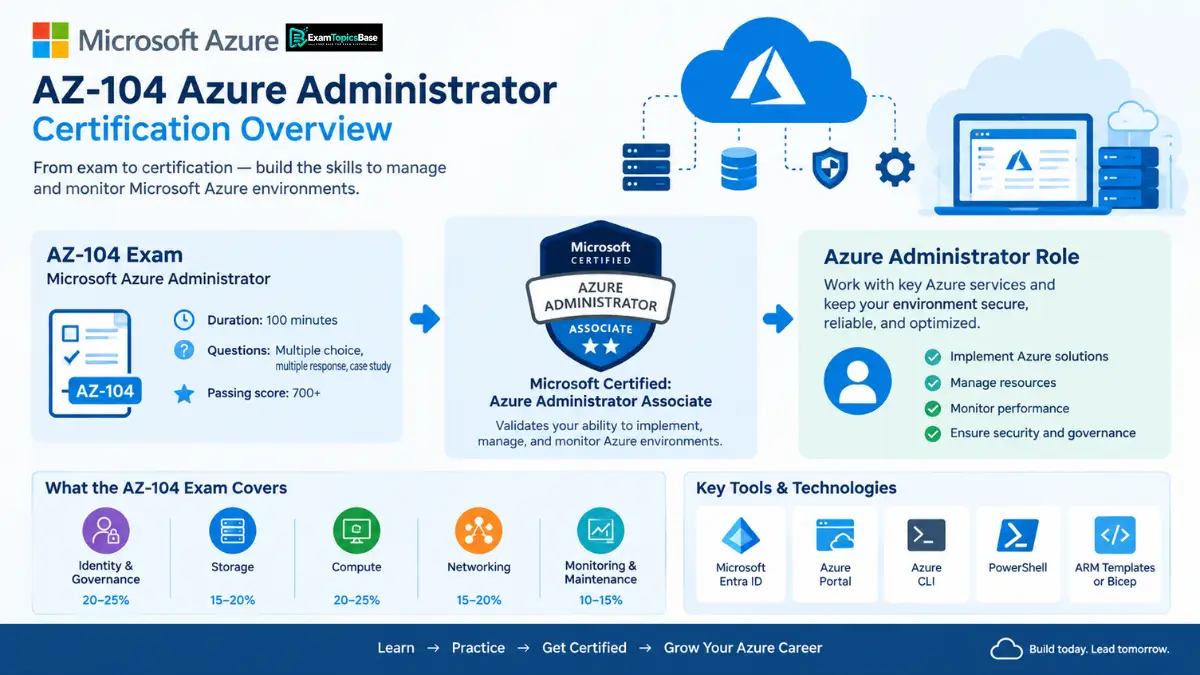
Furthermore, the certification page lists familiarity with PowerShell, Azure CLI, the Azure portal, ARM templates or Bicep, and Microsoft Entra ID as relevant experience for the role.
AZ-104 measures practical Azure administration skills across five major skill areas. Those areas provide the foundation for an effective AZ-104 study guide and should shape your preparation from the beginning.
Who Should Take the AZ-104 Azure Administrator Exam?
AZ-104 is designed for people who want to demonstrate Azure administration skills, particularly those working with cloud infrastructure and day-to-day Azure resources. Microsoft identifies the administrator role as one that helps implement, manage, and monitor cloud infrastructure.
For example, AZ-104 can be relevant to system administrators, IT support professionals moving into cloud administration, infrastructure professionals, and learners building practical Azure skills.
At the same time, beginners should distinguish between learning Azure fundamentals and preparing for an administrator-level exam. Microsoft provides prerequisite learning that covers cloud concepts, Azure architecture and services, and Azure management and governance.
Why Is AZ-104 Exam Preparation Important?
AZ-104 exam preparation is important because the exam covers several interconnected Azure administration skills that are easier to understand when you combine theory with practical work. Reading about a service is different from configuring that service yourself.
For example, learning that Azure RBAC controls access is useful, but creating a resource group, assigning a role, testing permissions, and removing the assignment gives you a clearer understanding of how access management works.
Similarly, learning about virtual networks becomes more useful when you actually create a VNet, configure subnets, apply an NSG, and test connectivity.
Effective AZ-104 preparation combines Microsoft Learn resources, hands-on Azure practice, practice assessments, and focused review of weak areas. This approach also helps you connect individual services instead of memorizing isolated definitions.
Moreover, Microsoft provides a structured administrator learning path that includes prerequisite learning and dedicated paths for identity and governance, storage, compute, virtual networking, and monitoring.
What Are the Current AZ-104 Exam Topics and Objectives in 2026?
The current AZ-104 exam objectives in 2026 cover five skill areas: identity and governance, storage, compute, virtual networking, and monitoring and maintenance. Microsoft lists the current skills measured as of April 17, 2026.
AZ-104 exam domain | Current weighting |
Manage Azure identities and governance | 20–25% |
Implement and manage storage | 15–20% |
Deploy and manage Azure compute resources | 20–25% |
Implement and manage virtual networking | 15–20% |
Monitor and maintain Azure resources | 10–15% |
What Should You Study for Azure Identity and Governance?
Azure identity and governance covers the management of identities, access, subscriptions, resource organization, and governance controls. Microsoft Learn's AZ-104 identity path includes Microsoft Entrance ID, RBAC, subscriptions, and governance concepts.
For example, your AZ-104 exam preparation should include understanding Microsoft Entra ID, role-based access control, Azure Policy, resource groups, subscriptions, and cost-management concepts.
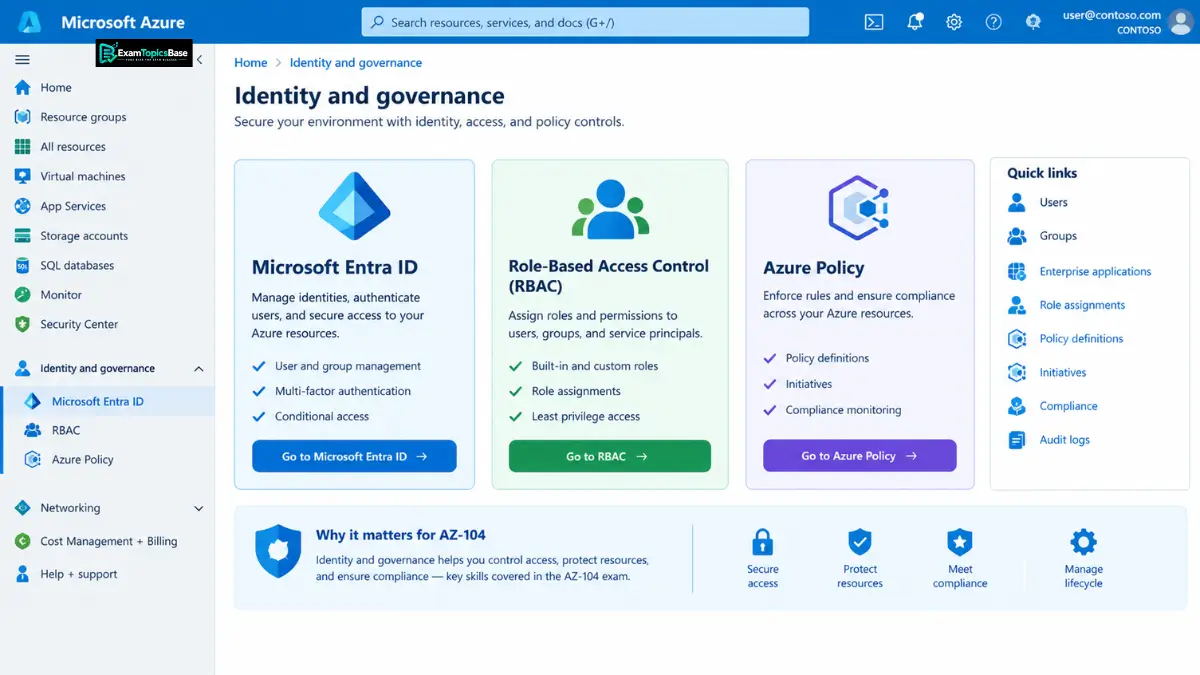
Furthermore, practice assigning an appropriate RBAC role to a user or group at the correct scope. This exercise helps connect identity concepts with the permissions an administrator manages in an actual Azure environment.
What Should You Study for Azure Storage?
Azure storage management covers storage accounts and services such as Blob Storage and Azure Files. Microsoft's official AZ-104 storage learning path covers storage accounts, data in Azure Storage, Azure File, and Blob storage.
For example, create a storage account, configure an appropriate replication option, upload a blob, and explore access and endpoint settings.
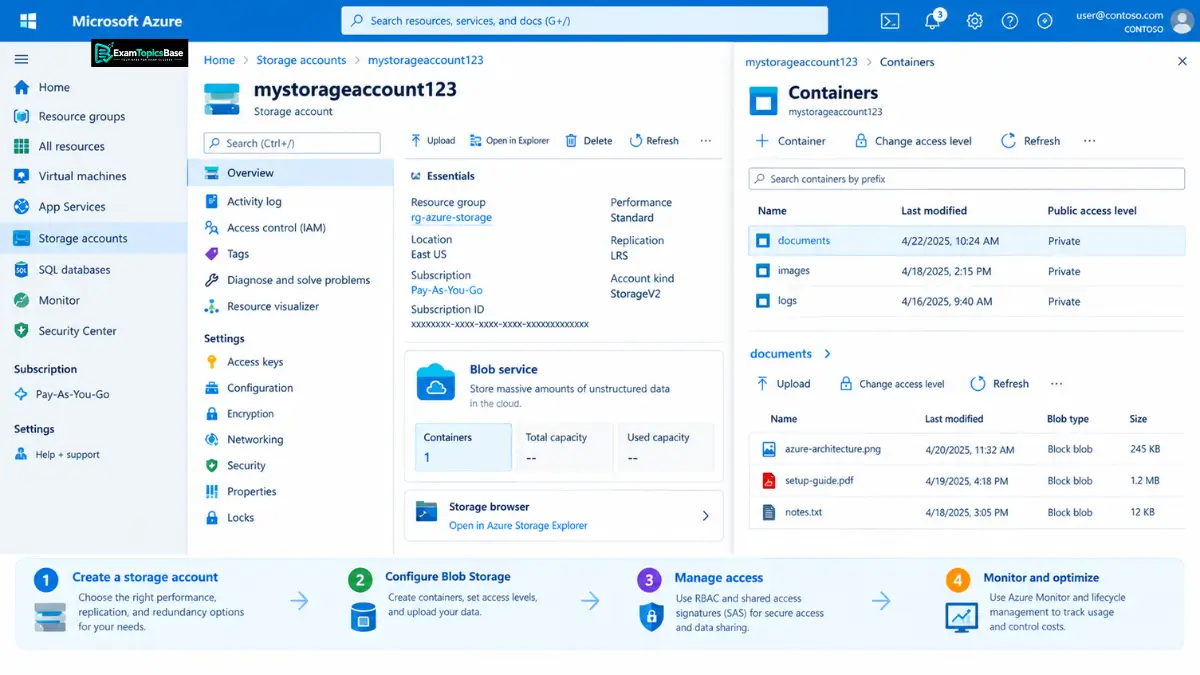
Additionally, understand how storage configuration affects access, availability, and administrative management. Hands-on configuration makes storage terminology easier to remember because you see the settings in context.
What Should You Study for Azure Computing?
Azure compute covers the deployment and management of resources such as virtual machines, containers, and web applications. Microsoft's compute learning path specifically includes Azure Virtual Machines, containers, and Web Apps.
For example, create an Azure VM, choose an appropriate configuration, connect to it, apply a management task, and explore backup and availability options.
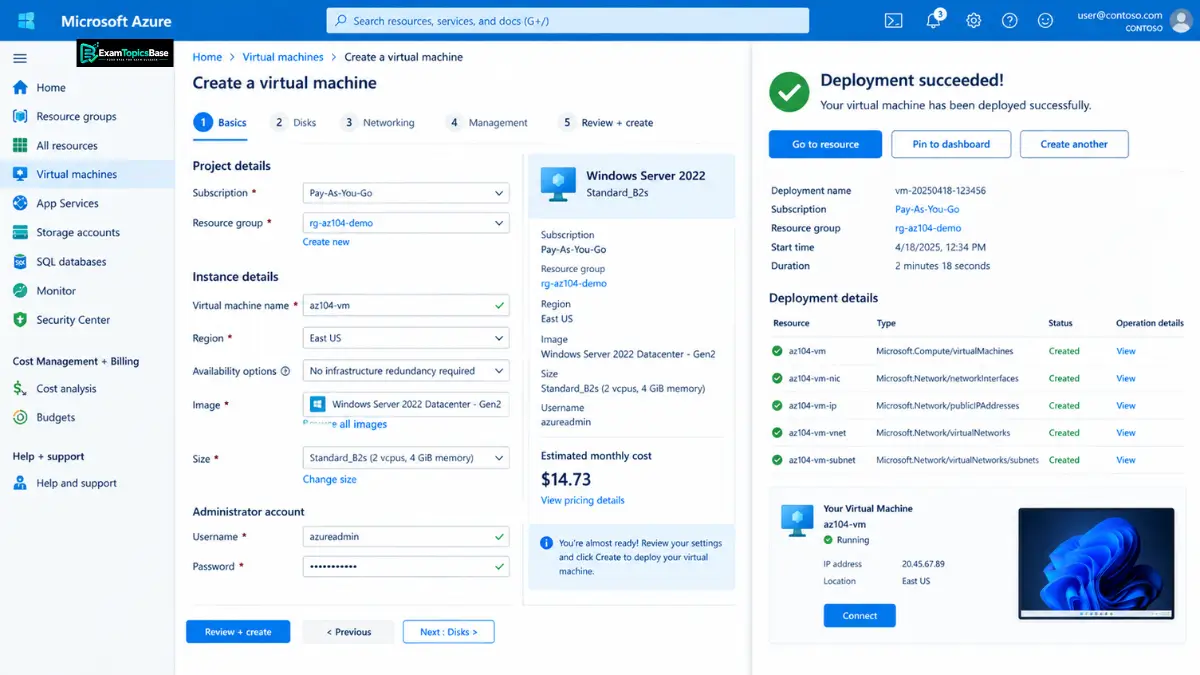
Furthermore, your AZ-104 study guide should connect compute concepts with administration tasks such as VM configuration, scaling, availability, and management.
What Should You Study for Azure Virtual Networking?
Azure virtual networking covers the configuration and management of network capabilities such as virtual networks, subnets, connectivity, application delivery, and network protection. Microsoft's AZ-104 networking path includes VNets, IP addressing, connectivity services, application protection, and monitoring.
For example, create a VNet with two subnets, configure an NSG, assign appropriate rules, and test communication between resources.
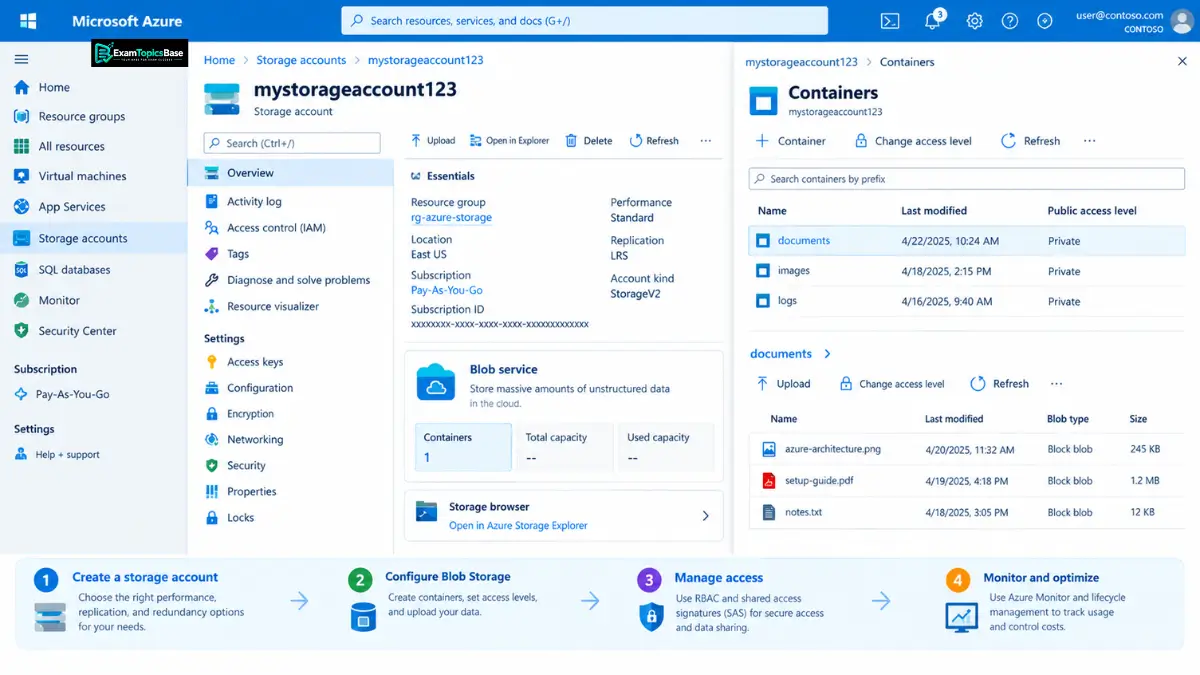
Moreover, understand the purpose of private endpoints, network security groups, DNS, VPN connectivity, load balancing, and other networking concepts included in the current learning material.
What Should You Study for Azure Monitoring and Maintenance?
Azure monitoring and maintenance covers the ongoing observation, protection, backup, and recovery of Azure resources. Microsoft's AZ-104 monitoring path includes Azure Monitor, Azure Backup, and Azure Site Recovery.
For example, configure a monitoring alert for an Azure resource and examine metrics or logs that could help an administrator investigate an issue.
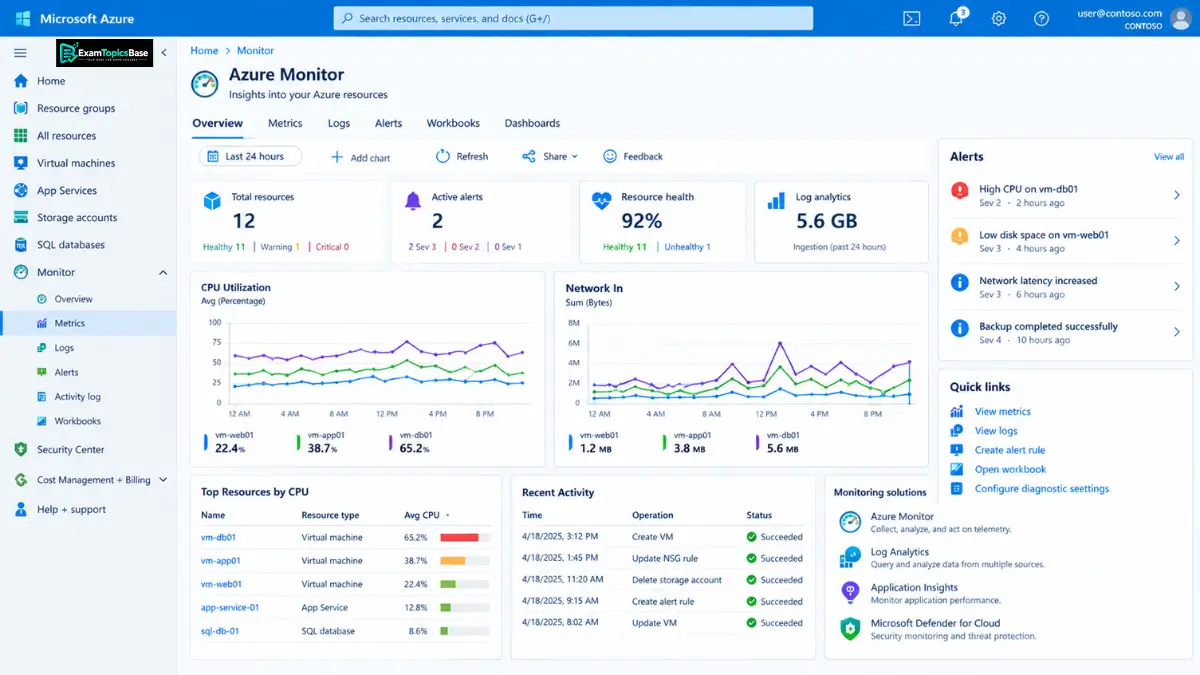
Additionally, practice backup and recovery concepts instead of memorizing their definitions alone. The goal is to understand how an administrator can monitor resources and respond when workloads require protection or recovery.
What Skills Are Required Before Taking AZ-104?
The skills required before AZ-104 include basic knowledge of operating systems, networking, servers, and virtualization, along with familiarity with common Azure administration tools. Microsoft specifically lists PowerShell, Azure CLI, the Azure portal, ARM templates or Bicep, and Microsoft Entra ID among relevant experience areas.
For example, a learner who already understands IP addresses, subnets, virtual machines, and basic server administration can usually connect those concepts to Azure more easily.
At the same time, you do not necessarily need to master every Azure service before beginning your preparation. Microsoft provides an AZ-104 prerequisite learning path that introduces foundational Azure concepts and includes Azure Cloud Shell and ARM template learning.
Microsoft recommends foundational Azure knowledge before moving into administrator-focused learning. That makes AZ-900-level knowledge useful preparation for learners who are completely new to Azure, although AZ-900 is not presented by Microsoft as a mandatory prerequisite for AZ-104.
Source: Study guide for Exam AZ-104: Microsoft Azure Administrator
How Should Beginners Prepare for the AZ-104 Exam?
Beginners should prepare for AZ-104 by following the exam objectives, learning each domain systematically, practicing Azure administration, testing their knowledge, and revisiting weak areas. A structured process prevents you from spending most of your study time on topics you already understand.
First, review the current Microsoft study guide. Second, learn the relevant Azure concepts. Third, complete practical exercises. Fourth, use practice assessments. Finally, review weak areas before scheduling or taking the exam.
What Is a Practical AZ-104 Preparation Process?
A practical AZ-104 preparation process can follow these seven steps:
Review the current objectives.
Assess your Azure fundamentals.
Study one AZ-104 domain at a time.
Complete hands-on Azure labs.
Use practice questions and assessments.
Track weak topics and revisit them.
Complete a final readiness review.
For example, after studying Azure storage, create a storage account and configure Blob Storage instead of moving immediately to another theoretical chapter.
Moreover, keep a simple study log containing the topic, practical task completed, mistakes made, and review date. This turns your AZ-104 preparation into a measurable process.
How Do You Create an Effective AZ-104 Study Plan?
An effective AZ-104 study plan divides time between theory, hands-on work, practice questions, and revision. The right schedule depends on your existing Azure knowledge and the amount of time you can study each week.
For example, a beginner with limited cloud experience may benefit from an eight-week plan, while someone already working with Azure could use a shorter schedule.
Week | Main focus | Practical work |
Week 1 | Azure fundamentals and prerequisites | Azure portal, Cloud Shell, basic resources |
Week 2 | Identity and governance | Entra ID, RBAC, Policy, resource groups |
Week 3 | Storage | Storage accounts, Blob Storage, Azure Files |
Week 4 | Compute | VMs, containers, App Service |
Week 5 | Networking | VNets, subnets, NSGs, connectivity |
Week 6 | Monitoring and maintenance | Azure Monitor, Backup, Site Recovery |
Week 7 | Practice and weak areas | Practice questions, labs, revision |
Week 8 | Final review | Practice assessment, labs, exam environment |
Source: Study structure based on Microsoft's current AZ-104 domains and learning paths.
Furthermore, you can compress this plan into four or six weeks if you already have relevant administration experience. The important principle is to preserve practical work and weak-area review rather than eliminating them entirely.
Get Free Microsoft Real Exam Questions & Answers of Here: https://examtopicsbase.com/vendors/microsoft
How Much Hands-On Practice Do You Need for AZ-104?
AZ-104 hands-on practice should be sufficient for you to perform common Azure administration tasks without relying entirely on step-by-step instructions. Microsoft describes relevant administrator experience in terms of implementing, managing, and monitoring Azure resources.
For example, practice the following tasks:
Create and manage resource groups.
Assign and remove RBAC roles.
Configure Microsoft Entra ID resources.
Apply Azure Policy.
Create and configure storage accounts.
Upload and manage Blob Storage data.
Deploy and manage Azure VMs.
Create VNets and subnets.
Configure NSGs.
Configure monitoring and alerts.
Explore Azure Backup and recovery.
Use Azure CLI and PowerShell for administrative tasks.
Moreover, repeat important tasks through different interfaces when practical. Microsoft Learn includes Azure portal exercises in its compute learning path, while the broader certification guidance identifies Azure CLI and PowerShell as relevant administration skills.
Hands-on Azure practice converts individual concepts into repeatable administration skills. If you can explain a service but cannot configure or troubleshoot a basic implementation, give that topic more practice time.
Which Azure Services Should You Practice for AZ-104?
The Azure services you should practice for AZ-104 should map directly to the five current exam domains. Microsoft Learn's official learning paths provide administrator-focused training across identity, storage, compute, networking, and monitoring.
Domain | Services and concepts to practice |
Identity and governance | Microsoft Entra ID, RBAC, Azure Policy, subscriptions, resource groups |
Storage | Storage accounts, Blob Storage, Azure Files, replication, access |
Compute | Azure VMs, containers, App Service, VM management |
Networking | VNets, subnets, NSGs, IP addressing, connectivity |
Monitoring | Azure Monitor, alerts, Azure Backup, Site Recovery |
For example, create a small Azure environment that includes a resource group, storage account, VM, VNet, subnet, NSG, and monitoring configuration.
At the same time, avoid creating expensive or unnecessary resources simply for practice. Delete resources after completing labs and monitor your Azure usage and costs.
How Can Microsoft Learn Help With AZ-104 Preparation?
Microsoft Learn provides official AZ-104 learning paths covering the major administrator skills required for the certification. The current administrator training collection includes prerequisite learning plus dedicated paths for identity and governance, storage, compute, networking, and monitoring.
For example, Microsoft's identity path currently covers Microsoft Entra ID, RBAC, subscriptions, and governance, while its storage path covers storage accounts, Blob Storage, and Azure Files.
Moreover, the compute path includes practical Azure VM exercises, and the networking path covers virtual networks, subnets, IP addressing, connectivity, and related network capabilities.
You can also use Microsoft's official AZ-104 study guide to check the latest objectives before studying and again shortly before your exam. Microsoft notes that certification exams are updated periodically to reflect the skills required for the role.
How Do AZ-104 Practice Tests Help You Prepare?
AZ-104 practice tests help you evaluate your understanding, recognize knowledge gaps, and become familiar with the style of questions used in certification preparation. Microsoft's official Practice Assessment is designed to help candidates assess readiness and determine where additional preparation is needed.
For example, if a practice assessment repeatedly exposes weaknesses in networking, you can return to VNets, subnets, NSGs, and connectivity before moving to final review.
Furthermore, practice questions should be used as a learning tool rather than as a substitute for understanding Azure administration. Unofficial question banks may vary in accuracy, so compare important concepts against current Microsoft documentation.
Practice assessments are most useful when they lead to targeted revision. Record the reason behind each mistake and then study the underlying Azure concept.
How Can You Identify Your Weak Areas Before AZ-104?
Your AZ-104 weak areas are the domains where you consistently struggle to explain concepts, complete practical tasks, or answer practice questions correctly. Identifying these areas early allows you to use your study time more efficiently.
For example, if you understand Azure storage terminology but struggle to configure replication or access settings, storage needs more practical review.
Readiness signal | What it means | Recommended action |
Can explain but not configure | Theory is stronger than practical skill | Complete a hands-on lab |
Frequent practice mistakes | Knowledge gap exists | Review the underlying concept |
Cannot explain why an option is used | Memorization may be incomplete | Study real-world use cases |
Can configure but cannot troubleshoot | Administration needs more depth | Practice failure scenarios |
Consistent understanding | Topic is becoming reliable | Move to another weak area |
Moreover, review all five domains rather than concentrating exclusively on the largest percentage areas. The official exam includes questions across identity and governance, storage, compute, networking, and monitoring and maintenance.
How Do You Know When You Are Ready for the AZ-104 Exam?
You are ready for AZ-104 when you can demonstrate understanding across the five domains, complete representative Azure administration tasks, and explain why you choose particular configurations. Readiness should be based on several signals rather than a single practice score.
For example, use this checklist during your final review:
I understand Microsoft Entra ID and Azure RBAC.
I can explain Azure Policy and resource organization.
I can configure storage accounts and common storage services.
I can deploy and manage an Azure VM.
I understand VNets, subnets, NSGs, and connectivity.
I can use Azure Monitor for basic monitoring tasks.
I understand Azure Backup and recovery concepts.
I have used Azure portal, Azure CLI, or PowerShell.
I have completed practical labs across all five domains.
I have reviewed mistakes from practice questions.
I have checked the current Microsoft objectives.
Furthermore, Microsoft's study guide states that a score of 700 or greater is required to pass the AZ-104 exam. Microsoft also provides an exam sandbox and a free Practice Assessment as preparation resources.
What Tools and Resources Should You Use for AZ-104?
The most useful AZ-104 learning resources include Microsoft Learn, the Azure portal, Azure CLI, PowerShell, ARM templates or Bicep, official documentation, the Practice Assessment, and the exam sandbox. Microsoft explicitly identifies several of these tools as relevant to the Azure administrator role.
For example, use the Azure portal for visual configuration, Azure CLI and PowerShell for command-based administration, and Bicep or ARM templates to understand infrastructure deployment concepts.
Moreover, Microsoft Learn currently provides dedicated paths for all five major administrator skill areas.
Recommended AZ-104 Learning Resources
Microsoft Learn: Official learning paths and modules.
AZ-104 Study Guide: Current objectives and exam preparation information.
Practice Assessment: Knowledge and readiness check.
Exam Sandbox: Familiarization with the exam environment.
Azure Portal: Hands-on administration.
Azure CLI: Command-line administration.
PowerShell: Automation and administration practice.
ARM templates/Bicep: Infrastructure deployment practice.
Official Azure documentation: Detailed service references.
What Should You Do Before Taking the AZ-104 Exam?
Before taking AZ-104, review the current objectives, revisit weak areas, complete important labs, use the official Practice Assessment, and become familiar with the exam environment. Microsoft's study guide specifically recommends reviewing current objectives and provides access to a Practice Assessment and exam sandbox.
First, stop adding large amounts of new material during the final review period. Instead, focus on concepts you have already studied but cannot confidently explain or configure.
Second, perform a final hands-on session covering identity, storage, compute, networking, and monitoring. For example, build a small Azure environment and explain the purpose of each resource you create.
Third, confirm practical details such as your exam language, scheduling information, and testing requirements. Microsoft lists a 100-minute exam duration and a $165 USD price on its certification page, with pricing subject to the country or region where the exam is proctored.
What Is the Next Step After AZ-104 Preparation?
The next step after AZ-104 preparation is to connect your administrator skills with your broader Azure learning or career roadmap. The appropriate direction depends on the type of cloud work you want to pursue.
For example, you might continue developing Azure administration expertise, explore architecture, move toward DevOps, or build data-focused cloud knowledge.
At the same time, related certifications can support different learning directions. AZ-900 focuses on Azure fundamentals, while AZ-400 focuses on DevOps engineering and DP-900 focuses on foundational data concepts. These certifications represent different skill areas rather than a mandatory sequence.
Conclusion
AZ-104 exam preparation is most effective when you combine current objectives, structured learning, hands-on Azure administration, practice assessments, and focused revision. The 2026 objectives cover five areas: identity and governance, storage, compute, virtual networking, and monitoring and maintenance.
Moreover, you do not need to approach the exam as a memorization exercise. Build resources, configure permissions, deploy workloads, manage networks, monitor services, and learn from mistakes.
For learners using ExamTopicsBase, the next step is to review the AZ-104 exam resources, practice questions, and preparation materials alongside Microsoft's official learning resources.
Finally, check Microsoft's current AZ-104 study guide shortly before your exam because certification objectives can change over time. A preparation strategy built around the latest objectives and real Azure administration tasks gives you a clear framework for measuring your progress.
Frequently Asked Questions
1. What is the AZ-104 exam?
AZ-104 is Microsoft's Azure Administrator exam. It assesses skills related to implementing, managing, and monitoring Azure environments across identity, storage, compute, networking, and monitoring.
2. What certification does AZ-104 lead to?
AZ-104 is the exam associated with the Microsoft Certified: Azure Administrator Associate certification. Microsoft currently lists this certification at the intermediate level.
3. What are the AZ-104 exam topics in 2026?
The current AZ-104 exam topics include Azure identity and governance, storage, compute, virtual networking, and monitoring and maintenance. Microsoft lists the current skills measured as of April 17, 2026.
4. What score is required to pass AZ-104?
Microsoft states that candidates need a score of 700 or greater to pass the AZ-104 exam.
5. Is AZ-104 suitable for beginners?
AZ-104 can be studied by beginners who first build the required Azure fundamentals and administration knowledge. Microsoft provides a prerequisite learning path covering basic Azure concepts before the administrator-focused material.
6. Do I need hands-on Azure experience for AZ-104?
Hands-on Azure experience is strongly relevant because the Azure Administrator role involves implementing, managing, and monitoring Azure resources. Microsoft also identifies practical familiarity with tools such as Azure CLI, PowerShell, and the Azure portal.
7. What tools should I learn for AZ-104?
Important tools include the Azure portal, Azure CLI, PowerShell, ARM templates or Bicep, and Microsoft Entra ID. These tools are specifically identified in Microsoft's Azure Administrator certification guidance.
8. Does Microsoft provide an AZ-104 practice test?
Microsoft provides a free Practice Assessment for AZ-104. Microsoft says the assessment can help candidates understand question style and difficulty, evaluate readiness, and identify areas requiring additional preparation.
9. How long does the AZ-104 exam take?
Microsoft currently lists the AZ-104 exam duration as 100 minutes. Exam details and availability can change, so candidates should verify the current information before scheduling.
10. Where should I start my AZ-104 preparation?
Start by reviewing Microsoft's current AZ-104 study guide and prerequisite learning, then study the five domains through Microsoft Learn and reinforce each topic with hands-on Azure practice.
You may also like to read:
How Hard Is the AZ-400 Exam? | A Complete Preparation & Study Guide
Is AZ-900 the Right Microsoft Certification for Your Career?
What Is the AZ-120 Exam and How Can You Prepare for It? The Ultimate Guide
Microsoft Certification Career Roadmaps | A Comprehensive Guide to Choosing the Right Career Path

Written by Julia Mercer
I’m Julia Mercer, a Microsoft Solutions Architect and technical contributor at ExamTopicsBase. Having navigated the evolving Microsoft certification roadmap throughout my career in enterprise IT, I focus on delivering accurate, scenario-tested practice questions and clear, blueprint-aligned explanations so you can walk into your test with total confidence.
Comments (0)
Leave a Reply
No comments yet. Be the first to share your thoughts!