
If you already understand accounting, financial operations, or Dynamics 365, many MB-310 concepts may feel familiar. However, passing the exam requires more than knowing finance terminology because you also need to understand how those processes are implemented and configured in Dynamics 365 Finance. In this guide, you will learn the current MB-310 exam topics, what to study in each domain, and how to build a practical preparation plan.
What Is the Microsoft MB-310 Exam?
Microsoft MB-310 is the exam that assesses skills for the Dynamics 365 Finance Functional Consultant role. The exam focuses on implementing financial management, accounts receivable, credit and collections, subscription billing, accounts payable, expenses, budgeting, and fixed assets in Dynamics 365 Finance.
First, the MB-310 exam is associated with the Microsoft Certified: Dynamics 365 Finance Functional Consultant Associate certification. Microsoft currently classifies this certification as an intermediate-level Dynamics 365 credential for the Functional Consultant role.
For example, a functional consultant might receive a requirement that a company needs separate financial reporting for departments and regions. The consultant could translate that requirement into financial dimensions, account structures, and appropriate Dynamics 365 Finance configuration.
Moreover, Microsoft describes the target candidate as someone who analyzes business requirements and translates them into business processes and solutions using industry-recommended practices. Candidates are expected to have foundational knowledge of accounting principles and financial operations.
For example, a candidate may need to understand how a customer invoice moves through accounts receivable, how a payment is recorded, and how the resulting financial information appears in reporting.
Additionally, the certification covers a broader set of Dynamics 365 Finance capabilities, including general ledger, cash and bank management, tax, accounts receivable, credit and collections, subscription billing, accounts payable, expense management, budgeting, fixed assets and asset leasing, cost accounting, consolidation and elimination, and agents.
Statistic: The current MB-310 certification has a 12-month renewal frequency.
Why Is the MB-310 Certification Important?
The MB-310 certification is important because it validates knowledge related to analyzing financial requirements and translating them into Dynamics 365 Finance processes and solutions. Microsoft positions the credential around business reporting, finance and accounting, and the Functional Consultant role.
First, the certification connects financial knowledge with business application implementation. That distinction matters because a consultant must understand both what the business needs and how the application can support that requirement.
For example, an accounting professional may understand how a company's general ledger works, while a Dynamics 365 Finance functional consultant also needs to understand how the ledger, account structures, dimensions, currencies, journals, and posting processes can be configured.
Furthermore, the certification is relevant to professionals working with Dynamics 365 Finance implementation and support. Microsoft describes functional consultants as professionals who understand business requirements and map them to product capabilities, including configuration, testing, data migration, and support.
For example, during an implementation, a consultant could work with finance stakeholders to document requirements, configure a process, test transactions, identify gaps, and help users adopt the solution.
At the same time, certification should be viewed as evidence of structured knowledge rather than a guarantee of employment or career advancement. Practical project experience remains important because real implementations involve requirements, configuration decisions, testing, integrations, data, and ongoing support.
What Are the Current MB-310 Exam Topics?
The current MB-310 exam measures five skill areas: financial management; accounts receivable, credit, collections, and subscription billing; accounts payable and expenses; budgeting; and fixed assets.
The current domain distribution is:
MB-310 exam domain | Current weighting |
Implement financial management | 35–40% |
Implement accounts receivable, credit, collections, and subscription billing | 15–20% |
Implement and manage accounts payable and expenses | 10–15% |
Manage budgeting | 10–15% |
Manage fixed assets | 10–15% |
First, financial management is the largest domain, so it deserves the greatest proportion of study time.
For example, if you have six hours available for a study session, you could devote a substantial portion to general ledger, chart of accounts, financial dimensions, currencies, journals, cash and bank management, periodic processes, and taxes.
Second, accounts receivable, credit, collections, and subscription billing form the second-largest domain. This area requires you to understand customer financial processes and related configuration.
Third, accounts payable and expenses, budgeting, and fixed assets each represent 10–15% of the exam. These domains are smaller than financial management but should still receive dedicated preparation time.
Statistic: The current MB-310 exam requires a score of 700 or greater to pass.
What Should You Study for MB-310 Financial Management?
MB-310 financial management covers the configuration and implementation of core financial capabilities in Dynamics 365 Finance. This is the largest current exam domain at 35–40%.
How Does MB-310 Cover the Chart of Accounts and Financial Dimensions?
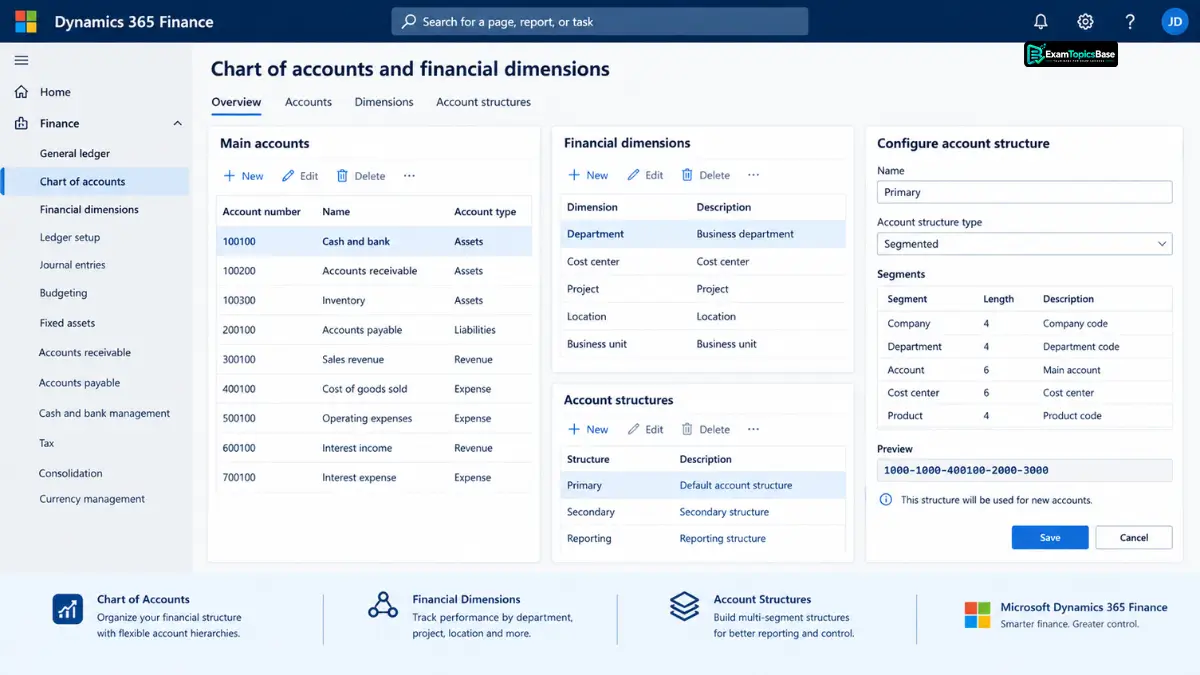
The chart of accounts defines the organization's financial account structure, while financial dimensions provide additional classifications for financial analysis and reporting. Microsoft includes designing and configuring both within the financial management domain.
For example, a company might use main account 6100 for travel expenses while using Department and Region dimensions to determine which business unit and geographic area generated the expense.
Moreover, study main accounts, account structures, advanced rules, financial dimension defaults, derived dimensions, financial tags, balance control accounts, and legal entity overrides. These concepts help you understand how Dynamics 365 Finance controls and organizes financial transactions.
What Should You Know About General Ledger, Journals, and Currencies?
General ledger functionality records and organizes financial transactions, while journals provide controlled mechanisms for entering and posting different transaction types. Microsoft also includes ledger and currency configuration within the current financial management objectives.
For example, a multinational organization may maintain an accounting currency while also reporting financial results in another currency. Your preparation should therefore cover exchange rate types, exchange rates, currency revaluation, accounting currencies, reporting currencies, and fiscal calendars.
Additionally, study journal processing, ledger calendars, fiscal calendars, posting profiles, periodic processes, and financial reporting concepts. Understanding how these pieces interact is more useful than memorizing isolated menu locations.
How Does MB-310 Cover Cash, Bank Management, and Taxes?
Cash and bank management covers processes for managing organizational bank accounts and related financial transactions, while tax functionality supports tax configuration, collection, and reporting. Both areas appear in Microsoft's current MB-310 skills outline.
For example, a company may reconcile bank transactions against transactions recorded in Dynamics 365 Finance and then use tax configuration to calculate and report applicable taxes.
Furthermore, review bank accounts, payment processes, reconciliation, tax configuration, tax reporting, and periodic financial operations as connected workflows rather than separate definitions.
Statistic: Microsoft identifies three major changes in the financial management objective groups compared with the previous skills outline, including major changes to ledgers and currencies, journals, and periodic processes.
How Should You Study MB-310 Accounts Receivable and Credit Management?
Accounts receivable, credit, collections, and subscription billing account for 15–20% of the current MB-310 exam and focus on implementing customer-side financial processes.First, study the relationship between customers, invoices, payments, credit management, collections, and financial posting. You should understand the business purpose of each process and how configuration affects the resulting workflow.
For example, if a customer exceeds an approved credit limit, a configured credit-management process can help identify the issue before additional transactions are processed.
Moreover, practice concepts involving customer payments, payment terms, collections, credit limits, collection activities, and related customer financial information. Connect each concept to a realistic business scenario.
What Does MB-310 Cover About Subscription Billing?
Subscription billing covers recurring or contract-based billing scenarios that require controlled schedules and financial processing. Microsoft includes subscription billing within the current accounts receivable, credit, collections, and subscription billing domain.
For example, a company providing a monthly service may need to generate recurring charges according to an agreed billing schedule instead of manually creating every invoice.
Additionally, focus on how subscription-related processes connect with customer accounts, billing schedules, invoices, revenue-related processes, and financial posting.
How Should You Prepare for MB-310 Accounts Payable and Expense Management?
Accounts payable and expense management cover vendor-side financial processing and employee expense workflows and represent 10–15% of the current MB-310 exam.
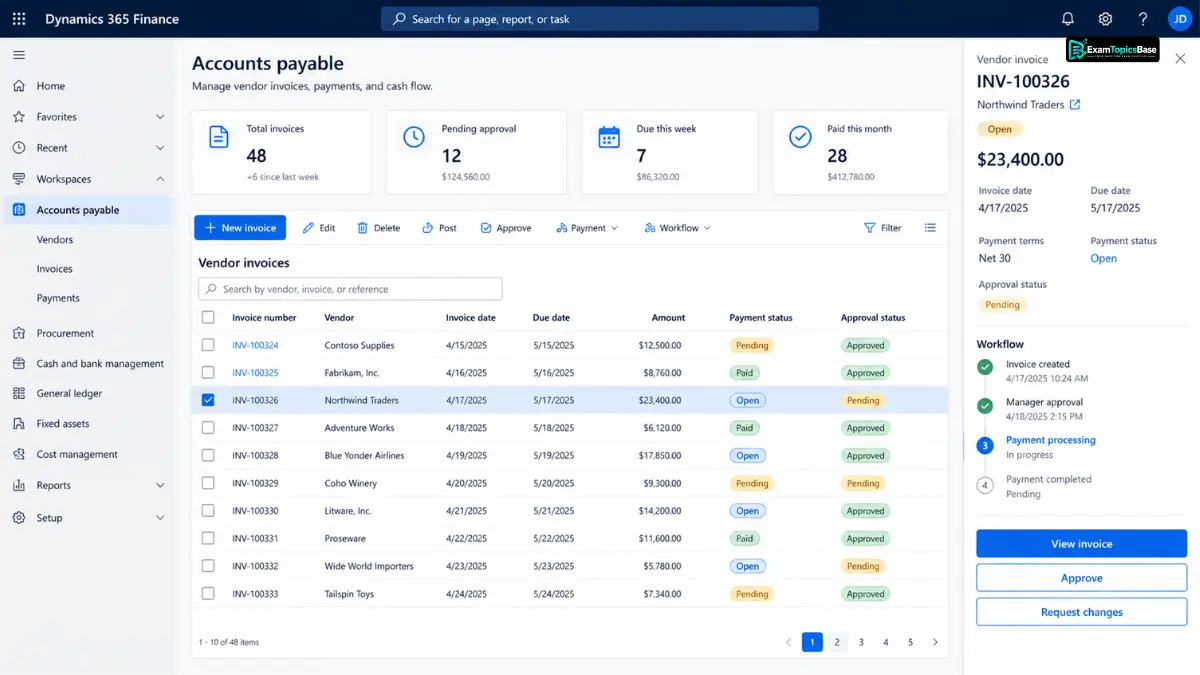
First, study vendor invoices, payment processing, invoice workflows, expense reports, policies, and financial posting. These processes help organizations control outgoing payments and employee-related expenses.
For example, an employee could submit a travel expense report that requires review and approval before the transaction is posted and reimbursed.
Furthermore, understand how vendor transactions move through Dynamics 365 Finance and how configuration can support approval and control requirements.
Moreover, compare accounts receivable and accounts payable during revision. Accounts receivable focuses primarily on money owed to the organization, while accounts payable focuses on money the organization owes to vendors.
Source: Study guide for Exam MB-310: Microsoft Dynamics 365 Finance Functional Consultant
What Should You Know About MB-310 Budgeting and Budget Controls?
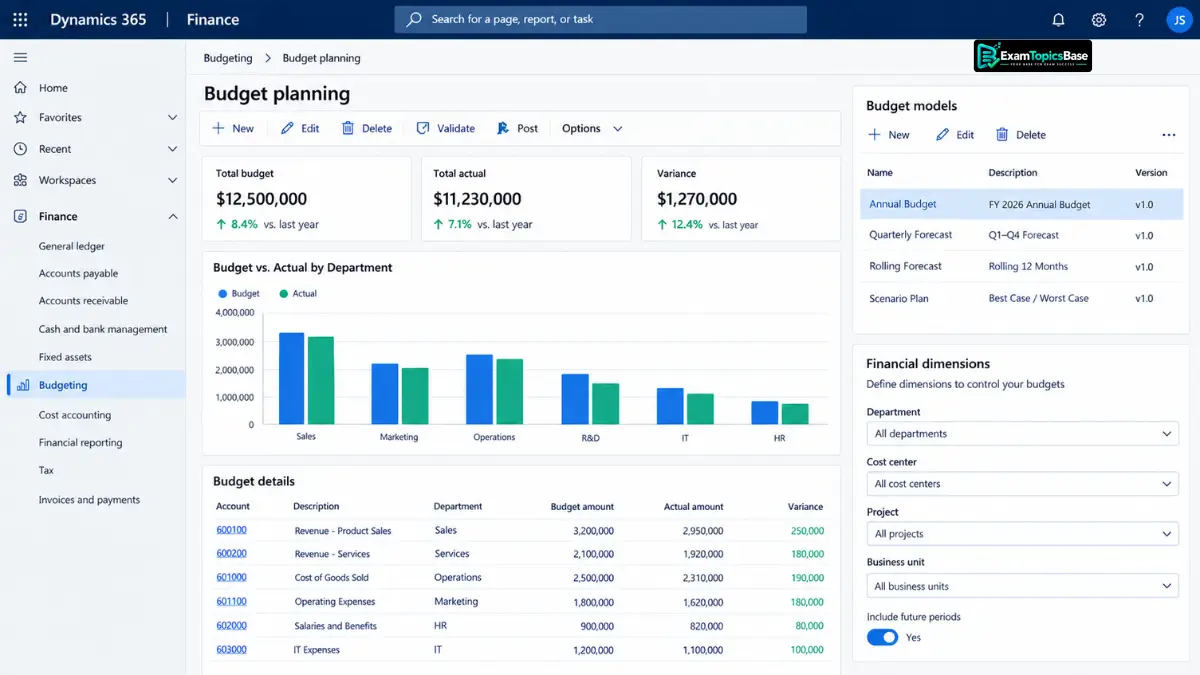
Budgeting in MB-310 covers the processes used to plan, control, monitor, and manage organizational financial budgets. Microsoft assigns budgeting 10–15% of the current exam.
First, study budget planning, budget controls, budget registers, budget models, and financial dimensions. Understand how organizations establish budgets and then compare financial activity against those planned amounts.
For example, a company could establish a yearly marketing budget by department and then monitor transactions against that approved amount.
Additionally, connect budgeting to the broader financial structure. Financial dimensions can help organizations analyze budget activity by department, cost center, project, or other business classifications.
How Does MB-310 Cover Fixed Assets and Depreciation?
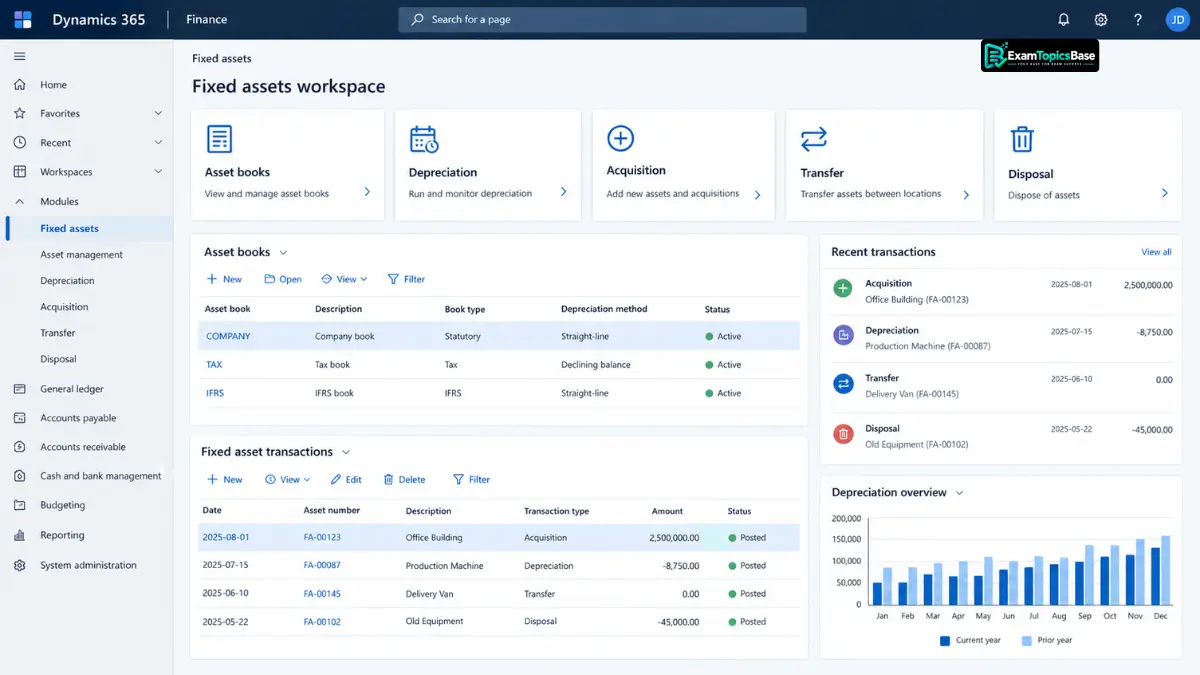
Fixed asset management covers the configuration and processing of assets throughout their financial lifecycle, including acquisition, depreciation, transfer, reclassification, and disposal. Microsoft assigns fixed assets 10–15% of the current MB-310 exam.
First, study fixed asset groups, posting profiles, books, depreciation profiles, asset attributes, and transaction processing. These concepts explain how Dynamics 365 Finance records and manages assets over time.
For example, a company purchasing new manufacturing equipment could create a fixed asset, record its acquisition, calculate depreciation, transfer it between business units, and eventually dispose of it.
Moreover, practice the complete asset lifecycle rather than memorizing individual transactions. Microsoft's current objectives include acquisitions, disposals, depreciation, splits, reclassification, transfers, and related fixed asset journal transactions.
What Microsoft Learn Resources Should You Use for MB-310?
Microsoft Learn provides the primary official study resources for MB-310, including the current study guide, learning content, documentation, community resources, and preparation tools.
First, start with the official MB-310 study guide because it identifies the current skills measured and provides links to additional learning resources. Microsoft explicitly states that the guide is intended to help candidates understand what to expect on the exam.
For example, you can use the study guide to create a checklist containing financial management, accounts receivable, accounts payable, budgeting, and fixed assets before moving into individual objectives.
Second, use Microsoft's Dynamics 365 Finance training. Microsoft offers the Manage Financial Operations with Dynamics 365 Finance course, which covers financial components, accounts payable, accounts receivable, collections, budgeting, fixed assets, and related functionality.
Statistic: Microsoft's MB-310 training course is listed as a four-day course and is associated with the Dynamics 365 Finance Functional Consultant Associate certification.
Third, use Dynamics 365 Finance documentation when you need deeper explanations of specific configuration and workflows. Microsoft also points candidates toward Microsoft Q&A and the Dynamics community for additional support.
How Do MB-310 Practice Questions Help With Exam Preparation?
MB-310 practice questions help you identify knowledge gaps and become familiar with the types of decisions required during exam preparation. Microsoft's official Practice Assessment is designed to help candidates test their skills before taking the exam.
First, use practice questions after learning a topic, rather than using questions as your only source of knowledge. A practice test should show you which concepts need additional study.
For example, if you repeatedly miss questions involving financial dimensions, return to account structures, derived dimensions, default dimensions, and related configuration before attempting another assessment.
Second, review the reasoning behind every missed question. Ask whether the problem came from misunderstanding a financial concept, confusing two Dynamics 365 features, overlooking a requirement, or failing to connect a configuration setting with its business effect.
How Should You Use MB-310 Exam Questions and Practice Tests?
MB-310 exam questions should be used as learning and diagnostic tools, not as substitutes for official study resources or hands-on experience. This distinction is particularly important when using third-party preparation websites because their content may not represent Microsoft's actual exam content.
For example, a practice question about fixed asset depreciation can be useful if it tests whether you understand the underlying configuration and process. A question that simply encourages memorization without explaining the business scenario provides less useful preparation.
Furthermore, combine practice tests with Microsoft Learn and practical configuration exercises. This creates a study cycle of learn → configure → test → review → repeat.
How Can You Build Hands-On MB-310 Experience?
Hands-on MB-310 preparation means practicing the financial workflows and configuration concepts that the exam measures instead of studying definitions alone. Microsoft recommends training and hands-on experience before taking the exam.
First, build a small practice sequence around the major domains:
Create or review a chart of accounts and financial dimensions.
Configure or explore ledger and currency settings.
Practice journal and financial transaction workflows.
Process customer and vendor financial transactions.
Explore credit and collections scenarios.
Build a simple budgeting scenario.
Create and manage a fixed asset lifecycle.
Review taxes, cash and bank management, and periodic processes.
For example, you could create a fictional company with several departments and regions, then design financial dimensions that allow management to analyze transactions by those classifications.
Second, connect each exercise to a business requirement. A functional consultant is not simply configuring screens; the role involves translating business requirements into processes and solutions.
Third, document what you learn. Keep short notes explaining what the feature does, why a business might use it, which configuration controls it, and what happens when a transaction is posted.
How Long Should You Study for the MB-310 Exam?
The ideal MB-310 study period depends on your existing accounting knowledge, Dynamics 365 Finance experience, and familiarity with functional consulting. A practical schedule should allocate more time to the largest exam domains while leaving room for hands-on work and revision.
First, consider a six-week preparation plan if you already have some Dynamics 365 Finance or finance experience. Beginners may need additional time to build accounting and application fundamentals.
Week | Primary focus | Practical activity |
Week 1 | Exam foundations and financial management | Review objectives, chart of accounts, dimensions, ledgers, and currencies |
Week 2 | General ledger and financial processes | Practice journals, cash and bank concepts, taxes, and periodic processes |
Week 3 | Accounts receivable and credit | Practice customer invoices, payments, credit, collections, and subscription billing |
Week 4 | Accounts payable, expenses, and budgeting | Review vendor processes, expense workflows, budgets, and controls |
Week 5 | Fixed assets and integrated scenarios | Practice acquisitions, depreciation, transfers, reclassification, and disposal |
Week 6 | Practice and final revision | Complete assessments, review weak areas, and repeat practical exercises |
Moreover, adjust the schedule according to your background. Someone who works with accounts payable every day may need less time on vendor processes and more time on financial dimensions, budgeting, or fixed assets.
Statistic: Microsoft currently lists the MB-310 assessment at 100 minutes.
How Can You Create an MB-310 Study Plan?
A strong MB-310 study plan prioritizes the official domain weightings while combining conceptual learning, hands-on exercises, and practice assessment. The plan should also include time for reviewing mistakes rather than simply increasing the number of practice questions.
First, divide your study time according to the exam structure:
Study priority | MB-310 domain | Suggested preparation approach |
Highest | Financial management | Study concepts, configuration, journals, currencies, taxes, and financial processes |
High | AR, credit, collections, subscription billing | Practice customer and billing workflows |
Medium | AP and expenses | Study vendor processes and expense management |
Medium | Budgeting | Practice budget planning and controls |
Medium | Fixed assets | Practice asset lifecycle and depreciation |
Second, use a repeatable study cycle. Read the objective, learn the concept, practice the workflow, answer questions, review mistakes, and then repeat the process for the next objective.
Third, revisit the official skills measured before scheduling your exam. Microsoft notes that exam skills can be updated periodically, so relying on an old MB-310 exam syllabus can leave gaps. The current study guide is dated to the August 14, 2026 skills update.
Get Free Microsoft Real Exam Questions & Answers of Here:https://examtopicsbase.com/vendors/microsoft
What Should You Know Before Scheduling the MB-310 Exam?
Before scheduling the MB-310 exam, you should be able to explain the major financial processes and apply the relevant Dynamics 365 Finance concepts to realistic business scenarios. A readiness decision should be based on demonstrated understanding rather than a single practice-test score.
First, use this readiness checklist:
I understand all five current MB-310 domains.
I can explain chart of accounts and financial dimensions.
I understand general ledger, journals, currencies, and fiscal calendars.
I understand cash and bank management and tax concepts.
I can explain accounts receivable and credit processes.
I understand collections and subscription billing concepts.
I can explain accounts payable and expense management.
I understand budgeting and budget controls.
I can explain fixed asset acquisition, depreciation, transfer, and disposal.
I have completed practical Dynamics 365 Finance exercises.
I have used the official Practice Assessment.
I have reviewed my weakest objectives.
Second, confirm the latest Microsoft information before booking. The current certification page lists the MB-310 assessment as a 100-minute exam, offered in English and Japanese, with the certification classified as intermediate and renewed every 12 months.
Statistic: The current MB-310 exam is offered in 2 listed languages: English and Japanese.
What Should You Do After Completing Your MB-310 Preparation?
After completing your MB-310 preparation, the next step is to validate your knowledge against Microsoft's current objectives and identify any remaining weak areas. The goal is to enter the exam with both conceptual understanding and practical confidence.
First, return to the official study guide and check each objective individually. Microsoft provides the current skills measured, study resources, Practice Assessment, and exam sandbox from the same preparation ecosystem.
For example, if you understand accounts receivable but struggle with financial dimensions, spend your final revision sessions on account structures, derived dimensions, default dimensions, financial tags, and related scenarios.
Second, complete another practical workflow from beginning to end. Configure the relevant feature, process a transaction, inspect the result, and explain why the system produced that outcome.
Third, use your final study sessions for targeted revision rather than broad rereading. Focus on the areas where your practice results and hands-on work show the largest gaps.
Tools and Practical Applications for MB-310 Preparation
The most useful MB-310 preparation tools are Microsoft Learn, Dynamics 365 Finance training, official documentation, the Practice Assessment, the exam sandbox, and hands-on Dynamics 365 Finance environments. Microsoft recommends combining training with practical experience before taking the exam.
First, use Microsoft Learn as the foundation for your study plan because it connects the exam objectives with learning resources and preparation information.
Second, use the Manage Financial Operations with Dynamics 365 Finance course to reinforce financial configuration and process knowledge. The course is aimed at business analysts, business users, and functional consultants and covers essential financial components, accounts payable, accounts receivable, collections, budgeting, and fixed assets.
Third, use the exam sandbox to understand the exam environment and available interaction styles before test day. Microsoft's certification page specifically provides access to an experience demo through the sandbox.
Fourth, use practical alternatives when a full Dynamics 365 environment is not immediately available. Microsoft Learn modules, official documentation, guided demonstrations, training content, and carefully documented business scenarios can still help reinforce concepts.
Fifth, treat third-party practice resources as supplementary material. They can help you practice concepts, but Microsoft's official study guide and learning resources should remain the foundation of your preparation.
Custom MB-310 Study Workflow
The most effective practical workflow connects an exam objective to a business requirement, configuration task, transaction, and review step.
For example, a financial-dimensions objective can become a complete exercise: identify the reporting requirement, design dimensions, configure account structures, process a transaction, review the posting, and explain the financial result.
Moreover, this workflow mirrors the broader role of a functional consultant because Microsoft describes the role as translating business requirements into fully realized processes and solutions.
Conclusion
Microsoft MB-310 preparation is most effective when it combines the current exam objectives, financial knowledge, Dynamics 365 Finance configuration, hands-on exercises, and targeted practice. The current exam measures five areas, with financial management representing 35–40% and the remaining domains covering accounts receivable/credit/collections/subscription billing, accounts payable/expenses, budgeting, and fixed assets.
Moreover, candidates should use the current Microsoft study guide because the skills measured were updated on August 14, 2026. Microsoft also recommends training and hands-on experience and provides resources such as Microsoft Learn, documentation, a Practice Assessment, and an exam sandbox.
Finally, resources such as ExamTopicsBase can supplement your preparation with additional practice material, while the official Microsoft objectives, training, documentation, and practical Dynamics 365 Finance experience should remain central to your study process. By learning the business reason behind each configuration and practicing complete workflows, you can turn MB-310 preparation into practical Dynamics 365 Finance knowledge that extends beyond the certification exam.
MB-310 Frequently Asked Questions
What Is the MB-310 Exam?
Microsoft MB-310 is the exam for the Dynamics 365 Finance Functional Consultant role. It measures skills across financial management, accounts receivable and related processes, accounts payable and expenses, budgeting, and fixed assets.
What Certification Does MB-310 Lead To?
MB-310 is associated with the Microsoft Certified: Dynamics 365 Finance Functional Consultant Associate certification. Microsoft classifies the credential as an intermediate Dynamics 365 certification for the Functional Consultant role.
What Are the Current MB-310 Exam Topics?
The current MB-310 exam covers five areas: financial management; accounts receivable, credit, collections, and subscription billing; accounts payable and expenses; budgeting; and fixed assets.
How Much of MB-310 Is Financial Management?
Financial management represents 35–40% of the current MB-310 exam, making it the largest measured domain.
Is MB-310 an Intermediate Exam?
Yes. Microsoft currently classifies the Dynamics 365 Finance Functional Consultant Associate certification as Intermediate.
How Long Is the MB-310 Exam?
Microsoft currently lists 100 minutes for the MB-310 assessment.
What Score Is Required to Pass MB-310?
A score of 700 or greater is required to pass the MB-310 exam.
Does Microsoft Provide an MB-310 Practice Test?
Microsoft provides an official Practice Assessment for MB-310 and also provides an exam sandbox to help candidates become familiar with the exam environment.
How Should Beginners Prepare for MB-310?
Beginners should first build accounting and Dynamics 365 Finance fundamentals, then study the official objectives, practice financial workflows, complete Microsoft Learn training, and use practice assessments to identify weak areas.
How Long Should You Study for MB-310?
The required study time depends on your accounting knowledge, Dynamics 365 Finance experience, and functional consulting background. A six-week plan can provide a useful structure for candidates who already have some relevant experience, while beginners may need additional preparation time.
You may also like to read:
DP-900 Exam Topics: What Should You Study for Azure Data Fundamentals?
What Is the MB-230 Exam? | Microsoft Dynamics 365 Study Guide

Written by Julia Mercer
I’m Julia Mercer, a Microsoft Solutions Architect and technical contributor at ExamTopicsBase. Having navigated the evolving Microsoft certification roadmap throughout my career in enterprise IT, I focus on delivering accurate, scenario-tested practice questions and clear, blueprint-aligned explanations so you can walk into your test with total confidence.
Comments (0)
Leave a Reply
No comments yet. Be the first to share your thoughts!