
If you've been working with customer service processes, CRM systems, or Dynamics 365, you've probably already encountered concepts that appear in the MB-230 exam. However, understanding customer-service workflows is different from knowing how to configure cases, routing, SLAs, knowledge management, and representative experiences in Dynamics 365. In this guide, you'll learn what the Microsoft MB-230 exam covers, how the current domains are weighted, what practical skills to study, and how to build an effective preparation plan.
What Is the Microsoft MB-230 Exam?
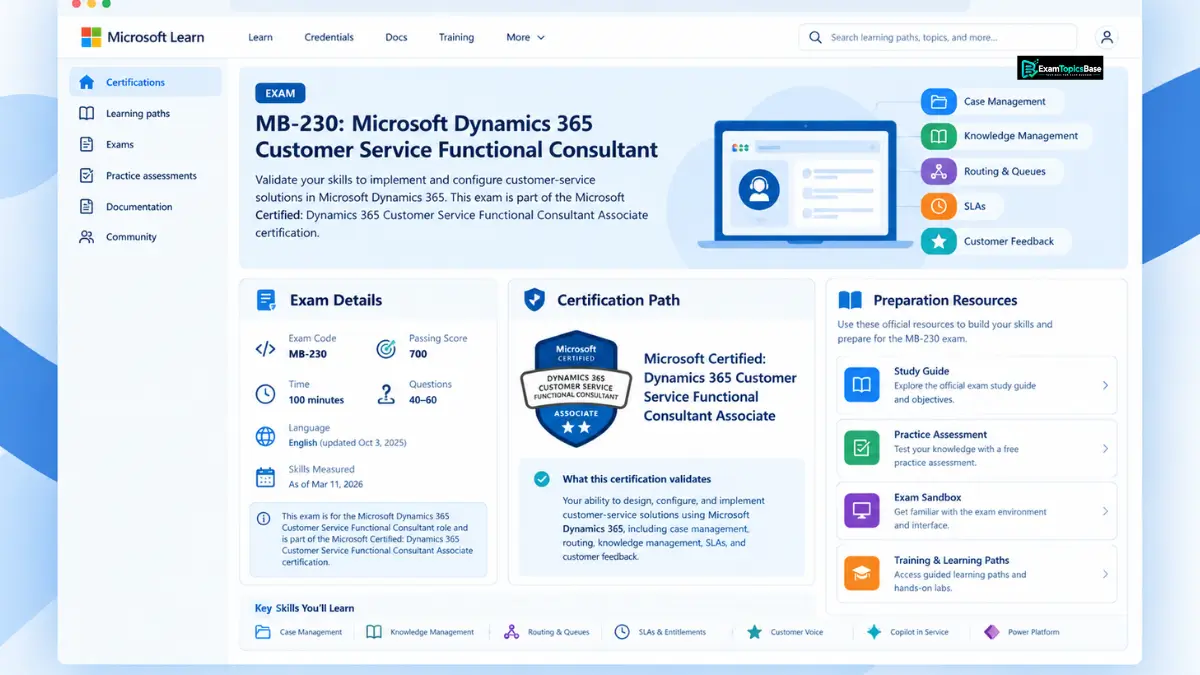
Microsoft MB-230 is the exam for the Dynamics 365 Customer Service Functional Consultant role, assessing skills used to implement and configure customer-service solutions in Dynamics 365. Microsoft identifies case management, Dynamics 365 Copilot in Service, collaboration, knowledge management, customer feedback, queues, SLAs, Customer Voice, and routing as important areas for candidates.
Moreover, the MB-230 exam is part of the requirements for the Microsoft Certified: Dynamics 365 Customer Service Functional Consultant Associate certification. For example, a functional consultant might configure a customer-service application so incoming cases are created, routed to the correct queue, monitored against an SLA, and resolved using knowledge resources.
Additionally, Microsoft currently lists a passing score of 700 for MB-230.
Furthermore, Microsoft states that the English-language version of the exam was updated on October 3, 2025, while the current study guide measures skills as of March 11, 2026.
MB-230 exam detail | Current information |
Exam code | MB-230 |
Exam name | Microsoft Dynamics 365 Customer Service Functional Consultant |
Certification | Microsoft Certified: Dynamics 365 Customer Service Functional Consultant Associate |
Passing score | 700 |
English exam update | October 3, 2025 |
Current skills measured | March 11, 2026 |
Current major domains | 3 |
Retirement date | None currently listed |
Moreover, the exam is designed around the work of a functional consultant, not simply the memorization of Dynamics 365 terminology. Microsoft describes candidates as professionals who design and implement service-management processes and automation while collaborating with solution architects, developers, and administrators.
Why Does the MB-230 Certification Matter?
The MB-230 certification matters because it validates structured knowledge of Dynamics 365 Customer Service configuration and implementation rather than focusing on one isolated feature. For example, a consultant may need to connect case management, routing, knowledge articles, SLAs, customer feedback, and automation into one customer-service workflow.
Moreover, the certification reflects a role that connects business requirements with technical configuration. A customer-service organization might need faster case assignment, better knowledge access, clearer SLA tracking, and more consistent representative workflows, and a functional consultant translates those requirements into a Dynamics 365 solution.
Additionally, certification should complement practical experience rather than replace it. Knowing what an SLA is is useful, but configuring SLA items, KPIs, warning actions, success actions, applicability, and a timer control requires a deeper understanding of how the platform works.
Furthermore, MB-230 preparation can help you organize your knowledge around real customer-service processes. Microsoft states that candidates should have strong applied knowledge of cases, knowledge management, queues, SLAs, Customer Service applications, Customer Voice, and routing.
What Are the Current MB-230 Exam Topics?
The current MB-230 exam measures three major skill areas: Manage cases in Customer Service, Configure representative experience and routing, and Extend Customer Service.
First, Manage cases in Customer Service accounts for 51–55% of the exam, making it the largest measured domain. For example, this area includes foundational Customer Service components, knowledge management, collaboration, Copilot in Service features, and SLAs.
Second, Configure representative experience and routing accounts for 25–30% of the exam. For example, candidates may need to understand workstreams, capacity profiles, classification, assignments, routing rules, skills-based routing, queues, scripts, macros, and the Copilot Service workspace.
Third, Extend Customer Service accounts for 15–20% of the exam. For example, this domain includes forms, views, model-driven app components, columns, relationships, Dataverse search, email templates, alerts, notifications, and Customer Voice.
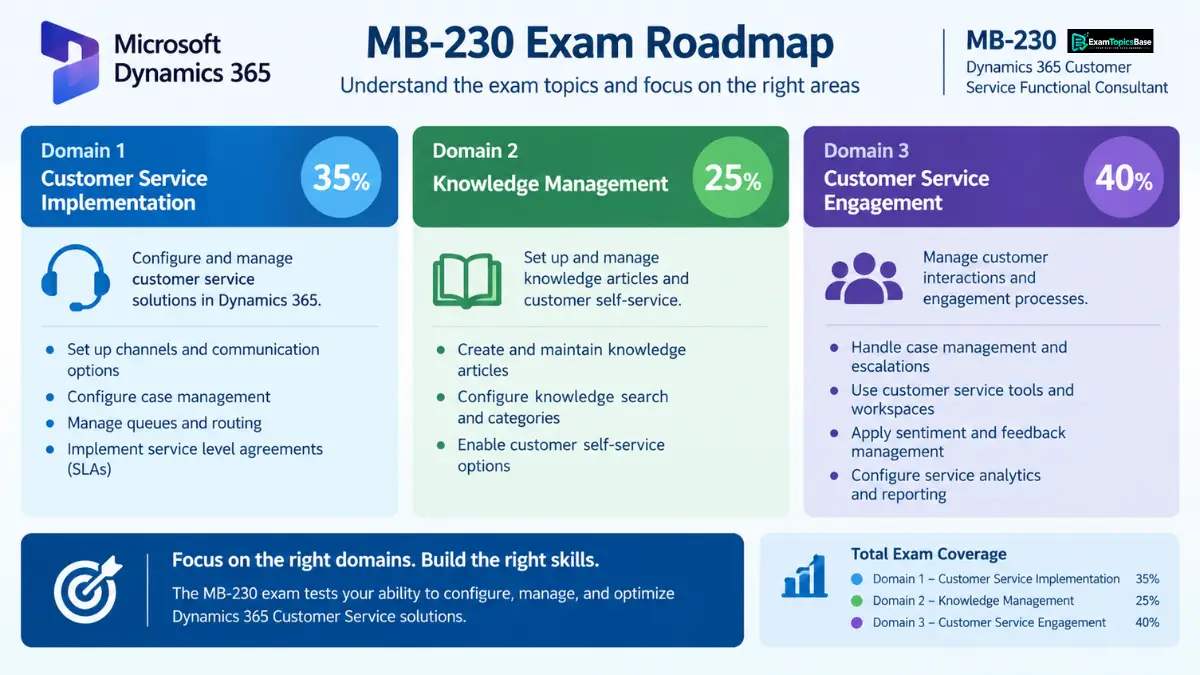
MB-230 domain | Weight | Main study areas |
Manage cases in Customer Service | 51–55% | Cases, knowledge, collaboration, Copilot, SLAs |
Configure representative experience and routing | 25–30% | Routing, queues, workstreams, productivity, workspace |
Extend Customer Service | 15–20% | Data model, UI components, Dataverse, Customer Voice |
Additionally, the current weighting means your study time should not necessarily be divided equally across all three domains. The official percentages make case management the largest measured area, while routing and extensions remain important supporting areas.
What Should You Study for MB-230 Case Management?
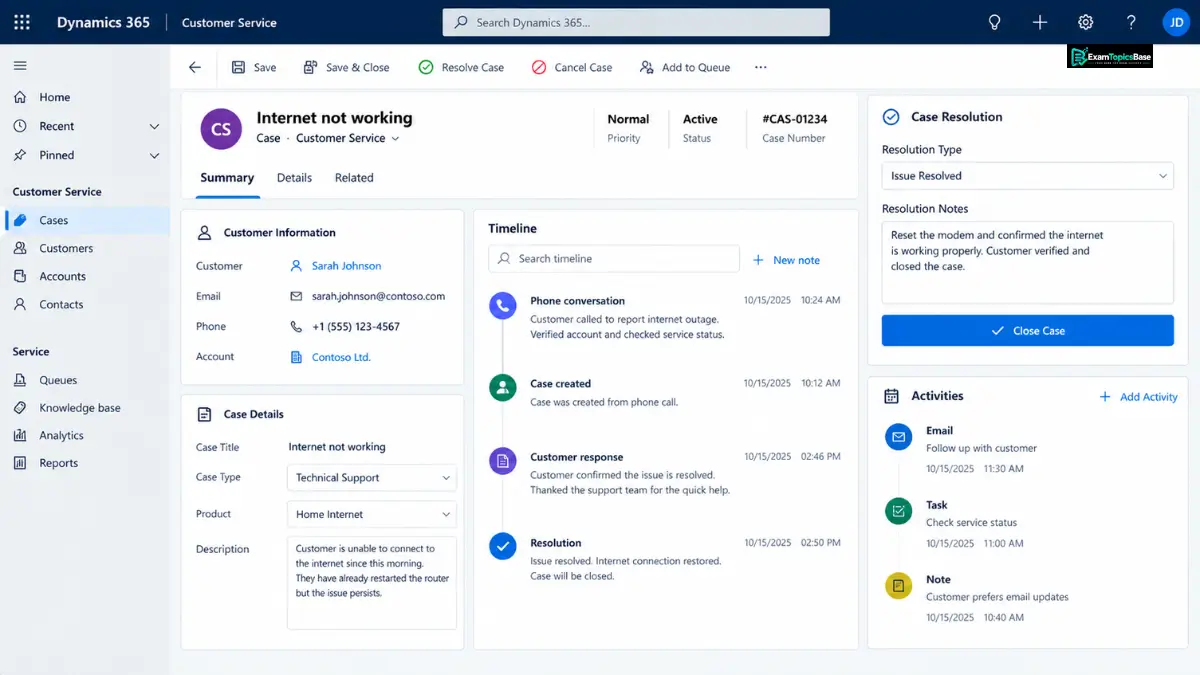
MB-230 case management covers the foundational configuration and operational processes used to create, manage, resolve, and support customer-service cases. Microsoft currently gives this domain 51–55% of the exam.
How Does MB-230 Cover Foundational Customer Service Components?
First, foundational Customer Service components include record creation and update rules, case resolution, security roles, timeline controls, records, card forms, and highlights. For example, a customer-service implementation may use rules to automate case creation from incoming interactions and then present important case information through a configured timeline.
Moreover, you should understand how security roles influence what users can see or change. A representative who handles cases may need different access from an administrator who configures customer-service components.
Additionally, study the relationship between forms, records, timelines, and case-resolution experiences. These concepts are easier to remember when you configure a simple case workflow rather than studying each term independently.
How Should You Study MB-230 Knowledge Management?
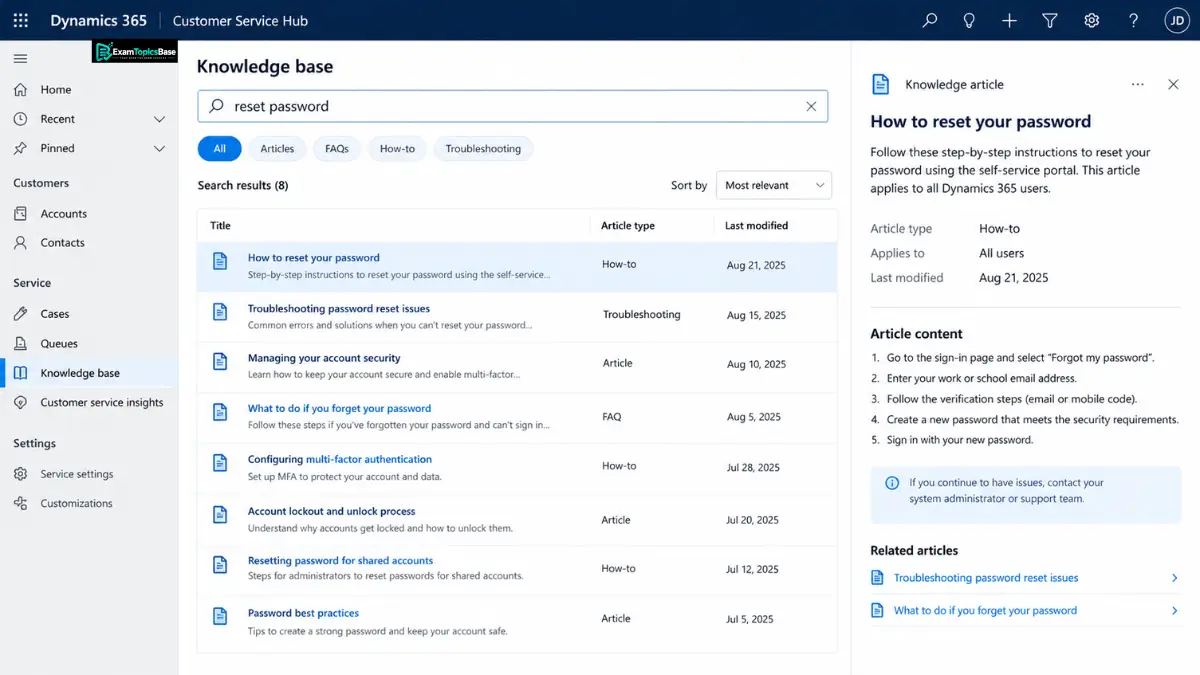
Second, knowledge management helps customer-service teams create, organize, search, and use information while handling customer issues. For example, a representative can search for an approved knowledge article while working on a case instead of creating a response from scratch.
Moreover, Microsoft includes internal knowledge search, knowledge-management tables, translated knowledge articles, external knowledge sources, AI suggestions, and Copilot-led knowledge article creation in the current objectives.
Additionally, practice connecting knowledge management to case resolution. Ask yourself how a representative would locate the correct article, verify its relevance, and use the information during a customer interaction.
What Should You Know About MB-230 Collaboration and Copilot?
Third, collaboration and Copilot-related capabilities are included in the current case-management objectives. Microsoft lists Microsoft Teams chat, suggested contacts, collaboration experiences, Ask a Question, case summaries, timeline and conversation summaries, Draft a Response, and the Case Management Agent.
Furthermore, study these features from a functional perspective rather than trying to memorize isolated feature names. For example, understand how a representative could use a summary or suggested response to work more efficiently while still following the organization's customer-service process.
How Should You Prepare for MB-230 Routing, SLAs, and Representative Experience?
MB-230 routing and representative-experience topics focus on how customer interactions are assigned, managed, prioritized, and handled by customer-service teams. Microsoft currently assigns 25–30% of the exam to this domain.
What Should You Know About MB-230 Routing and Queues?
First, routing determines how customer-service work reaches the appropriate people or teams. For example, a support organization might classify billing cases differently from technical-support cases and route each type to the appropriate queue or representative.
Moreover, Microsoft includes workstreams, user settings, capacity profiles, work classification, assignments, routing rulesets, skills-based routing, skill finder models, queues, and routing for records in the current objectives.
Additionally, practice scenarios that require you to decide how work should be classified and assigned. Understanding the reason behind a routing configuration is more useful than memorizing feature names.
How Should You Study MB-230 SLAs and Entitlements?
Second, a service-level agreement defines measurable service commitments that can be tracked against customer-service cases. For example, an organization could configure a KPI that tracks how quickly a case receives its first response.
Furthermore, the current MB-230 objectives include SLA settings, Power Automate actions, SLA application, SLA items, KPIs, warning actions, success actions, applicability, timer controls, and SLA KPIs.
Additionally, practice explaining the difference between an SLA, an SLA item, a KPI, and the actions associated with reaching a warning or success condition. This distinction can make scenario-based questions easier to analyze.
How Does MB-230 Test Representative Experience?
Third, representative experience covers the tools and workspace configuration that help customer-service employees handle their work. For example, a configured workspace can provide sessions, tabs, inbox views, profiles, scripts, and macros suited to different service scenarios.
Moreover, Microsoft includes scripts, slugs, macros, session templates, experience profiles, Inbox configuration, custom views, and application tab templates in the current objectives.
Additionally, think about these features as parts of a complete user experience. A representative should be able to receive work, understand the customer context, access relevant information, and complete repetitive actions efficiently.
How Does MB-230 Cover Customer Voice and Customer Service Extensions?
The Extend Customer Service domain covers configuration capabilities that expand the customer-service application beyond core case handling. Microsoft currently assigns 15–20% of the exam to this domain.
What Does MB-230 Cover About Customer Voice?
First, Microsoft Customer Voice is used to capture customer feedback through surveys and related experiences. For example, an organization can distribute a survey after a case or conversation and connect the resulting feedback to the customer-service process.
Moreover, the current MB-230 objectives include triggering survey distribution, personalizing surveys, and populating survey results against cases and conversations.
Additionally, study Customer Voice as part of a feedback loop. The important concept is not simply creating a survey but understanding how feedback can become part of a broader customer-service process.
What Should You Know About the MB-230 Data Model?
Second, the data-model portion includes forms, views, model-driven app components, columns, alerts, in-app notifications, tables, relationships, Dataverse search, and email templates. For example, a functional consultant might configure a form so representatives see the most relevant case information without changing the underlying business process.
Furthermore, practice creating or modifying a simple model-driven application component and understand how tables, columns, relationships, forms, and views work together.
How Does MB-230 Connect With Power Platform?
Third, Power Platform capabilities are relevant because Dynamics 365 Customer Service uses platform services for configuration, automation, data, and application experiences. Microsoft identifies implementation of Microsoft Power Platform among the technical tasks associated with MB-230.
Moreover, Power Automate appears directly in the current objectives for implementing actions associated with SLAs. For example, an automation could perform a defined action when a service-level condition is reached.
Source: Study guide for Exam MB-230: Microsoft Dynamics 365 Customer Service Functional Consultant
What Tools and Practical Experience Should You Use for MB-230 Preparation?
Effective MB-230 preparation combines official Microsoft learning resources with hands-on Dynamics 365 Customer Service practice. Microsoft recommends training and hands-on experience before taking the exam and provides links to documentation, learning paths, community resources, and a free Practice Assessment.
Which Microsoft Learn Resources Should You Use?
First, Microsoft Learn should be the foundation of your MB-230 study material because its resources align directly with Microsoft's certification objectives. For example, the MB-230 exam page provides a learning path for working with cases in Dynamics 365 Customer Service, while the study guide links to documentation and additional learning resources.
Moreover, Microsoft provides self-paced and instructor-led preparation options for MB-230.
How Can Hands-On Practice Improve MB-230 Preparation?
Second, hands-on practice turns abstract concepts into repeatable skills. For example, create a customer-service scenario where an incoming case is created, routed to a queue, assigned to a representative, monitored against an SLA, supported by a knowledge article, and followed by customer feedback.
Additionally, repeat the workflow after changing one configuration at a time. This method helps you understand why a configuration works and what happens when a setting changes.
How Do MB-230 Practice Questions Help?
Third, MB-230 practice questions are most useful when they expose gaps in your understanding rather than simply providing a score. For example, if you repeatedly miss questions about routing, review workstreams, classification, queues, capacity profiles, and skills-based routing before attempting another practice test.
Moreover, Microsoft's free Practice Assessment is designed to help candidates test their skills with practice questions.
Additionally, third-party MB-230 practice questions can supplement preparation, but they should not be treated as official Microsoft exam content unless Microsoft identifies them as such.
Why Should You Use the MB-230 Exam Sandbox?
Fourth, the exam sandbox lets you become familiar with the exam environment before test day. For example, you can use the sandbox to understand the interface and reduce uncertainty about how the assessment environment works.
Furthermore, Microsoft provides the exam sandbox as one of its official preparation resources.
How Can You Create an MB-230 Study Plan for Beginners?
A practical MB-230 study plan should prioritize case management first, then representative experience and routing, and finally Customer Service extensions. The current domain weighting supports this order because the three areas represent 51–55%, 25–30%, and 15–20%, respectively.
What Should You Study During a Six-Week MB-230 Plan?
First, use the first week to understand Dynamics 365 Customer Service fundamentals and the official exam objectives. For example, map cases, knowledge management, queues, SLAs, routing, and Customer Voice to the three domains.
Second, use weeks two and three for case management, knowledge management, collaboration, Copilot in Service, and SLAs. These weeks should contain hands-on configuration rather than reading alone.
Third, use week four for routing and representative experience. Practice queues, workstreams, classification, assignments, capacity profiles, scripts, macros, and workspace configuration.
Fourth, use week five for Customer Service extensions, data-model concepts, Customer Voice, forms, views, relationships, Dataverse search, and email templates.
Finally, use week six for practice questions, the official Practice Assessment, exam-sandbox familiarization, weak-topic review, and a final objective-by-objective checklist.
Study period | Primary focus | Practical activity |
Week 1 | Foundations and exam objectives | Map domains and review Dynamics 365 Customer Service |
Weeks 2–3 | Cases, knowledge, collaboration, SLAs | Configure an end-to-end case workflow |
Week 4 | Routing and representative experience | Practice queues, workstreams, classification, and workspace |
Week 5 | Customer Service extensions | Practice forms, views, Dataverse, Customer Voice, and automation |
Week 6 | Assessment and revision | Complete practice assessments and review weak areas |
Moreover, the six-week schedule is a framework rather than a requirement. If you already administer Dynamics 365 Customer Service, you can shorten the foundational phase and spend more time on less familiar configuration areas.
How Can You Tell If You Are Ready for the MB-230 Exam?
Exam readiness means you can explain the current objectives and apply the relevant Dynamics 365 concepts to realistic customer-service scenarios. For example, you should be able to explain why a particular routing approach, SLA configuration, knowledge workflow, or representative experience fits a stated business requirement.
Moreover, use the following checklist before scheduling:
I understand all three current MB-230 domains.
I can explain Dynamics 365 Customer Service case management.
I understand knowledge management and knowledge search.
I can explain queues, workstreams, and routing.
I understand skills-based routing and capacity concepts.
I understand SLAs, KPIs, warning actions, and success actions.
I understand representative experience and the Copilot Service workspace.
I understand forms, views, tables, columns, and relationships.
I understand Customer Voice survey workflows.
I have practiced Dynamics 365 Customer Service scenarios.
I have completed practice questions and reviewed weak areas.
I have explored the Microsoft exam sandbox.
Additionally, a practice score should be treated as a diagnostic rather than a guarantee of exam performance. The stronger signal is whether you can explain the reasoning behind an answer and apply the same concept to a different customer-service scenario.
Get Free Microsoft Real Exam Questions & Answers of Here:https://examtopicsbase.com/vendors/microsoft
What Should You Do Next for MB-230 Exam Preparation?
The next step for MB-230 preparation is to compare your current skills against Microsoft's latest study guide and then turn each weak objective into a practical exercise. Microsoft says the study guide is intended to help candidates understand what to expect and focus their preparation.
First, review the three official domains and mark each objective as strong, developing, or weak. For example, if case management is strong but routing is weak, spend additional practice time on workstreams, classification, queues, capacity, and assignments.
Second, build one complete customer-service scenario. A useful exercise can include case creation, knowledge search, routing, SLA tracking, representative productivity, automation, and customer feedback.
Third, complete the official Practice Assessment and analyze incorrect answers. Microsoft specifically provides the assessment as a preparation resource.
Fourth, review the exam sandbox before test day. This helps you understand the assessment environment and separates interface familiarity from actual knowledge.
Finally, use ExamTopicsBase as an additional preparation resource alongside official Microsoft Learn materials, hands-on practice, and other trusted study resources. The goal should be to understand the underlying Dynamics 365 Customer Service concepts rather than rely entirely on memorization.
Conclusion
Microsoft MB-230 is the exam for the Dynamics 365 Customer Service Functional Consultant role, and its current objectives focus on case management, representative experience and routing, and extending Customer Service.
Moreover, the largest domain is Manage cases in Customer Service at 51–55%, followed by representative experience and routing at 25–30%, and Customer Service extensions at 15–20%.
Additionally, effective MB-230 exam preparation combines the official Microsoft study guide, hands-on Dynamics 365 Customer Service configuration, practice questions, Microsoft's Practice Assessment, and targeted review of weak areas.
Finally, ExamTopicsBase can supplement your MB-230 study process with additional practice resources, while Microsoft Learn and practical Dynamics 365 experience should remain central to your preparation. When you can configure cases, manage knowledge, design routing, work with SLAs, support representatives, and capture customer feedback, you are building practical skills that extend beyond the certification exam.
Frequently Asked Questions
1. What Is the MB-230 Exam?
MB-230 is the Microsoft Dynamics 365 Customer Service Functional Consultant exam. It measures skills related to implementing and configuring customer-service solutions, including cases, knowledge management, routing, SLAs, representative experiences, and Customer Service extensions.
2. What Certification Is Associated With MB-230?
MB-230 is part of the requirements for the Microsoft Certified: Dynamics 365 Customer Service Functional Consultant Associate certification.
3. What Are the Current MB-230 Exam Topics?
The current MB-230 domains are Manage cases in Customer Service at 51–55%, Configure representative experience and routing at 25–30%, and Extend Customer Service at 15–20%.
4. What Is the Passing Score for MB-230?
Microsoft currently lists 700 as the passing score for MB-230.
5. What Should I Study First for MB-230?
The largest domain is case management, so begin with foundational Customer Service components, cases, knowledge management, collaboration, Copilot in Service, and SLAs. The official weighting makes this the largest measured area.
6. Are MB-230 Practice Questions Useful?
MB-230 practice questions can help identify knowledge gaps and improve scenario-based reasoning. Microsoft's free Practice Assessment is an official preparation resource, while third-party practice questions should be treated as supplementary and unofficial unless otherwise identified.
7. Does MB-230 Require Hands-On Dynamics 365 Experience?
Microsoft recommends training and hands-on experience before taking the exam. Practical work can help you understand how cases, routing, SLAs, knowledge management, and Customer Voice operate in realistic scenarios.
8. What Is Covered in MB-230 Routing?
MB-230 routing includes workstreams, user settings, capacity profiles, work classification, assignments, routing rulesets, skills-based routing, skill finder models, queues, and routing for records.
9. Does MB-230 Cover Customer Voice?
Yes. The current Extend Customer Service objectives include triggering survey distribution, personalizing surveys, and populating survey results against cases and conversations.
10. Where Should I Start My MB-230 Preparation?
Start with the current Microsoft study guide, map the three domains against your existing knowledge, complete relevant Microsoft Learn training, build hands-on Customer Service scenarios, use the Practice Assessment, and review weak areas before scheduling the exam.
You may also like to read:
DP-900 Exam Topics: What Should You Study for Azure Data Fundamentals?
What Is the AZ-104 Exam and How Can You Prepare for It? | The Ultimate Guide

Written by Julia Mercer
I’m Julia Mercer, a Microsoft Solutions Architect and technical contributor at ExamTopicsBase. Having navigated the evolving Microsoft certification roadmap throughout my career in enterprise IT, I focus on delivering accurate, scenario-tested practice questions and clear, blueprint-aligned explanations so you can walk into your test with total confidence.
Comments (0)
Leave a Reply
No comments yet. Be the first to share your thoughts!