
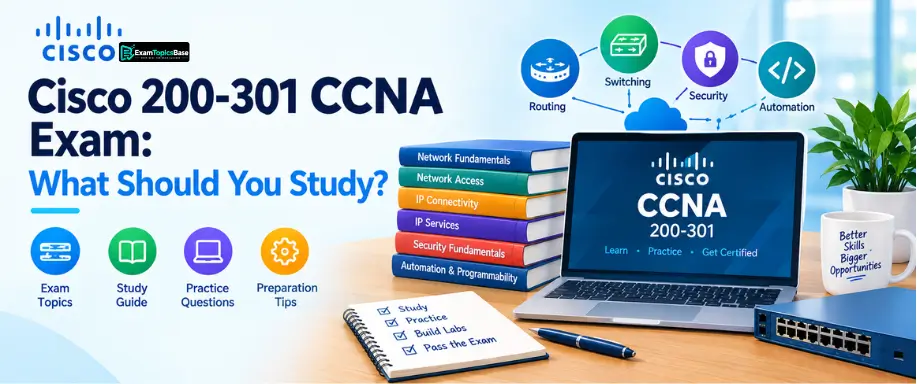
If you're preparing for the Cisco 200-301 exam, you've probably already seen that the CCNA covers everything from IP addressing and switching to security and automation. However, knowing the topic list is different from knowing what to study first, how to practice, and how to recognize your weak areas. In this guide, you'll learn the current 200-301 CCNA exam topics, practical skills to build, useful Cisco resources, and a structured approach to exam preparation.
What Is the Cisco 200-301 CCNA Exam?
Cisco 200-301 is the core examination used to earn the Cisco Certified Network Associate certification. The current exam, officially titled Implementing and Administering Cisco Solutions (200-301 CCNA) v1.1, evaluates knowledge and skills across network fundamentals, network access, IP connectivity, IP services, security fundamentals, and automation and programmability.
Moreover, the current 200-301 CCNA exam has a 120-minute duration and Cisco lists no prerequisite certification for taking the exam. The CCNA certification is valid for three years, while exam results are available online within 48 hours according to Cisco's certification information.
For example, a candidate might need to understand how a switch handles a frame, calculate an IPv4 subnet, configure a VLAN, interpret a routing table, troubleshoot an ACL, and recognize an automation workflow.
Exam detail | Current information |
Exam | 200-301 CCNA v1.1 |
Certification | Cisco Certified Network Associate |
Duration | 120 minutes |
Prerequisites | None |
Certification validity | 3 years |
Result format | Pass/fail |
Results availability | Online within 48 hours |
Furthermore, Cisco's current training describes the CCNA audience as including entry-level network engineers, network administrators, network support technicians, and help desk technicians. Cisco's recommended foundation includes basic computer literacy, operating-system navigation, internet usage, and basic IP-address knowledge.
For example, someone moving from IT support into networking can begin with basic IP addressing and gradually progress toward VLANs, routing, network security, and automation
Why Does the Cisco 200-301 CCNA Certification Matter?
The Cisco 200-301 CCNA certification matters because it validates a broad foundation in networking technologies rather than a single networking tool. The knowledge tested by the exam covers the basic concepts required to configure, operate, verify, and troubleshoot small-to-medium network environments.
Additionally, Cisco's official CCNA training covers installing, configuring, and verifying IPv4 and IPv6 networks, working with switches and routers, managing network devices, identifying basic security threats, and understanding automation and programmability.
For example, understanding VLANs is useful when separating departments on a network, while understanding routing is necessary when traffic must move between different IP networks.
Moreover, the CCNA foundation can be useful across several IT areas, including network administration, infrastructure support, security operations, cloud networking, and technical support. Certification does not guarantee employment, but it provides a structured framework for developing and demonstrating networking knowledge.
The CCNA connects networking fundamentals with practical configuration and troubleshooting skills.
What Are the Current 200-301 CCNA Exam Topics?
The current 200-301 CCNA exam covers six major knowledge areas: network fundamentals, network access, IP connectivity, IP services, security fundamentals, and automation and programmability. Cisco identifies these six areas on its current official exam page.
For example, network fundamentals can involve IPv4 subnetting and network components, while IP connectivity can involve routing decisions and OSPF.
200-301 domain | What to study |
Network fundamentals | Network components, topologies, cabling, TCP/UDP, IPv4/IPv6, subnetting |
Network access | VLANs, trunks, EtherChannel, STP, wireless, device access |
IP connectivity | Routing tables, static routing, IPv4/IPv6 routing, OSPF |
IP services | NAT, DHCP, DNS, NTP, SNMP, syslog, QoS concepts |
Security fundamentals | Threats, authentication, ACLs, wireless security, device hardening |
Automation and programmability | Controller-based networking, APIs, JSON, automation concepts, software-defined networking |
Furthermore, Cisco says its published exam topics are guidelines for exam content and can change. Candidates should therefore use the latest official Cisco exam-topic documentation rather than relying solely on an older study guide.
What Is Changing With the Cisco CCNA Exam?
The current Cisco 200-301 CCNA v1.1 remains available through February 2, 2027, while Cisco has announced that the refreshed CCNA v2.0 becomes available on February 3, 2027.
For example, a candidate taking the current exam before the transition should organize preparation around the applicable v1.1 objectives rather than mixing future exam requirements into the current study plan.
Additionally, Cisco announced the refreshed CCNA with a greater emphasis on practical skills and updated learning materials. Candidates should verify the official Cisco exam page before scheduling so that their preparation matches the version they intend to take.
Source: Cisco Certified Network Associate
How Should You Study Network Fundamentals for 200-301?
Network fundamentals are the foundation of CCNA preparation because they explain how devices, protocols, addressing, and physical connections work together. This area should include network components, topologies, cabling, TCP and UDP, IPv4, IPv6, subnetting, and basic network architecture.
First, learn the purpose of common network components. Routers connect different networks, switches connect devices within local networks, access points provide wireless connectivity, and firewalls enforce security policies.
For example, a router can connect a company's local network to another network, while a switch can connect several computers inside the same office LAN.
Second, practice IPv4 addressing and subnetting until you can determine network addresses, host ranges, broadcast addresses, and prefix lengths without relying completely on a calculator.
For example, if a network uses 192.168.10.0/24, you should understand how dividing it into smaller prefixes changes the number of available subnets and hosts.
Third, compare TCP and UDP and understand where common protocols operate. You should also recognize basic IPv6 addressing and the purpose of private IPv4 addressing.
Subnetting is one of the most useful practical skills to develop before taking the CCNA exam.
What Switching and Network Access Topics Should You Study for CCNA?
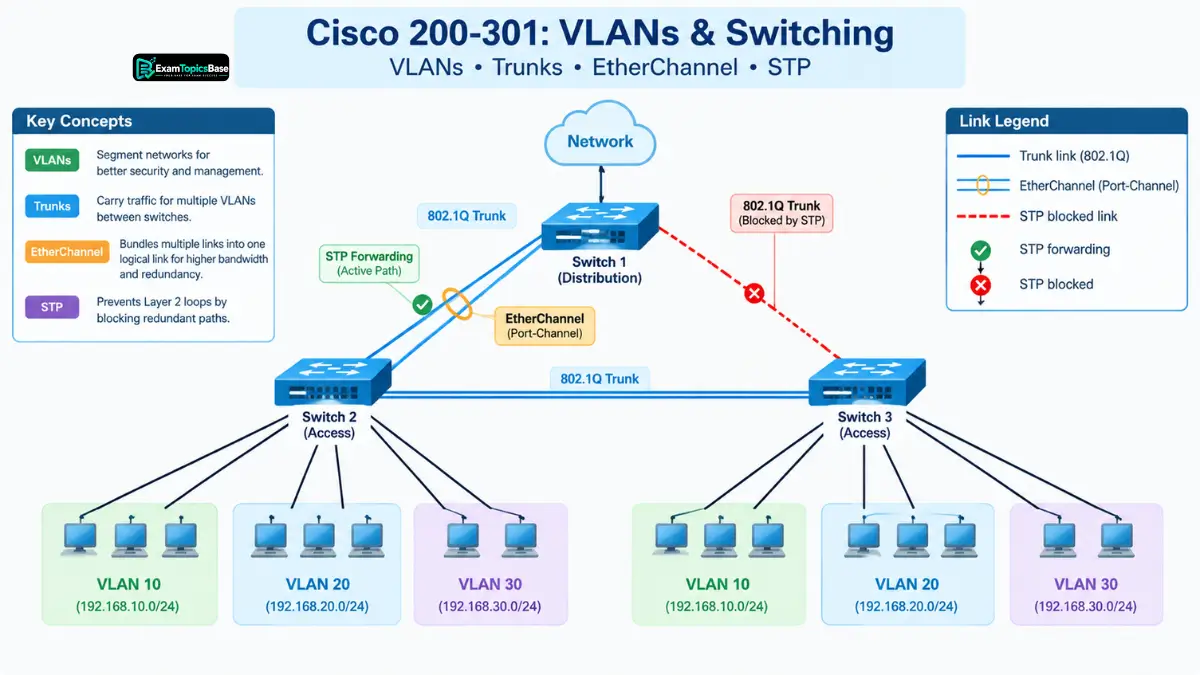
Network access topics focus on how devices connect to LANs and how switches control traffic. Your study should include VLANs, trunks, EtherChannel, Spanning Tree Protocol, wireless concepts, and device-management fundamentals.
First, understand VLANs and trunking. VLANs logically separate devices into different broadcast domains, while trunk links can carry traffic for multiple VLANs between network devices.
For example, a company could place accounting computers in one VLAN and guest devices in another, even when both groups use the same physical switching infrastructure.
Second, study EtherChannel and STP. EtherChannel combines multiple physical links into a logical connection, while STP helps prevent Layer 2 loops in redundant switching environments.
For example, two switches may have multiple physical connections for redundancy, but uncontrolled Layer 2 loops can cause serious network problems.
Third, review wireless networking concepts and the role of wireless LAN controllers. Cisco's current training also includes practical work involving WLAN configuration and wireless security.
How Should You Prepare for IP Connectivity and Routing Questions?
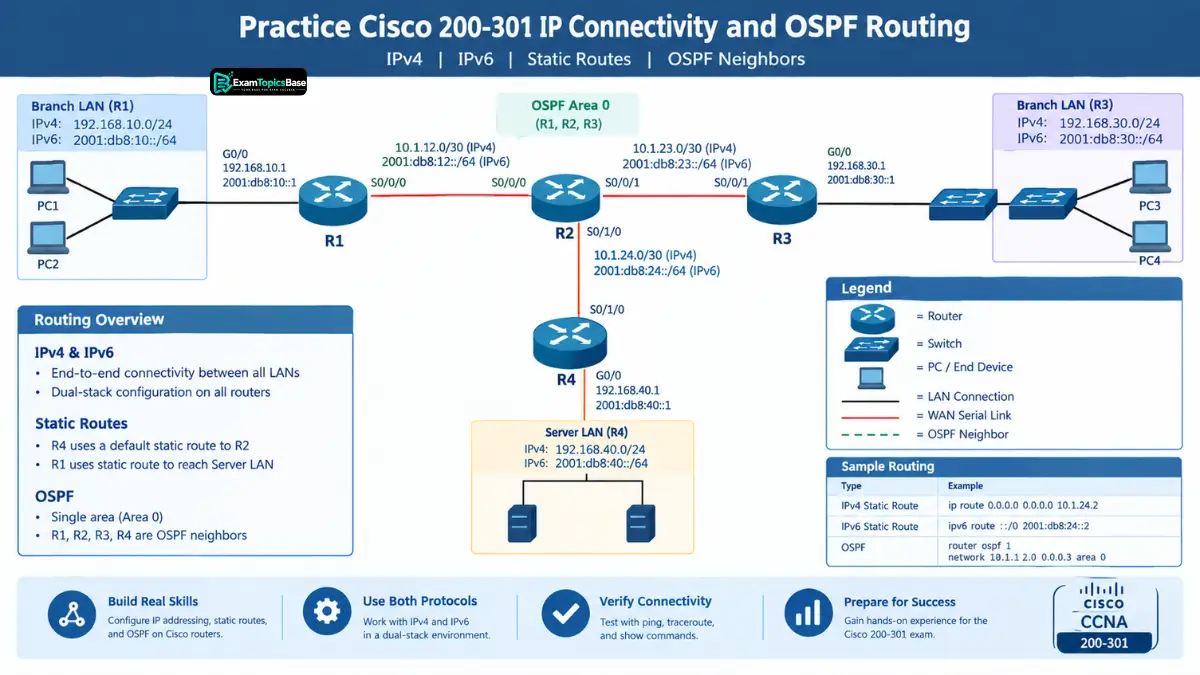
IP connectivity preparation should focus on understanding how routers select paths and how devices communicate across different networks. Key areas include routing tables, static routes, IPv4 and IPv6 routing, and single-area OSPF.
First, learn how a router makes forwarding decisions. A routing table contains information that allows a router to determine where packets should be sent next.
For example, if a router has routes to 10.10.10.0/24 and 10.10.20.0/24, a packet destined for 10.10.20.25 should be forwarded using the route that matches that destination network.
Second, practice static routes and default routes. Static routing helps you understand the basic forwarding process before you move into dynamic routing.
Third, study single-area OSPF and understand neighbors, areas, router IDs, and basic route selection concepts.
For example, when several routers participate in an OSPF area, they exchange routing information so that the network can calculate paths dynamically.
Cisco's official CCNA training includes configuring and verifying IPv4 static routes, IPv6 static routes, and single-area OSPF.
What IP Services Should You Know for the Cisco 200-301 Exam?
IP services cover the network services that help devices obtain configuration, resolve names, synchronize time, translate addresses, and report operational information. Your preparation should include DHCP, DNS, NAT, NTP, SNMP, syslog, and related service concepts.
First, understand DHCP and DNS separately. DHCP can automatically provide network configuration to clients, while DNS translates domain names into IP addresses.
For example, a workstation can receive an IP address from DHCP and then use DNS to resolve a server name into an IP address.
Second, study NAT and PAT and understand why organizations use address translation. NAT can translate private addresses into public addresses, while PAT allows multiple private hosts to share a public IPv4 address through different port mappings.
For example, dozens of internal devices can access the internet through a smaller number of public IPv4 addresses.
Third, understand NTP, SNMP, and syslog at a practical level. Accurate time synchronization and centralized logging can make network troubleshooting easier.
IP services connect basic networking with the operational services that keep networks manageable.
What Security Fundamentals Are Covered on the CCNA Exam?
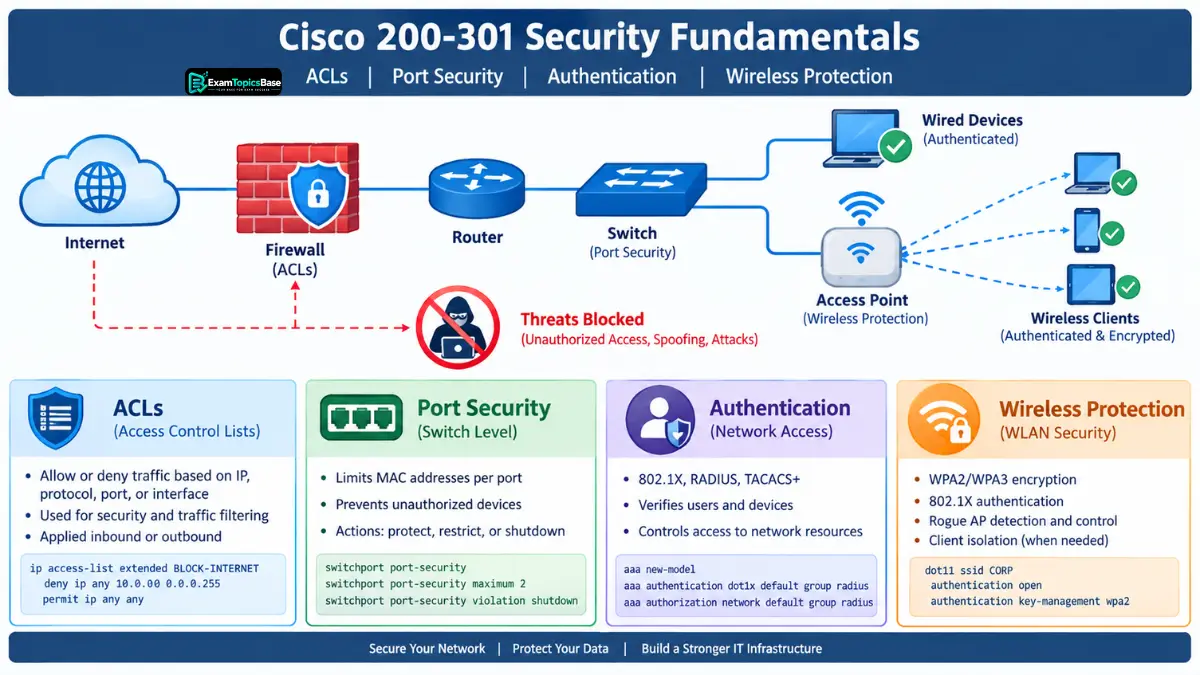
CCNA security fundamentals cover basic threats, security controls, authentication concepts, access control, wireless security, and device hardening. The goal is to understand how network infrastructure can be protected and how common security mechanisms work.
First, learn common security threats and attack concepts. You should recognize examples such as social engineering, malware, denial-of-service attacks, password attacks, and unauthorized access.
For example, a weak password can create an access risk even when the underlying network infrastructure is properly configured.
Second, practice access control lists and understand how rules can permit or deny traffic. ACLs are particularly important because they connect security policy with actual router or network-device configuration.
For example, an ACL might allow traffic from a trusted subnet while denying a particular source or destination.
Third, study device-hardening concepts, secure management access, port security, authentication, and wireless security. Cisco's official training includes exercises involving IPv4 ACLs, port security, remote access, RADIUS, SNMP, syslog, and WPA2 PSK.
What Automation and Programmability Topics Should You Study?
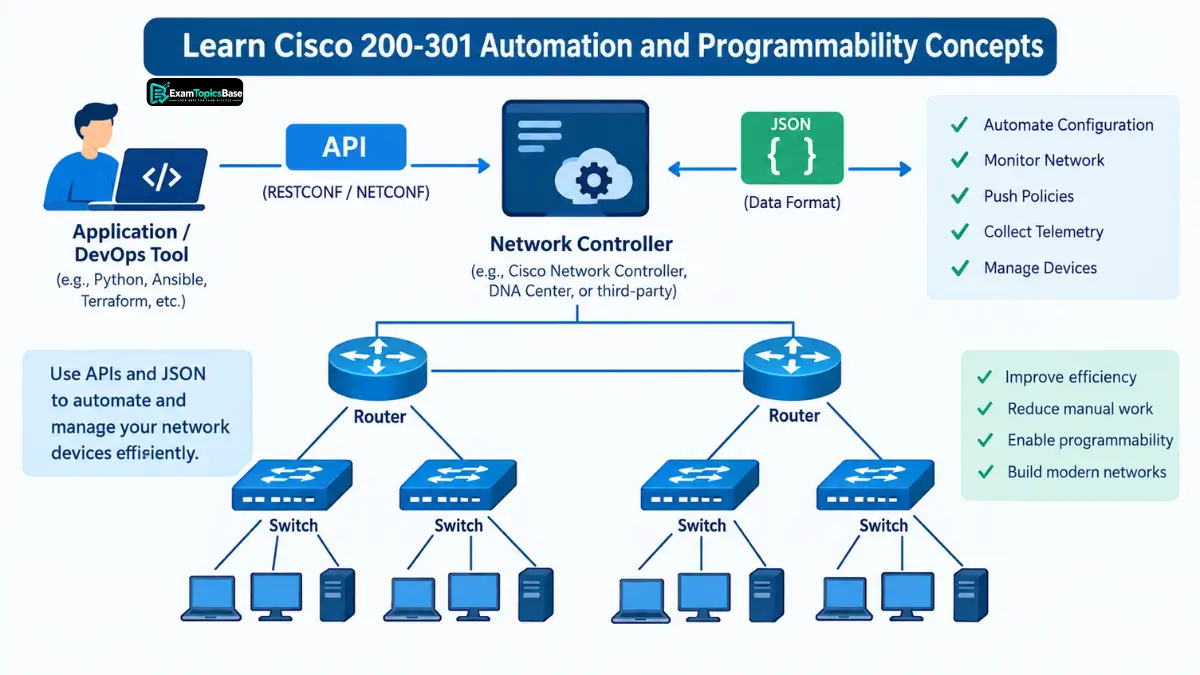
Automation and programmability topics introduce the ways modern networks can be managed through controllers, APIs, software, and structured data. You should understand controller-based networking, software-defined networking concepts, APIs, JSON, and basic automation terminology.
First, understand the difference between traditional device-by-device management and controller-based management. Traditional management often involves configuring individual devices, while controller-based approaches can centralize management and policy.
For example, instead of manually applying the same configuration to dozens of devices, an organization can use centralized automation to apply consistent changes.
Second, learn basic API concepts and recognize common data formats such as JSON. You do not need to become a software engineer to understand why APIs matter in modern networking.
For example, an API can allow an automation application to request information from a network controller or send a configuration request.
Third, review software-defined networking and network programmability concepts. Cisco's current training also introduces AI and machine learning in network operations.
How Much Time Should You Spend Studying for the CCNA 200-301 Exam?
The amount of study time required for the CCNA 200-301 exam depends on your networking background, available study hours, and hands-on experience. A structured four-to-eight-week plan can provide a practical framework, but learners should extend it when important concepts remain unclear.
First, begin by assessing your current knowledge. Spend one session reviewing subnetting, VLANs, routing, IP services, security, and automation, then mark each area as strong, developing, or weak.
For example, someone who already configures Cisco switches daily may need less time on VLAN fundamentals than a learner who has never used Cisco IOS.
Second, divide your study schedule into theory, labs, and practice questions. Avoid spending every study session reading because CCNA concepts become easier to understand when you configure and troubleshoot them.
Third, reserve the final part of your plan for mixed-topic practice and troubleshooting. Cisco's official training is designed around installing, operating, configuring, and verifying network technologies rather than memorizing isolated facts.
Study stage | Main focus | Example activities |
Week 1 | Network fundamentals | OSI/TCP-IP, devices, Ethernet, IPv4, IPv6, subnetting |
Week 2 | Network access | VLANs, trunks, STP, EtherChannel, wireless |
Weeks 3–4 | IP connectivity | Routing tables, static routes, IPv6, OSPF |
Week 5 | IP services and security | DHCP, DNS, NAT, ACLs, authentication, device hardening |
Week 6 | Automation and review | APIs, JSON, automation, troubleshooting, mixed practice |
Final review | Readiness | Practice tests, weak-domain review, full labs |
Moreover, a longer schedule can be useful if you are new to networking. A shorter schedule may work for an experienced network professional who already has strong Cisco configuration and troubleshooting skills.
Get Free Cisco Real Exam Questions & Answers of
Here:https://examtopicsbase.com/vendors/cisco
How Can Hands-On Labs Improve Cisco 200-301 Preparation?
Hands-on labs improve Cisco 200-301 preparation by allowing you to apply networking concepts instead of only reading about them. Practical work is particularly useful for configuration, verification, troubleshooting, and understanding how changes affect network behavior.
First, create a small topology containing routers, switches, hosts, and multiple networks. Configure interfaces, assign addresses, and verify connectivity.
For example, build two VLANs, configure a trunk between switches, configure inter-VLAN routing, and test whether hosts can communicate as expected.
Second, introduce intentional problems into your lab. Shut down an interface, configure an incorrect subnet mask, remove a route, change a VLAN assignment, or apply an incorrect ACL.
For example, if two hosts suddenly cannot communicate after a VLAN change, use show commands and configuration checks to identify the cause.
Third, repeat the same task without following a step-by-step guide. This forces you to recall commands and reasoning instead of simply copying a configuration.
Cisco's official training includes practical exercises involving switches, routers, VLANs, trunks, routing, OSPF, ACLs, NAT, NTP, port security, wireless, and device management.
Which Tools Should You Use for Cisco 200-301 Practice?
Cisco 200-301 preparation can use several tools, including Cisco Packet Tracer, Cisco Modeling Labs, Cisco U., Cisco Networking Academy, and physical Cisco equipment. The best combination depends on your experience, budget, and access to hardware.
First, Cisco Packet Tracer is useful for creating simulated network topologies and practicing configurations without physical equipment. Cisco describes Packet Tracer as a network simulation tool that can support experimentation and troubleshooting.
Second, Cisco Modeling Labs provides another environment for building and troubleshooting network environments. Cisco currently lists CML among its official hands-on learning tools.
Third, Cisco U. provides guided Learning Paths, assessments, and certification-focused training. Cisco says its Learning Paths can help learners identify what they already know and focus on areas requiring additional study.
Fourth, Cisco Networking Academy provides learning resources and courses, including an introductory Packet Tracer course. Cisco describes Networking Academy as offering free courses and career guidance.
Finally, combine these tools rather than depending on one platform. Free resources can establish fundamentals, simulation tools can provide practice, and structured training can help organize broader exam preparation.
How Do 200-301 Practice Questions Help With Exam Preparation?
200-301 practice questions help candidates identify knowledge gaps and become more comfortable applying networking concepts to unfamiliar scenarios. Practice questions are most useful when you analyze why an answer is correct rather than simply memorizing an answer pattern.
First, use practice questions after studying a topic. For example, complete subnetting exercises before taking a subnetting-focused practice test.
Second, record the reason behind every incorrect answer. If you repeatedly miss questions involving OSPF, review neighbor relationships, route selection, configuration, and verification rather than simply repeating the same questions.
Third, use a practice test to measure consistency across different domains. A strong result in one area does not automatically mean that you are ready across the entire exam.
Practice questions measure your understanding; they should not replace learning the underlying networking concepts.
What Should You Know About Cisco 200-301 Exam Questions and Dumps?
Cisco 200-301 exam questions should be used as learning exercises rather than as a substitute for understanding the official objectives. Materials advertised as “real exam questions,” leaked questions, or guaranteed answer sets should not be treated as authoritative Cisco preparation resources.
First, distinguish legitimate practice questions from purported exam dumps. A legitimate practice resource helps you understand a concept, explains the answer, and encourages further study.
For example, a good subnetting question should help you understand how prefix length affects network size instead of merely teaching you which option to select.
Second, use the official Cisco exam topics as your primary source. Cisco explicitly publishes the skills and topics candidates should study, while its training provides practical exercises that connect those topics with network configuration.
Third, treat third-party practice material as supplementary. If a practice question conflicts with Cisco's current documentation or exam topics, investigate the discrepancy rather than memorizing the third-party answer.
What Cisco Resources Should You Use for the CCNA Exam?
Cisco provides several official resources that can support Cisco certification exam preparation. These include the current exam topics, Cisco U., Cisco Networking Academy, Cisco Modeling Labs, Packet Tracer, Cisco Learning Network resources, and official CCNA training.
First, start with the official exam topics. This document gives you the clearest framework for deciding what concepts belong in your study plan.
Second, use Cisco U. when you want a structured Learning Path. Cisco currently provides guided certification learning with assessments and hands-on training options.
Third, use Cisco Networking Academy when you want accessible foundational learning. Its current catalog includes networking and Packet Tracer resources.
Fourth, use Cisco Modeling Labs or Packet Tracer when you need practical experience. Cisco's training resources include configuration and troubleshooting exercises that can be reproduced in suitable lab environments.
How Can You Tell If You Are Ready for the 200-301 CCNA Exam?
You are ready to schedule the 200-301 CCNA exam when you can consistently explain core networking concepts, configure common technologies, troubleshoot unfamiliar scenarios, and perform well across the official topic areas. Readiness should be based on demonstrated understanding rather than one isolated practice score.
First, use this checklist:
I can calculate common IPv4 subnets.
I understand IPv4 and IPv6 addressing.
I can explain VLANs and trunking.
I understand STP and EtherChannel.
I can interpret routing tables.
I understand static routing and OSPF.
I understand DHCP, DNS, NAT, and NTP.
I can explain common security controls.
I understand ACL fundamentals.
I understand basic automation and API concepts.
I have completed hands-on configuration labs.
I can troubleshoot common network failures.
I have reviewed the current Cisco exam topics.
I have practiced questions across all major domains.
Moreover, Cisco currently identifies the 200-301 exam as a 120-minute assessment, so your preparation should eventually include timed practice and efficient scenario analysis.
For example, instead of spending ten minutes trying to remember a single command, practice identifying the network problem, narrowing down the likely cause, checking the relevant configuration, and verifying the result.
What Should You Do After Completing Your CCNA Preparation?
The next step after completing your CCNA preparation is to validate your weak areas, perform final hands-on labs, and confirm that your study material matches the exam version you plan to take. Cisco currently states that the existing 200-301 CCNA v1.1 remains available through February 2, 2027, before the refreshed exam becomes available February 3, 2027.
First, review your practice-test results by topic rather than looking only at the total score. This approach helps you identify whether subnetting, routing, switching, security, or automation requires additional attention.
Second, complete one final end-to-end lab. Configure a small network with VLANs, routing, IP services, ACLs, and troubleshooting scenarios.
Third, review the current official Cisco exam information immediately before scheduling. Exam requirements and topics can change, and Cisco advises candidates to use current exam information.
Finally, keep your study notes after the exam. Networking knowledge remains useful for later certifications and roles involving enterprise networking, security, cloud infrastructure, and automation.
Conclusion
The Cisco 200-301 CCNA exam covers a broad networking foundation that includes network fundamentals, network access, IP connectivity, IP services, security fundamentals, and automation and programmability. The current exam is 120 minutes, and Cisco identifies 200-301 CCNA v1.1 as the core exam for earning the CCNA certification.
Moreover, effective Cisco 200-301 exam preparation should combine the official exam topics with hands-on configuration, troubleshooting, structured learning, and practice questions. Focus on understanding why networks behave in a particular way rather than memorizing isolated Cisco commands or purported exam answers.
Furthermore, resources such as Packet Tracer, Cisco Modeling Labs, Cisco U., and Cisco Networking Academy can give you different ways to build and reinforce networking skills. Cisco also recommends using its current exam information and training resources when preparing for certification.
Finally, use ExamTopicsBase as an additional preparation resource alongside official Cisco materials, hands-on labs, and structured review. A strong CCNA preparation strategy is ultimately about building networking knowledge that you can apply to real configurations, troubleshooting situations, and future technical challenges.
Frequently Asked Questions
1. What Is the Cisco 200-301 Exam?
Cisco 200-301 is the core exam associated with the Cisco Certified Network Associate certification. The current exam tests network fundamentals, network access, IP connectivity, IP services, security fundamentals, and automation and programmability.
2. How Long Is the Cisco 200-301 CCNA Exam?
The current 200-301 CCNA exam has a 120-minute duration according to Cisco's official exam information.
3. What Topics Are Covered in the 200-301 CCNA Exam?
The exam covers six broad areas: network fundamentals, network access, IP connectivity, IP services, security fundamentals, and automation and programmability.
4. Is Cisco 200-301 Suitable for Beginners?
Cisco 200-301 can be studied by beginners who first build basic networking knowledge. Cisco's official training lists basic computer literacy, internet usage, operating-system navigation, and basic IP-address knowledge as expected foundations.
5. How Should I Prepare for the Cisco 200-301 Exam?
A practical approach combines the official exam topics, networking theory, hands-on labs, troubleshooting exercises, and practice questions. Reviewing incorrect practice answers can help identify areas requiring additional study.
6. Are 200-301 Practice Questions Useful?
200-301 practice questions can help you identify knowledge gaps and become familiar with scenario-based reasoning. They should supplement official Cisco learning resources rather than replace them.
7. Should I Use Cisco Packet Tracer for CCNA Preparation?
Cisco Packet Tracer can be useful for practicing network configurations and troubleshooting without physical networking equipment. Cisco describes it as a network simulation tool for experimenting with network behavior.
8. Does Cisco Require Prerequisites for the CCNA Exam?
Cisco currently lists no prerequisites for the CCNA certification exam. However, basic networking knowledge can make preparation more manageable.
9. Is the Current 200-301 CCNA Exam Changing?
Yes. Cisco has announced that the refreshed CCNA v2.0 will become available on February 3, 2027, while the current 200-301 CCNA v1.1 remains available through February 2, 2027.
10. What Is the Best Way to Study for CCNA 200-301?
The most useful approach is to combine official Cisco exam topics with structured study, hands-on labs, troubleshooting practice, and practice assessments. Focus on understanding networking principles so you can apply them to unfamiliar scenarios.
You may also like to read:
Cisco 200-201 Exam Topics | The Ultimate Study Guide for Smarter Preparation
What Is the Cisco 820-605 Exam? | Topics, Tips & Preparation Guide

Written by Marcus Vance
I’m Marcus Vance, a Cisco Solutions Architect and technical contributor at ExamTopicsBase. Having designed mission-critical enterprise backbones and navigated Cisco's certification tracks for over a decade, I focus on delivering accurate, real-world packet analyses and blueprint-aligned practice questions so you can pass your exam with total confidence.
Comments (0)
Leave a Reply
No comments yet. Be the first to share your thoughts!