
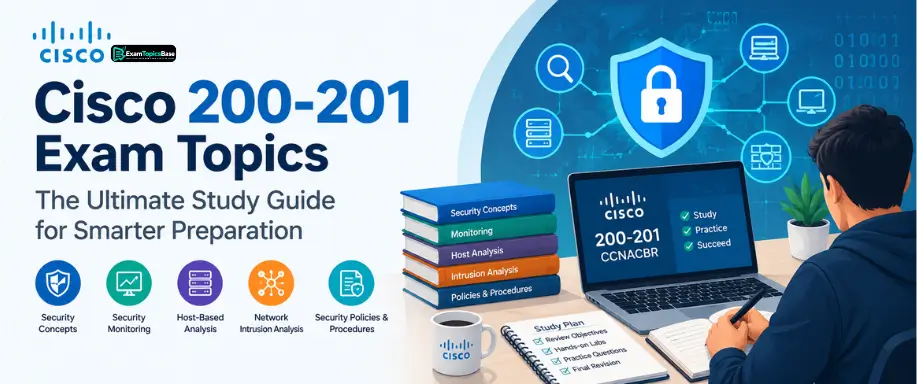
What Is the Cisco 200-201 CCNACBR Exam?
Cisco 200-201 CCNACBR is the core exam for the CCNA Cybersecurity certification and tests security concepts, security monitoring, host-based analysis, network intrusion analysis, and security policies and procedures. Cisco identifies the current exam as Understanding Cisco Cybersecurity Operations Fundamentals v1.2.
Moreover, Cisco lists the exam as 120 minutes long, delivered in English, and priced at US$300 or Cisco Learning Credits. Cisco currently lists no formal prerequisites and states that the certification is valid for three years.
Furthermore, Cisco states that the exam is graded pass/fail and that results are available online within 48 hours.
Exam detail | Current information |
Exam code | 200-201 CCNACBR |
Exam name | Understanding Cisco Cybersecurity Operations Fundamentals |
Version | v1.2 |
Certification | CCNA Cybersecurity |
Duration | 120 minutes |
Language | English |
Price | US$300 or Cisco Learning Credits |
Prerequisites | None |
Certification validity | 3 years |
At the same time, Cisco's current certification pages note that cybersecurity certification names have changed, so older online resources may use different terminology. The current Cisco certification page identifies the credential as CCNA Cybersecurity, with 200-201 CCNACBR as its core exam.
What Does 200-201 CCNACBR Actually Test?
The 200-201 CCNACBR exam tests both cybersecurity knowledge and the ability to understand security operations data. For example, a candidate may need to understand what a monitoring source reveals, how a security control works, or how evidence contributes to an investigation.
Additionally, Cisco's official exam-topics document describes its objectives as general guidelines and warns that related topics may appear on a particular exam delivery. Therefore, your Cisco 200-201 study guide should explain the concepts behind the objectives instead of treating the published list as a collection of isolated terms.
Why Is the Cisco 200-201 Exam Important for Cybersecurity Operations?
The Cisco 200-201 exam is important for cybersecurity operations because it covers the foundational knowledge used to monitor, analyze, investigate, and respond to security events. For example, a SOC analyst may need to combine endpoint information, network telemetry, and security alerts to understand suspicious activity.
Moreover, Cisco's current CCNACBR training says it provides the basic knowledge required for an associate-level cybersecurity analyst role in a threat-centric security operations center. This makes the exam relevant to learners building SOC analyst fundamentals.
At the same time, certification should be viewed as one part of professional development rather than a guarantee of employment. Practical abilities such as analyzing logs, investigating network activity, understanding operating systems, and documenting incidents remain important.
Furthermore, Cisco's training covers network infrastructure, TCP/IP vulnerabilities, Windows and Linux, security incident data, network attacks, security monitoring, SIEM, SOAR, XDR, threat intelligence, incident response, and threat hunting.
For example, knowing the definition of SIEM is useful, but understanding how an analyst could correlate an authentication event with an endpoint alert demonstrates more practical understanding.
What Are the Current Cisco 200-201 Exam Topics and Objectives?
The current Cisco 200-201 exam topics are divided into five domains: Security Concepts, Security Monitoring, Host-Based Analysis, Network Intrusion Analysis, and Security Policies and Procedures.
Moreover, Cisco's current exam-topics document assigns the following weights:
Cisco 200-201 domain | Exam weight |
Security Concepts | 20% |
Security Monitoring | 25% |
Host-Based Analysis | 20% |
Network Intrusion Analysis | 20% |
Security Policies and Procedures | 15% |
Security Monitoring is the largest domain at 25% of the current exam, while Security Concepts, Host-Based Analysis, and Network Intrusion Analysis each account for 20%.
Therefore, a practical 200-201 exam preparation strategy should allocate slightly more time to security monitoring while still covering every objective.
What Security Concepts Should You Study for Cisco 200-201?
Security concepts are the foundational principles used to understand threats, vulnerabilities, controls, detection, and protection. For example, the CIA triad describes confidentiality, integrity, and availability as core security objectives.
Furthermore, the current objectives include network, endpoint, and application security, agent-based and agentless protections, antivirus and antimalware, SIEM, SOAR, log management, cloud security, containers, and virtual environments.
Additionally, study threat intelligence, threat hunting, malware analysis, threat actors, reverse engineering, threat modeling, anomaly detection, DevSecOps, and runbook automation. These concepts help connect security theory with operational analysis.
Moreover, understand the differences between risk, threat, vulnerability, and exploit. For example, a vulnerable application may create a security weakness, while an exploit represents a method of taking advantage of that weakness.
Why Do Defense in Depth and Access Control Matter?
Defense in depth is a security strategy that uses multiple protective layers instead of depending on one control. For example, an organization may combine identity controls, endpoint protection, network segmentation, firewalls, monitoring, and incident response.
Similarly, access control models determine how users or systems receive permission to access resources. You should understand models such as role-based, rule-based, discretionary, mandatory, and attribute-based access control.
How Does Security Monitoring Work in the 200-201 Exam?
Security monitoring is the process of collecting and analyzing security data to identify suspicious activity and support investigations. For example, an analyst can compare an IDS alert with NetFlow records and endpoint logs to determine whether unusual traffic requires investigation.
Moreover, the Cisco objectives include data from tcpdump, NetFlow, next-generation firewalls, stateful firewalls, application visibility controls, web filtering, and email filtering.
Security monitoring for Cisco 200-201 includes interpreting logs, Network Security Monitoring data, NetFlow, packet captures, IDS/IPS information, and security-platform data.
Furthermore, the objectives distinguish several monitoring data types, including full packet capture, session data, transaction data, statistical information, metadata, and alert data.
What Is Network Security Monitoring?
Network Security Monitoring is the collection and analysis of network information to identify suspicious behavior and support security investigations. For example, a security analyst can examine DNS requests to identify an endpoint communicating with an unusual domain.
Additionally, NetFlow provides summarized information about network communications, helping analysts understand which systems communicated, which ports were involved, and how traffic patterns changed.
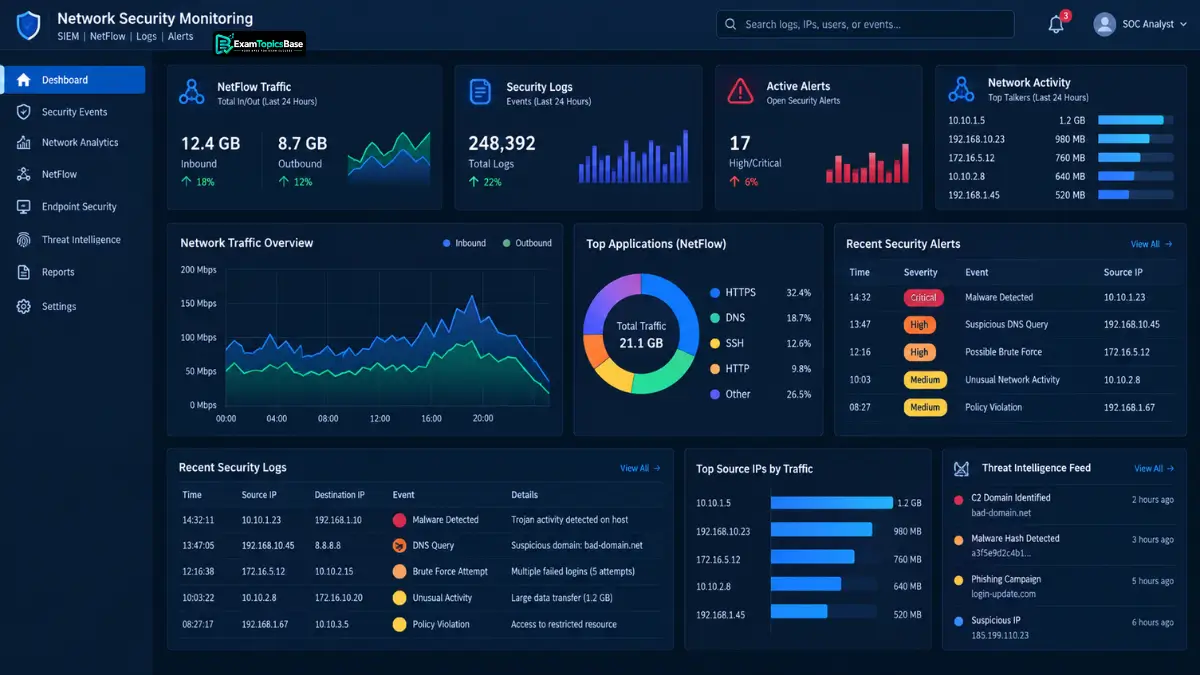
How Should You Study Security Monitoring Data?
Security monitoring data should be studied according to the visibility each source provides. For example, a full packet capture can expose protocol details and payload information that may not exist in a summarized flow record.
Therefore, practice comparing these data sources:
Full packet capture: Detailed packet-level information.
Session data: Information about communication sessions.
Transaction data: Details about individual interactions.
Metadata: Descriptive information about activity.
Statistical data: Aggregated traffic patterns.
Alert data: Notifications generated by security controls.
What Should You Know About Host-Based Analysis for 200-201?
Host-based analysis is the examination of individual systems, operating-system information, endpoint security data, and host-generated evidence during an investigation. For example, an analyst may investigate Windows event logs after an endpoint security product reports suspicious activity.
Moreover, the current objectives include host-based intrusion detection, antivirus and antimalware, host firewalls, application controls, Windows and Linux operating-system components, and security evidence.
Additionally, you should understand basic Windows and Linux concepts because operating-system knowledge helps you interpret users, processes, services, files, networking information, and logs.
What Is Endpoint Security?
Endpoint security protects individual systems such as laptops, workstations, and servers from malicious activity. For example, an endpoint protection platform may identify suspicious behavior, block an action, and create an alert for a SOC analyst.
Furthermore, Cisco includes concepts such as indicators of compromise, indicators of attack, assets, threat actors, evidence types, and chain of custody in the host-based analysis objectives.
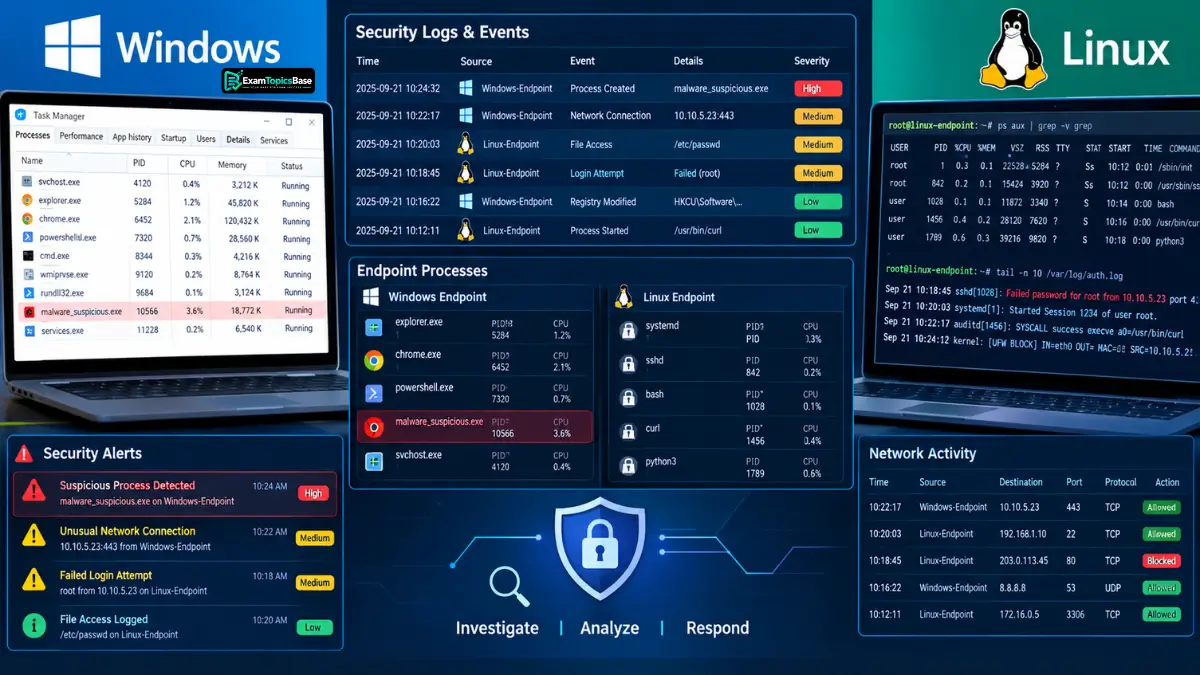
How Should You Practice Security Logs Analysis?
Security logs analysis is the process of examining records generated by operating systems, applications, network devices, and security platforms. For example, repeated failed logins followed by a successful authentication can provide an investigation lead.
Therefore, practice identifying the timestamp, source, user, host, event type, destination, and relevant indicators within sample logs. Then determine what additional evidence would be needed before classifying the activity as malicious.
How Should You Study Network Intrusion Analysis for 200-201?
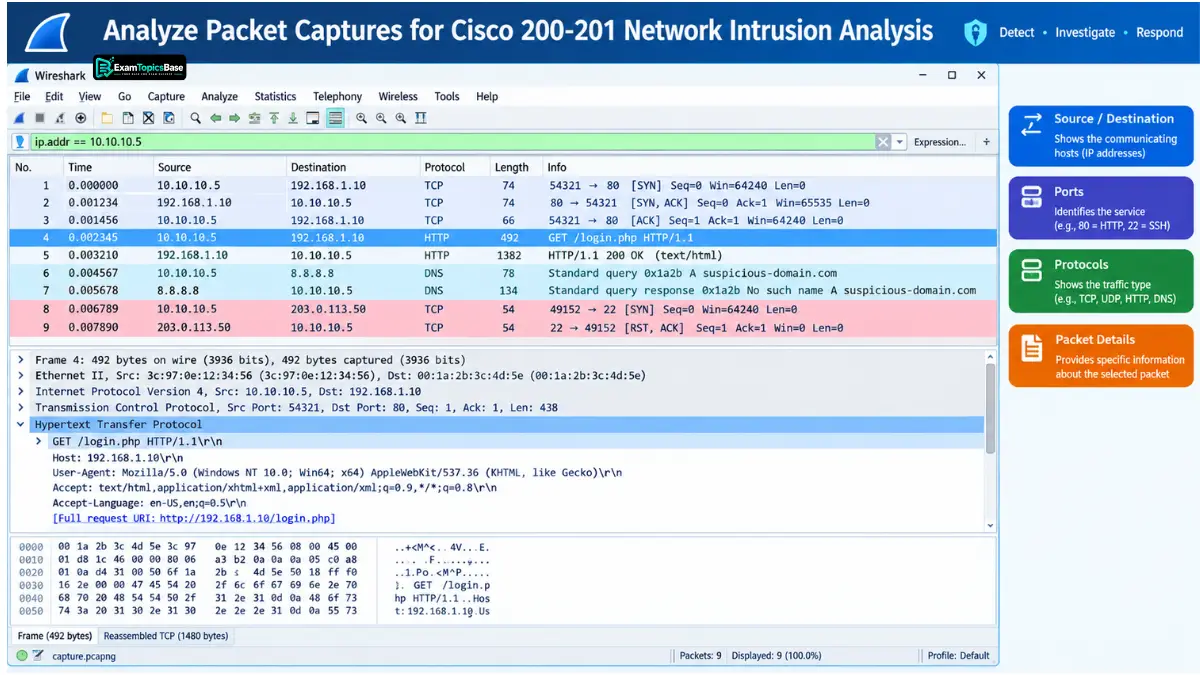
Network intrusion analysis is the process of examining network activity and security alerts to determine whether suspicious behavior represents an actual security event. For example, an analyst can correlate an IDS alert with packet-capture information to investigate a suspicious connection.
Moreover, the current objectives include IDS and IPS information, firewall data, network application control, proxy data, antivirus information, and NetFlow.
Furthermore, study true positives, false positives, true negatives, and false negatives. For example, a false positive occurs when a security control identifies legitimate activity as malicious.
How Does Packet Capture Analysis Help?
Packet capture analysis provides detailed network evidence for investigating communications and suspicious traffic. For example, Wireshark can show source and destination addresses, ports, protocols, packet details, and application-level information.
Additionally, the Cisco objectives include extracting files from TCP streams and interpreting Ethernet, IPv4, IPv6, TCP, UDP, ICMP, DNS, SMTP, POP3, IMAP, HTTP, HTTPS, HTTP/2, and ARP information.
What Security Monitoring Tools Should You Know for 200-201?
Security monitoring tools help analysts collect, correlate, investigate, and respond to security information. For example, a SOC can combine SIEM alerts, endpoint telemetry, NetFlow, IDS/IPS events, and threat-intelligence information during an investigation.
Moreover, Cisco's current training specifically includes Network Security Monitoring tools, NetFlow, packet capture and forensics, malware and threat intelligence, SIEM, SOAR, XDR, security monitoring playbooks, and threat hunting.
How Do SIEM, SOAR, and XDR Support Security Operations?
SIEM is a security platform that centralizes and correlates event information for monitoring and investigation. For example, a SIEM can correlate authentication activity from one system with network alerts from another source.
SOAR is an approach for orchestrating and automating repeatable security-response actions. For example, a SOAR playbook can enrich an alert, check an indicator against threat intelligence, and create a response task.
XDR is an extended detection and response approach that combines security signals across multiple environments. For example, XDR can connect endpoint, identity, email, and network information to provide broader incident context.
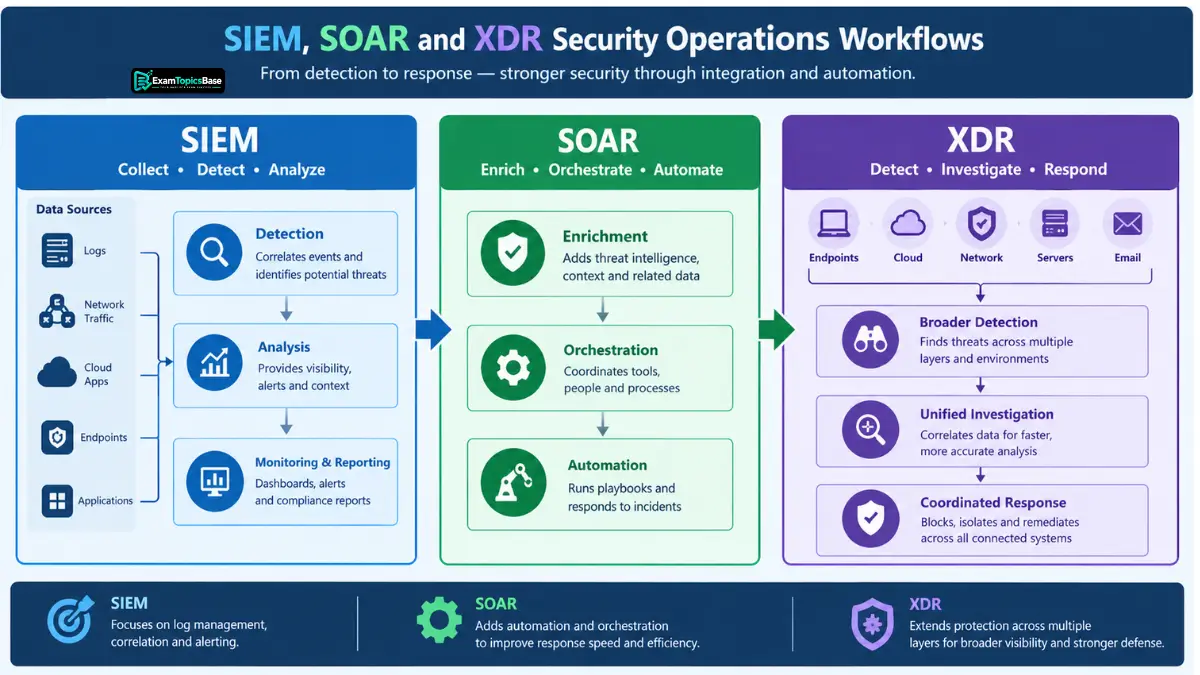
Therefore, your 200-201 exam guide should focus on what each technology does, what information it provides, and how it supports a security workflow rather than memorizing vendor-specific screens.
What Other Security Concepts Should You Practice?
Threat intelligence provides information about threats, indicators, adversaries, and attack activity that can support investigations. For example, an analyst may check whether a suspicious domain appears in available threat-intelligence information.
Threat hunting is a proactive search for suspicious behavior that may not have generated a conventional alert. For example, a hunter could search DNS records for unusual query patterns across multiple endpoints.
MITRE ATT&CK is a framework for organizing adversary tactics and techniques. For example, an analyst can use ATT&CK terminology to describe how an attacker attempted persistence or credential access.
Furthermore, malware analysis, incident response, security playbooks, endpoint security, and network security controls should be studied as connected parts of cybersecurity operations.
How Can You Build a Cisco 200-201 Study Plan?
A Cisco 200-201 study plan is a structured schedule that divides the exam objectives into focused learning, hands-on practice, and revision activities. For example, an eight-week plan can progress from fundamentals to monitoring, investigation, incident response, and final assessment.
Week | Study focus | Practical activity |
1 | Security fundamentals | CIA triad, threats, vulnerabilities, risk, access control |
2 | Security monitoring | Logs, NetFlow, tcpdump, IDS/IPS, monitoring data |
3 | Windows and Linux | Users, processes, services, logs, endpoint security |
4 | Network analysis | PCAPs, protocols, alerts, intrusion analysis |
5 | SIEM, SOAR, XDR | Correlation, automation, playbooks, response workflows |
6 | Incident response | Evidence, stakeholders, response processes, SOC procedures |
7 | Practice and review | Practice questions and targeted weak-area exercises |
8 | Final preparation | Full review, practical scenarios, timed practice test |
First, use Week 1 to build the vocabulary required for later analysis. A strong foundation makes technical topics such as threat hunting and SIEM correlation easier to understand.
Second, use Weeks 2 through 5 to develop operational knowledge. Spend time analyzing examples instead of simply reading definitions.
Third, use Weeks 6 through 8 to connect technical analysis with incident response and exam practice.
Source: 200-201 CCNACBR Exam Topics and Study Guide
What Hands-On Skills Should You Practice Before the 200-201 Exam?
Hands-on 200-201 preparation can include investigating suspicious DNS activity, analyzing Windows and Linux systems, correlating event logs with packet captures and alerts, exploring SOC playbooks, and identifying malicious traffic. Cisco's current training specifically includes these types of laboratory activities.
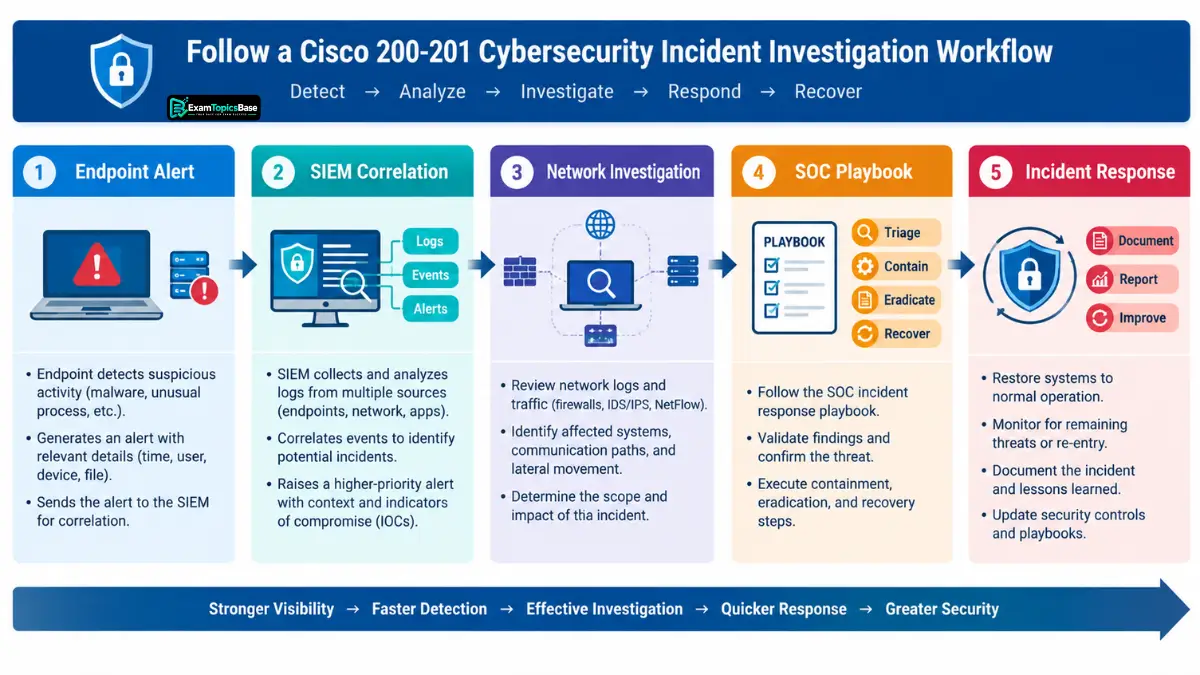
Moreover, you can build a simple investigation scenario around suspicious DNS traffic. For example, identify the requesting host, examine the domain, review related network activity, and determine what additional evidence should be collected.
Additionally, practice correlating three types of evidence rather than examining each source separately. For example, compare an endpoint event, a network alert, and a PCAP to determine whether they describe the same activity.
Finally, use free tools where possible. Wireshark, tcpdump, Linux utilities, and locally generated logs can provide useful practice without requiring a commercial SOC platform.
How Can You Use Practice Questions for Cisco 200-201 Preparation?
Cisco 200-201 practice questions are most useful when they help you identify knowledge gaps and apply concepts to unfamiliar situations. For example, after studying NetFlow, use practice questions to test whether you can distinguish flow information from full packet-capture evidence.
Moreover, a 200-201 practice test should be treated as a diagnostic tool rather than a replacement for learning. Review each missed question and identify whether the problem came from terminology, networking, operating systems, security monitoring, or incident response.
Furthermore, third-party exam-dump material should not be treated as official Cisco content. Official Cisco objectives, training, and practical exercises should remain the foundation of Cisco 200-201 practice.
How Can You Identify Weak Areas During 200-201 Preparation?
Weak areas during 200-201 exam preparation are topics where you repeatedly struggle to explain, interpret, or apply an objective. For example, if you can define NetFlow but cannot explain what information it provides compared with a PCAP, the concept needs more practice.
First, track missed questions by domain instead of relying only on an overall score. This approach can reveal whether your difficulties are concentrated in monitoring, host analysis, intrusion analysis, security concepts, or policies.
Second, turn each weak topic into a practical task. If security logs analysis is difficult, work through sample authentication or endpoint events and identify the fields that matter to an investigation.
Third, repeat the exercise later without your notes. The ability to explain the concept independently is a stronger study signal than simply recognizing the correct answer.
Get Free Cisco Real Exam Questions & Answers of Here:https://examtopicsbase.com/vendors/cisco
How Can You Tell If You Are Ready for the Cisco 200-201 Exam?
You are ready for the Cisco 200-201 exam when you can explain the current objectives, interpret common security data, complete practical investigation exercises, and identify weak areas without relying entirely on memorization. For example, you should be able to explain why an analyst might use NetFlow, PCAP, endpoint logs, or SIEM data in different situations.
Use this final readiness checklist:
I understand all five current 200-201 domains.
I can explain the CIA triad.
I understand threats, vulnerabilities, exploits, and risk.
I can explain defense in depth and access control.
I understand SIEM, SOAR, and XDR.
I understand Network Security Monitoring.
I can interpret basic security logs.
I understand Windows and Linux security concepts.
I understand endpoint security.
I can interpret basic packet-capture information.
I understand IDS and IPS.
I understand NetFlow security monitoring.
I can explain threat intelligence and threat hunting.
I understand basic incident-response concepts.
I have completed practical investigation exercises.
I have reviewed my weak areas.
I can explain major concepts without relying entirely on memorization.
Furthermore, Cisco lists the exam duration as 120 minutes, so timed practice can help you become comfortable working within the available testing period.
What Tools and Resources Can You Use for Cisco 200-201 Preparation?
Cisco 200-201 preparation can combine official Cisco resources, hands-on analysis tools, free learning platforms, and structured practice. For example, Cisco provides Cisco U. learning paths and Cisco Networking Academy resources for cybersecurity learning.
Moreover, Cisco states that Cisco U. study is not required for the exam but recommends it as a preparation option. Cisco Networking Academy also provides free learning options, giving learners an accessible way to strengthen cybersecurity fundamentals.
Additionally, free tools such as Wireshark, tcpdump, Linux command-line utilities, and sample logs can support practical learning. These tools are useful for developing analysis habits even when an enterprise SOC uses different commercial platforms.
What Should You Do After Preparing for Cisco 200-201?
After preparing for Cisco 200-201, you should complete a final review, verify your readiness, schedule the exam when appropriate, and continue developing practical cybersecurity skills. For example, review the current Cisco objectives and make sure every domain has received focused attention.
Furthermore, verify current exam information immediately before scheduling because Cisco can update certification requirements, objectives, and exam information over time. The official Cisco exam page should therefore remain your final source for scheduling details.
Additionally, continue practicing cybersecurity operations after the exam. Skills such as security logs analysis, packet capture analysis, network monitoring, threat hunting, endpoint investigation, and incident response become stronger through repeated practical use.
Conclusion
Cisco 200-201 exam preparation is a combination of current exam objectives, security fundamentals, monitoring knowledge, investigation skills, hands-on practice, and systematic revision. The current 200-201 CCNACBR exam covers five major domains, with Security Monitoring carrying the largest weighting at 25%.
Moreover, effective preparation should go beyond memorizing definitions. You should practice interpreting logs, understanding NetFlow, examining packet captures, recognizing IDS and IPS information, analyzing endpoint evidence, and connecting alerts to broader investigation workflows.
Furthermore, a structured 200-201 study plan makes a broad syllabus easier to manage. Use Cisco's current objectives as the foundation, supplement them with practical exercises and practice questions, and revisit weak topics until you can explain and apply them independently.
Finally, ExamTopicsBase can provide additional Cisco 200-201 exam topics, study resources, practice questions, and preparation materials to complement official Cisco learning resources. The strongest preparation strategy combines trustworthy reference material with hands-on cybersecurity operations practice.
Frequently Asked Questions
1. What is the Cisco 200-201 exam?
Cisco 200-201 is Understanding Cisco Cybersecurity Operations Fundamentals, identified as 200-201 CCNACBR v1.2. It is the core exam associated with the CCNA Cybersecurity certification and covers security concepts, security monitoring, host-based analysis, network intrusion analysis, and security policies and procedures.
2. How long is the Cisco 200-201 exam?
The Cisco 200-201 exam is 120 minutes long. Cisco currently lists the exam in English and lists its price as US$300 or Cisco Learning Credits.
3. What are the main Cisco 200-201 exam topics?
The five main Cisco 200-201 exam topics are Security Concepts, Security Monitoring, Host-Based Analysis, Network Intrusion Analysis, and Security Policies and Procedures. Security Monitoring currently carries the largest weighting at 25%.
4. Is Cisco 200-201 suitable for beginners?
Cisco 200-201 can be studied by beginners, but basic networking, Windows/Linux, and security knowledge can make preparation easier. Cisco's related training recommends familiarity with Ethernet/TCP/IP, Windows, Linux, and basic network-security concepts.
5. What should I study first for 200-201?
Start with the current Cisco 200-201 exam objectives and security fundamentals. Then move into security monitoring, host-based analysis, network intrusion analysis, and security policies while adding practical exercises to reinforce each domain.
6. Does Cisco 200-201 cover SIEM and SOAR?
Yes. The current security-concepts objectives include SIEM and SOAR, while Cisco's related training also covers SIEM, SOAR, XDR, security monitoring playbooks, threat intelligence, and incident response.
7. Do I need hands-on practice for Cisco 200-201?
Hands-on practice is useful because the exam covers operational analysis concepts. Cisco's training includes practical activities involving Windows, Linux, endpoint security, suspicious DNS activity, PCAPs, event logs, alerts, SOC playbooks, and malicious traffic.
8. How should I use a 200-201 practice test?
Use a 200-201 practice test to identify knowledge gaps rather than treating the score as the only measure of readiness. Review incorrect answers, identify the related objective, and complete targeted study or practical exercises before testing again.
9. Does Cisco 200-201 have prerequisites?
Cisco currently lists no formal prerequisites for 200-201 CCNACBR. However, Cisco's related training recommends familiarity with Ethernet/TCP/IP, Windows, Linux, and basic network-security concepts.
10. What certification do I earn after passing 200-201?
Passing 200-201 CCNACBR earns the CCNA Cybersecurity certification under Cisco's current certification structure. Cisco currently lists the certification as valid for three years, and the exam can also be used toward recertification.
You may also like to read:
What Is the Cisco 820-605 Exam? | Topics, Tips & Preparation Guide
CCNA 200-301 V2.0 | What’s Changing for the February 2027 Exam?

Written by Marcus Vance
I’m Marcus Vance, a Cisco Solutions Architect and technical contributor at ExamTopicsBase. Having designed mission-critical enterprise backbones and navigated Cisco's certification tracks for over a decade, I focus on delivering accurate, real-world packet analyses and blueprint-aligned practice questions so you can pass your exam with total confidence.
Comments (0)
Leave a Reply
No comments yet. Be the first to share your thoughts!