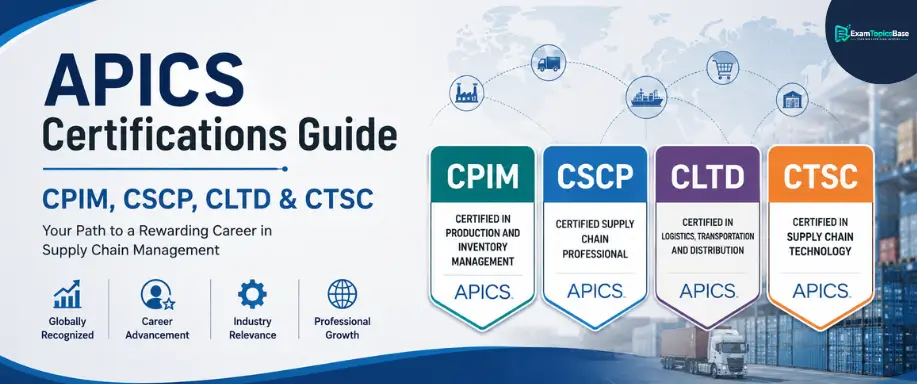
APICS certification is a premier suite of globally recognized professional credentials administered by the Association for Supply Chain Management (ASCM). Designed to establish standardized operational excellence across industries, these credentials validate an individual's mastery of end-to-end supply chain architecture, internal production planning, warehouse network optimization, and digital enterprise transformation.
Originally founded in 1957 as the American Production and Inventory Control Society (APICS), the organization rebranded its broader operational wing to ASCM while keeping the "APICS" designation as the elite benchmark for individual professional certification. Among prominent global supply chain management organizations, holding an APICS credential signals that a practitioner speaks the universal language of supply chain operations. Whether an employer is evaluating plant inventory accuracy, multi-tier procurement risk, or freight distribution bottlenecks, APICS-certified talent brings structured, data-driven problem-solving to the table.
If you are evaluating which supply chain management certifications align with your career goals, this guide breaks down the core credentials—CPIM, CSCP, CLTD, and CTSC—alongside exam structures, preparation strategies, and real-world costs.
Quick Comparison: Which APICS Supply Chain Professional Certification Is Right for You?
Selecting the right credential depends on where your day-to-day work lives within the value chain. While some professionals oversee factory-floor master scheduling, others negotiate cross-border trade agreements or lead complex ERP migrations. You can explore all official paths directly through the ASCM Certifications Directory.
Certification | Full Designation | Core Operational Focus | Ideal Target Roles | Typical Exam Format |
CPIM | Certified in Planning and Inventory Management | Internal operations, Master Scheduling, MRP, capacity planning | Production Planners, Materials Managers, Inventory Controllers | 150 questions (3.5 hours) |
Certified Supply Chain Professional | End-to-end extended supply chain, sourcing, risk, customer integration | Supply Chain Managers, Directors, Global Sourcing Analysts | 150 questions (3.5 hours) | |
Certified in Logistics, Transportation and Distribution | Global freight routing, distribution center layout, international trade | Logistics Coordinators, Warehouse Directors, 3PL Managers | 150 questions (3.5 hours) | |
CTSC | Certified in Transformation for Supply Chain | Digital transformation frameworks, SCOR-DS, change management | Transformation Leads, Process Engineers, Enterprise Architects | 150 questions (3.5 hours) |
Get Free APICS Real Exam Questions & Answers of Here: https://examtopicsbase.com/vendors/apics
1. APICS CPIM Certification (Certified in Planning and Inventory Management)
The APICS CPIM certification represents ASCM's longest-standing credential. Often referred to in the industry as the foundational cpim cert, this credential addresses the mechanics of what happens directly inside an organization's four walls—from the raw material dock to the final production staging area.
Planning Hierarchy Level | Operational Stage | Primary Planning Focus & Objective |
Level 1: Strategic Planning | Sales & Operations Planning (S&OP) | Aligns executive business strategy, financial budgets, and high-level market demand. |
Level 2: Tactical Scheduling | Master Production Schedule (MPS) | Converts aggregate demand into disaggregated manufacturing timetables for finished goods. |
Level 3: Component Detailing | Material Requirements Planning (MRP) | Explodes the Bill of Materials (BOM) to schedule raw component purchase and delivery. |
Level 4: Execution & Control | Capacity Planning & Inventory Control | Validates work center loads via CRP and controls buffer stocks, scrap rates, and WIP. |
Core Domains and Exam Content
The CPIM body of knowledge revolves around matching supply capabilities with customer demand:
Demand Management & Forecasting: Utilizing statistical forecasting methods to establish baseline operational requirements.
Master Production Scheduling (MPS): Translating aggregate demand forecasts into realistic manufacturing timelines.
Material Requirements Planning (MRP): Exploding the Bill of Materials (BOM) to verify exact component timing and quantity.
Capacity Management: Executing Rough-Cut Capacity Planning (RCCP) and Capacity Requirements Planning (CRP) to eliminate production bottlenecks.
Inventory Governance: Cycle counting strategies, buffer stock calculation, economic order quantities (EOQ), and mitigating the bullwhip effect.
The CPIM Exam Format and Scoring
The modern cpim exam is a single, unified examination. ASCM consolidated the historic two-part model (Part 1 and Part 2) into one comprehensive test containing 150 multiple-choice questions (130 operational, 20 unscored pretest questions) with a 3.5-hour time window. Candidates receive a scaled score between 200 and 350; achieving a 300 or higher is required to earn the cpim certificate.
Preparing with the CPIM Learning System
Achieving proficiency requires familiarity with the official CPIM learning system. This system includes modular reading units that trace directly to the Exam Content Manual (ECM) alongside pre-tests, chapter-level quizzes, and full-length simulated practice exams. Most professionals invest between 100 and 140 hours of focused study to comfortably pass the exam.
2. APICS CSCP Certification (Certified Supply Chain Professional)
Introduced to serve the broader strategic ecosystem, the certified supply chain professional cscp designation takes a holistic, outside-in approach. While CPIM focuses heavily on manufacturing plants and internal warehouses, an APICS certified supply chain professional orchestrates the complex flow of capital, physical goods, and information across independent, globally distributed business entities.
Supply Chain Segment | Primary Function | Key Core Activities & Governance |
Upstream (Tier-2 / Tier-1) | Supplier Relationship Management | Vendor onboarding, contractual SLA management, and multi-tier supplier risk profiling. |
Inbound Gateway | International Logistics & Customs | Tariff management, customs clearance, bonded storage, and carrier performance tracking. |
Internal Operations | Manufacturing & Demand Alignment | Cross-functional integration, internal capacity orchestration, and operational working capital. |
Outbound Fulfillment | Distribution & 3PL/4PL Routing | Multimodal transport execution, warehouse distribution centers, and last-mile freight. |
Downstream Loop | Customer Management & Reverse Logistics | Customer segmentation, SLA monitoring, returns management, and circular economy loops. |
Global Scope: End-to-End Supply Chain Operations
The apics cscp certification focuses on the friction points between external and internal partners:
Supply Chain Design & Network Architecture: Configuring manufacturing sites, distribution hubs, and communication infrastructure to match corporate strategy.
Upstream Supplier Relationship Management (SRM): Multi-tier visibility, supplier risk profiling, and total cost of ownership (TCO) calculations.
Downstream Customer Relationship Management (CRM): Managing customer segmentation, service level agreements (SLAs), and reverse logistics loops.
Risk, Sustainability, and Governance: Addressing disruptions, circular economy mandates, ESG disclosures, and international regulatory compliance.
The CSCP Exam Structure & Passing Standards
The cscp exam features 150 multiple-choice questions administered over a 3.5-hour sitting. Candidates sit for the exam at physical testing centers or remotely. Like CPIM, scoring is calibrated on a scale of 200 to 350, with 300 representing the passing cutoff.
How to Study for the CSCP Certification APICS Exam?
Candidates preparing for the cscp certification apics typically select between independent study through the online learning system or interactive instructor-led classes offered by ASCM chapters. Because the CSCP requires synthesis across finance, risk, and IT disciplines, working through the ECM flashcards and scenario-based case questions is crucial for mastering the situational questions favored by ASCM.
3. APICS CLTD & CTSC: Logistics and Digital Transformation
Beyond production and broad supply chain strategy, ASCM provides specialized credentials designed for targeted functional tracks.
APICS CLTD: Logistics, Transportation and Distribution
The APICS CLTD credential is built for managers operating within the physical movement and storage layers of commerce. As global trade rules, freight tariffs, and e-commerce distribution demands intensify, specialized logistics certifications have become critical organizational assets:
Order Management & Warehouse Layout: Maximizing cubic storage capacity, designing efficient picking paths, and deploying warehouse management systems (WMS).
Transportation Modes and Infrastructure: Assessing maritime, intermodal, over-the-road (OTR), and air freight trade-offs based on transit velocity and emissions.
Global Trade & Customs Compliance: Navigating Incoterms, customs clearance documents, bonded storage, and dangerous goods classifications.
APICS CTSC: Transformation for Supply Chain
Launched to support organizational disruption, the APICS CTSC framework provides a blueprint for enterprise-wide systems transformation. Anchored in the ASCM SCOR Digital Standard (SCOR-DS) and the Digital Capabilities Model (DCM), the CTSC guides professionals through:
Identifying functional performance gaps using benchmarking metrics.
Managing enterprise change architectures and overcoming organizational inertia.
Evaluating emerging technologies such as automated track-and-trace, artificial intelligence demand engines, and digital twins.
APICS Certification Cost, Exam Fees & Retake Policies
Navigating apics certification cost structures requires understanding ASCM’s membership framework. ASCM uses a tiered pricing model that significantly favors members who purchase the Certification Upgrade add-on alongside their base membership.
Fee Component | Standard Rate | With Certification Upgrade | Net Savings & Financial Benefit |
Annual ASCM Membership | $99 / year | $99 + $100 upgrade ($199 total) | Unlocks member-exclusive credential discounts across all exams. |
Exam & Prep Bundle | ~$3,200 – $3,650 | ~$2,300 – $2,620 | Saves $900 – $1,030 on study materials and voucher bundles. |
2nd Chance Exam Option | Paid add-on ($400+) | Included with eligible bundle | Provides a free retake voucher if you do not pass on attempt one. |
Each Certification Costs
Credential | Member Bundle (with Upgrade) | Non-Member / Standard Bundle | Standalone Exam Fee (Member vs. Non) | Retake Fee (Outside of Bundle) |
CPIM | ~$2,300 – $2,620 USD | ~$3,200 – $3,650 USD | $1,450 / $2,015 USD | $400 – $500 USD |
CSCP | ~$2,620 USD | ~$3,650 USD | $1,450 / $2,015 USD | $400 – $500 USD |
CLTD | ~$2,300 – $2,620 USD | ~$3,200 – $3,650 USD | $1,450 / $2,015 USD | $400 – $500 USD |
CTSC | ~$2,300 – $2,620 USD | ~$3,200 – $3,650 USD | $1,450 / $2,015 USD | $400 – $500 USD |
Note: Bundles typically include the comprehensive Learning System, physical and digital textbooks, the exam voucher, and ASCM's "2nd Chance Exam" retake policy. Purchasing the bundle with an upgraded membership delivers the highest return on investment compared to buying study manuals and exam vouchers à la carte.
Head-to-Head: APICS CPIM vs. CSCP
The most frequent crossroad for supply chain practitioners is deciding between apics cpim and apics cscp. Choosing the wrong exam can lead to studying concepts disconnected from your daily responsibilities.
Evaluation Metric | APICS CPIM (Internal Operational Depth) | APICS CSCP (Global Strategic Breadth) |
Primary Scope | Inside plant & internal warehouse walls | End-to-end extended global enterprise network |
Dominant Subjects | Demand planning, MPS, MRP, shop-floor execution | Global sourcing, CRM, logistics networks, risk, ESG |
Key Core KPIs | Schedule adherence, inventory turns, scrap, OTIF | Cash-to-cash cycle, total cost of ownership, net risk |
Level of Detail | High operational, procedural, and mathematical rigor | High strategic, cross-functional, and executive scope |
Ideal Role Match | Planners, schedulers, buyers, plant managers | Supply chain managers, directors, sourcing analysts |
Choose CPIM if: You deal primarily with scheduling jobs, calculating safety stock, maintaining bill of materials accuracy, running MRP runs, and working alongside plant floor operations. It is a technically detailed, procedural qualification.Choose CSCP if: You work across multiple business functions, manage international suppliers, evaluate freight contracts, or work with enterprise sales teams to align regional inventories. It functions like an applied supply chain MBA.
Step-by-Step: How to Earn and Maintain Your APICS Credential
Earning an APICS designation requires disciplined preparation and structured execution:
Confirm Alignment: Review ASCM exam content outlines to evaluate which credential fits your immediate career path.
Secure Membership with Certification Upgrade: Join ASCM ($99/year) and add the Certification Upgrade ($100/year) before purchasing materials to unlock the lowest package rates.
Master the Learning System: Dedicate 100 to 150 hours of structured study time. Complete the online pre-test to establish a baseline, read the modules, and do not schedule your exam until your practice post-tests consistently score above 85%.
Acquire an Authorization to Test (ATT): Request your exam voucher via your ASCM portal and redeem it on the official Pearson VUE APICS Portal.
Take the Exam: Choose between an in-person facility or an online-proctored remote session.
Maintain Certification: To retain your credential, log 75 professional development points every five years. Points are earned through webinars, industry conferences, local chapter events, professional projects, and ongoing coursework.
Frequently Asked Questions
What is the difference between APICS and ASCM?
APICS originally stood for the American Production and Inventory Control Society. In 2019, the organization transitioned into ASCM (Association for Supply Chain Management) to expand its global industry research and corporate partnerships. However, the professional certifications themselves retain the APICS brand name.
What is the passing score for APICS certification exams?
All APICS exams use a scaled scoring model between 200 and 350. A candidate must score 300 or higher to receive a passing grade.
Can I take APICS exams online from home?
Yes. Candidates can schedule their exams through Pearson VUE’s OnVUE remote proctoring service or take them in person at an official Pearson VUE test center.
Do APICS certifications expire?
Yes, certifications expire after five years. To maintain the credential, holders must log 75 continuing professional development points within that five-year window.
What are the prerequisites to take the CPIM exam?
There are no formal educational or professional prerequisites required to sit for the CPIM exam, making it accessible to early-career professionals and career switchers.
Are there prerequisites to take the CSCP exam?
While ASCM historically enforced formal degree and experience prerequisites for CSCP, candidates can now sit for the exam directly. However, ASCM strongly recommends at least three years of related business experience due to the advanced strategic nature of the content.
How long does it take to prepare for an APICS certification?
Most candidates spend between 100 and 150 hours studying over a 3- to 6-month period, depending on their prior industry experience and daily study schedule.
What is the ASCM 2nd Chance Exam policy?
ASCM includes a "2nd Chance Exam" voucher in qualifying Learning System and exam bundle packages. If a candidate does not pass on their first attempt, they receive one complimentary retake voucher valid for a designated testing window.
Which APICS certification pays the highest salary?
Because CSCP and CTSC credentials focus on executive management, enterprise transformation, and strategic sourcing, holders often occupy senior managerial and director roles that command higher average compensation.
Can I write post-nominal letters on my resume after passing?
Yes. Once you pass an APICS certification, you are legally entitled to append the designation after your name (e.g., Jane Doe, CPIM or John Smith, CSCP) and showcase an official verifiable digital credential badge via Credly.

Written by Julia Mercer
I’m Julia Mercer, a Microsoft Solutions Architect and technical contributor at ExamTopicsBase. Having navigated the evolving Microsoft certification roadmap throughout my career in enterprise IT, I focus on delivering accurate, scenario-tested practice questions and clear, blueprint-aligned explanations so you can walk into your test with total confidence.
Comments (0)
Leave a Reply
No comments yet. Be the first to share your thoughts!