
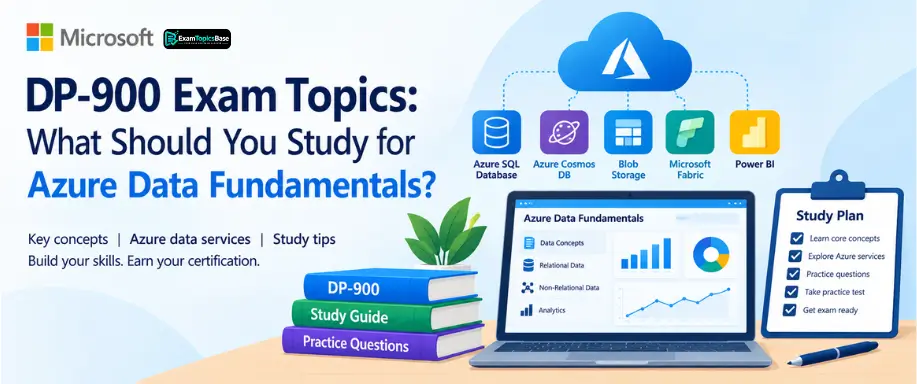
What Is the DP-900 Exam and Azure Data Fundamentals Certification?
DP-900 is Microsoft's exam for Azure Data Fundamentals, a beginner-level certification that demonstrates foundational knowledge of core data concepts and related Azure data services. Microsoft describes the certification as intended for candidates who are beginning to work with data in the cloud.
Moreover, the current certification expects familiarity with relational and non-relational data and different types of data workloads, including transactional and analytical workloads. For example, a learner might need to distinguish a relational database used for structured business transactions from an analytical system designed to examine large volumes of historical data.
DP-900 exam detail | Current information |
Certification | Microsoft Certified: Azure Data Fundamentals |
Exam | DP-900 |
Level | Beginner |
Product | Microsoft Azure |
Primary subject | Databases and data fundamentals |
Current skills update | July 21, 2026 |
Passing score | 700 or greater |
Exam duration | 45 minutes |
Exam price | US$99* |
Practice resources | Practice Assessment and Exam Sandbox |
*Pricing is based on the country or region where the exam is proctored. Microsoft currently lists US$99 as the displayed base price.
Additionally, Microsoft states that a score of 700 or greater is required to pass the exam. The current exam page lists a 45-minute assessment, while regional pricing can vary.
Who Should Take the Microsoft DP-900 Exam?
DP-900 is designed for people beginning to work with data in the cloud and who need foundational knowledge rather than advanced data-engineering expertise. For example, students, junior IT professionals, aspiring data analysts, developers, and career changers can use the certification to organize their understanding of Azure data concepts.
At the same time, DP-900 does not require you to become an advanced database administrator before starting. Instead, you should become comfortable with basic concepts such as tables, databases, storage, data workloads, analytics, and visualization.
Why Is the DP-900 Certification Important for Azure Data Beginners?
The DP-900 certification matters because it establishes foundational knowledge of data concepts and Azure data services without requiring advanced data-engineering specialization. This foundation can make later Azure data learning easier because you first understand the difference between data models, workloads, storage options, and analytics approaches.
For example, someone who understands transactional versus analytical workloads can make more informed decisions when studying Azure SQL Database, Microsoft Fabric, Azure Databricks, or Power BI.
Moreover, Microsoft says Azure Data Fundamentals can help learners prepare for role-based certifications such as Azure Database Administrator Associate and Azure Data Engineer Associate, although DP-900 is not a prerequisite for either certification.
Importantly, certification alone does not guarantee employment or professional advancement. Instead, the strongest value comes from combining certification preparation with practical understanding and the ability to apply data concepts to realistic scenarios.
What Are the Current DP-900 Exam Topics and Objectives?
The current DP-900 exam measures four major skill areas: core data concepts, relational data on Azure, non-relational data on Azure, and analytics workloads. Microsoft currently lists the skills measured as of July 21, 2026, so candidates should use the current study guide rather than relying on an outdated exam outline.
DP-900 skill area | Current weight |
Describe core data concepts | 25–30% |
Identify considerations for relational data on Azure | 20–25% |
Describe considerations for working with non-relational data on Azure | 15–20% |
Describe an analytics workload on Azure | 25–30% |
The largest current weighting is 25–30% for core data concepts and 25–30% for analytics workloads.
Meanwhile, relational data accounts for 20–25%, while non-relational data accounts for 15–20%.
Therefore, your study plan should give substantial attention to both fundamentals and analytics instead of spending most of your time memorizing individual Azure services.
Microsoft also notes that the listed bullets illustrate how skills are assessed and that related topics may appear on the exam.
What Are the Core Data Concepts Covered in DP-900?
DP-900 core data concepts cover how data is represented, stored, processed, and used across common workloads. The current objectives include structured, semi-structured, and unstructured data, common data stores, transactional workloads, analytical workloads, and the roles involved in data workloads.
What Is Structured, Semi-Structured, and Unstructured Data?
Structured data follows a defined organizational model, semi-structured data uses flexible structures or metadata, and unstructured data does not follow a fixed tabular structure. For example, a customer table is structured, a JSON document is semi-structured, and an image or video file is generally unstructured.
First, structured data commonly appears in relational databases where rows, columns, tables, and relationships provide a predictable model. For example, an employee database may contain columns for employee ID, department, role, and salary.
Second, semi-structured data can contain organizational information without requiring a rigid relational table. For example, JSON documents can contain nested objects and fields that vary between records.
Finally, unstructured data includes content such as documents, images, audio, and video. For example, a company might store customer-support recordings as files while maintaining related metadata separately.
What Is the Difference Between Transactional and Analytical Workloads?
Transactional workloads handle operational activities such as creating, updating, and retrieving individual business records, while analytical workloads focus on examining data to discover trends and support decisions. For example, an online store uses transactional processing when a customer places an order, while analysts use historical sales data to identify purchasing trends.
Moreover, transactional systems typically prioritize consistent and reliable operations. Analytical systems instead emphasize querying, aggregation, reporting, and analysis across larger collections of data.
This distinction is important because DP-900 tests whether you understand why different data solutions exist, not merely whether you can recognize Azure service names.
What Relational Data Topics Should You Study for DP-900?
DP-900 relational data preparation focuses on relational concepts, analytical data stores, and Azure services that support structured data workloads. Microsoft currently allocates 20–25% of the exam to considerations for relational data on Azure.
How Does Azure SQL Database Fit Into DP-900 Preparation?
Azure SQL Database is a managed relational database service that should be understood as part of the broader Azure relational-data ecosystem. For example, a business application can store customers, products, orders, and invoices in relational tables with defined relationships.
First, review basic relational concepts such as tables, rows, columns, keys, relationships, and schemas. These concepts provide the foundation needed to understand why relational databases are useful for structured transactional information.
What Relational Concepts Should You Practice?
Relational database concepts describe how structured data is organized into related tables and queried through database systems. For example, a sales database might connect a Customers table to an Orders table using a customer identifier.
Practice the following concepts:
Tables, rows, and columns
Primary and foreign keys
Relationships between entities
Relational schemas
SQL concepts
Relational database workloads
Analytical data stores
Managed Azure database services
Moreover, avoid studying these concepts as isolated definitions. Instead, create simple scenarios and ask which data structure would make the information easiest to store, retrieve, and analyze.
Source: Study guide for Exam DP-900: Microsoft Azure Data Fundamentals
What Non-Relational Data Topics Should You Study for DP-900?
DP-900 non-relational data preparation focuses on data models and Azure services designed for flexible, document-oriented, key-value, object, and other non-tabular workloads. Microsoft currently allocates 15–20% of the exam to considerations for working with non-relational data on Azure.
What Should You Know About Azure Cosmos DB for DP-900?
Azure Cosmos DB is an Azure database service that supports non-relational data scenarios and should be studied in the context of appropriate workload requirements. For example, an application that stores flexible JSON-style customer profiles may use a document-oriented data model rather than a traditional relational schema.
Furthermore, focus on understanding the relationship between data model and workload. You do not need to memorize every advanced Cosmos DB configuration for a fundamentals-level exam.
Instead, ask practical questions such as: Does the application need flexible document structures? Does the data naturally fit a relational table? Does the workload require a globally distributed cloud database?
What Should You Study About Azure Blob Storage?
Azure Blob Storage is designed for storing large amounts of unstructured object data such as files, images, documents, and media. For example, an organization can use Blob Storage to store product images while keeping product metadata in a database.
At the same time, do not confuse object storage with a relational database. Blob Storage is optimized for storing objects rather than representing business relationships through tables and foreign keys.
Microsoft's current DP-900 study resources specifically include documentation for Azure Blob Storage, Azure Table Storage, Azure Storage, Azure Cosmos DB, and other Azure data services.
What Analytics Topics Are Covered in the DP-900 Exam?
DP-900 analytics covers analytical workloads, large-scale analytics, real-time analytics, batch and streaming data, and data visualization with Power BI. Analytics represents 25–30% of the current exam, making it one of the largest measured skill areas.
What Is the Difference Between Batch and Streaming Data?
Batch processing handles data in groups, while streaming processing handles data continuously or near continuously as it becomes available. For example, a retailer might process yesterday's sales in a scheduled batch while monitoring live website events through a streaming pipeline.
Moreover, the correct processing approach depends on the business requirement. A monthly report may work well with batch processing, while fraud detection or live telemetry may require more immediate processing.
How Do Azure Databricks and Microsoft Fabric Relate to DP-900?
Azure Databricks and Microsoft Fabric are Microsoft cloud services that candidates should recognize in the context of large-scale analytics and data workloads. For example, an analytics team might use large-scale processing capabilities to transform and analyze substantial datasets before producing business insights.
Microsoft's current study guide specifically includes Azure Databricks and Microsoft Fabric when describing Microsoft cloud services for large-scale analytics.
What Power BI Concepts Should You Study?
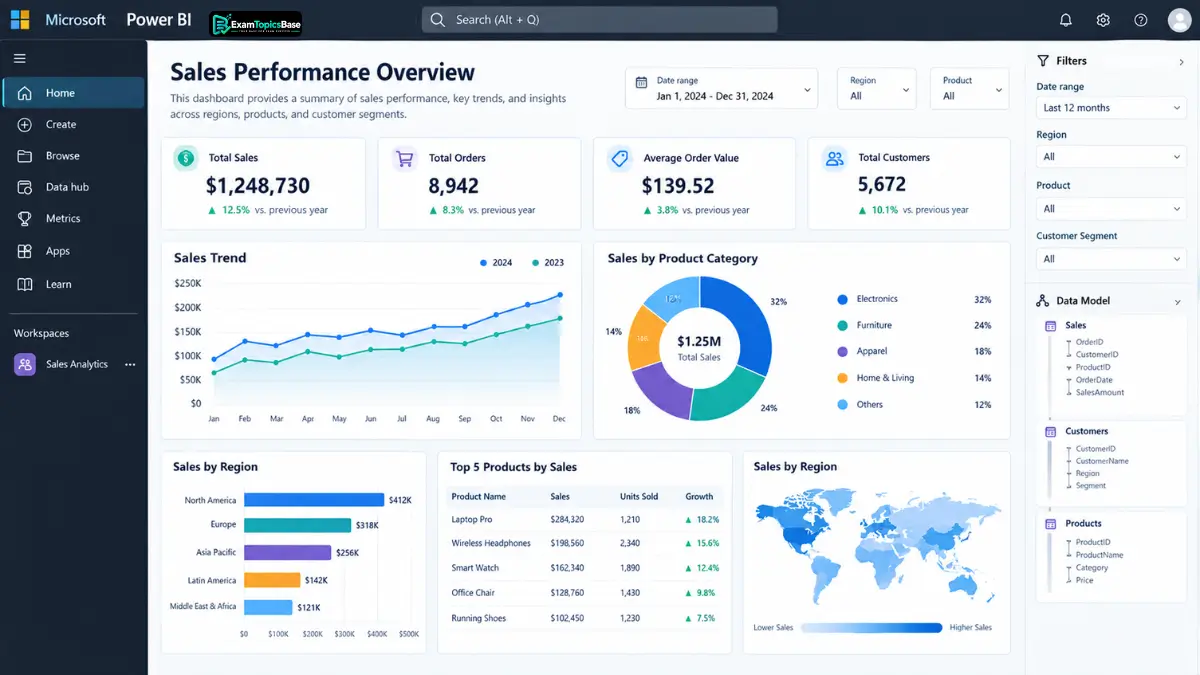
Power BI is a Microsoft analytics and visualization platform that helps users build data models, reports, and visual representations of data. For example, a sales analyst can transform business data into charts and dashboards that reveal revenue patterns.
First, understand the purpose of data models and why data needs to be structured appropriately before visualization. Next, learn how different visualizations communicate different types of information.
Microsoft's current DP-900 objectives specifically include identifying Power BI capabilities, describing data-model features, and identifying appropriate visualizations.
Which Azure Data Services Should DP-900 Candidates Practice?
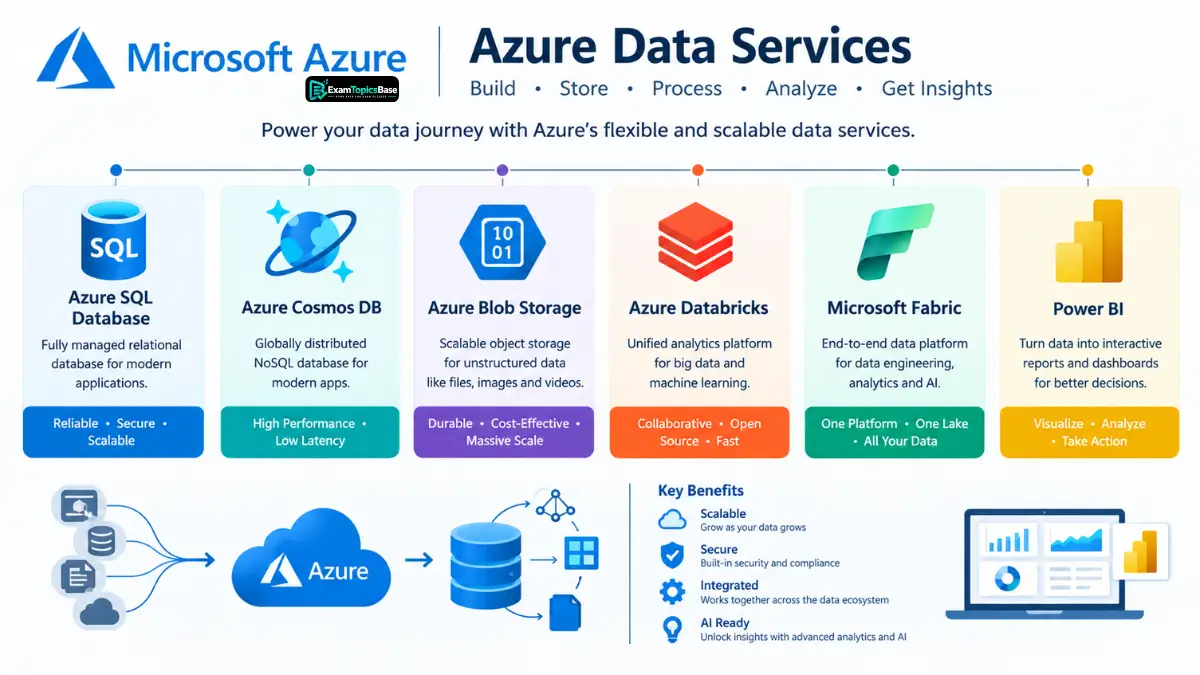
DP-900 candidates should practice recognizing Azure data services by their common workloads rather than trying to memorize every product feature. For example, Azure SQL Database relates to relational data, Azure Blob Storage relates to object storage, Azure Cosmos DB relates to non-relational data, and Power BI relates to visualization and analytics.
Service or technology | What to understand | Example learning scenario |
Azure SQL Database | Relational database concepts | Store structured customer and order data |
Azure Cosmos DB | Non-relational/document scenarios | Store flexible application documents |
Azure Blob Storage | Object and unstructured data | Store images, files, and media |
Azure Databricks | Large-scale analytics | Process and analyze large datasets |
Microsoft Fabric | Integrated data and analytics workloads | Prepare and analyze organizational data |
Power BI | Data models and visualization | Build reports and business dashboards |
First, use Microsoft Learn documentation to understand each service's role. Microsoft's current DP-900 study resources link to Azure SQL, Blob Storage, Cosmos DB, Azure Databricks, Power BI, and other relevant documentation.
Second, reinforce each service with a scenario. For example, ask whether a company's requirement involves structured transactions, flexible documents, file storage, large-scale analytics, or visual reporting.
Third, remember that DP-900 is about foundational understanding rather than advanced service administration. That distinction can prevent you from spending too much time on features outside the exam's intended level.
How Can You Build a DP-900 Study Plan for Beginners?
A practical DP-900 study plan should progress from core data concepts to Azure services, analytics, practice questions, and final readiness checks. Microsoft recommends training and hands-on experience before taking the exam.
Study period | Main focus | Practical activity |
Week 1 | Core data concepts | Study structured, semi-structured, unstructured, transactional, and analytical data |
Week 2 | Relational data | Practice tables, relationships, SQL concepts, and Azure SQL scenarios |
Week 3 | Non-relational data | Study Cosmos DB, Blob Storage, and flexible data models |
Week 4 | Analytics | Study batch, streaming, large-scale analytics, Databricks, Fabric, and Power BI |
Week 5 | Practice | Complete practice questions and review weak objectives |
Week 6 | Final preparation | Use the Practice Assessment, Exam Sandbox, revision notes, and readiness checklist |
Second, build simple exercises around each domain. For example, create a sample customer dataset, identify whether it is structured, decide whether a relational or non-relational model fits, and consider how the information could eventually be visualized.
Third, use the final weeks to revisit weak areas instead of restarting the entire syllabus. A focused review is usually more useful than repeatedly reading topics you already understand.
How Can DP-900 Practice Questions Identify Knowledge Gaps?
DP-900 practice questions are most useful when they reveal which concepts you understand and which concepts require additional study. Microsoft says its Practice Assessment provides an overview of the style, wording, and difficulty of questions candidates are likely to experience, while also helping identify knowledge gaps.
For example, if you repeatedly miss questions about analytical workloads, return to batch processing, streaming, large-scale analytics, and Power BI before attempting another assessment.
Moreover, keep an error log with three simple categories:
Concept gap: You do not understand the underlying idea.
Service gap: You understand the concept but confuse Azure services.
Scenario gap: You know the definition but struggle to apply it to a business situation.
At the same time, third-party practice material should not be treated as official Microsoft exam content. Use current Microsoft objectives and official learning resources as your primary reference.
Get Free Microsoft Real Exam Questions & Answers of Here:https://examtopicsbase.com/vendors/microsoft
What Tools and Practical Exercises Should You Use for DP-900?
The most useful DP-900 practice environment combines Microsoft Learn, documentation, hands-on Azure exercises, Practice Assessment, Exam Sandbox, and simple data scenarios. Microsoft currently provides self-paced learning, documentation, a Practice Assessment, and an Exam Sandbox as preparation resources.
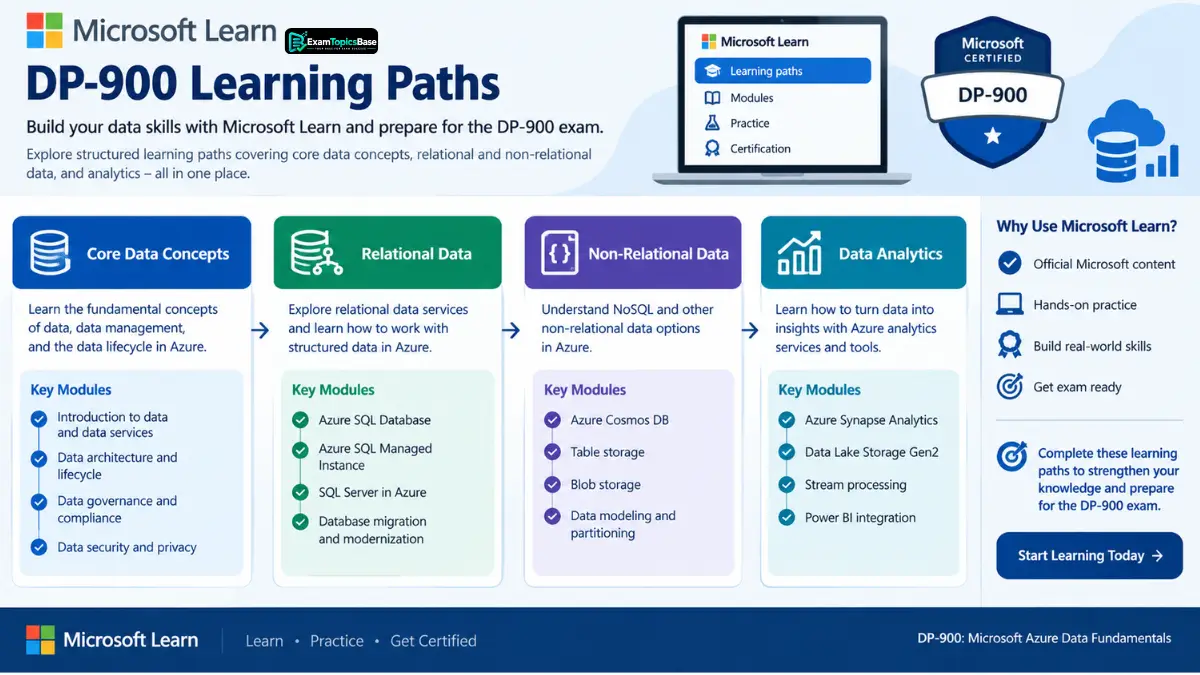
First, use Microsoft Learn to study the four main learning paths covering core concepts, relational data, non-relational data, and analytics. Microsoft currently lists these learning resources directly on the DP-900 certification page.
Second, use hands-on examples to reinforce abstract concepts. For example, create or inspect a small dataset, decide whether it is structured or semi-structured, and explain which Azure service could support the workload.
Third, use the Practice Assessment after completing your initial study. Microsoft says the assessment can help you determine where additional preparation is needed and fill knowledge gaps.
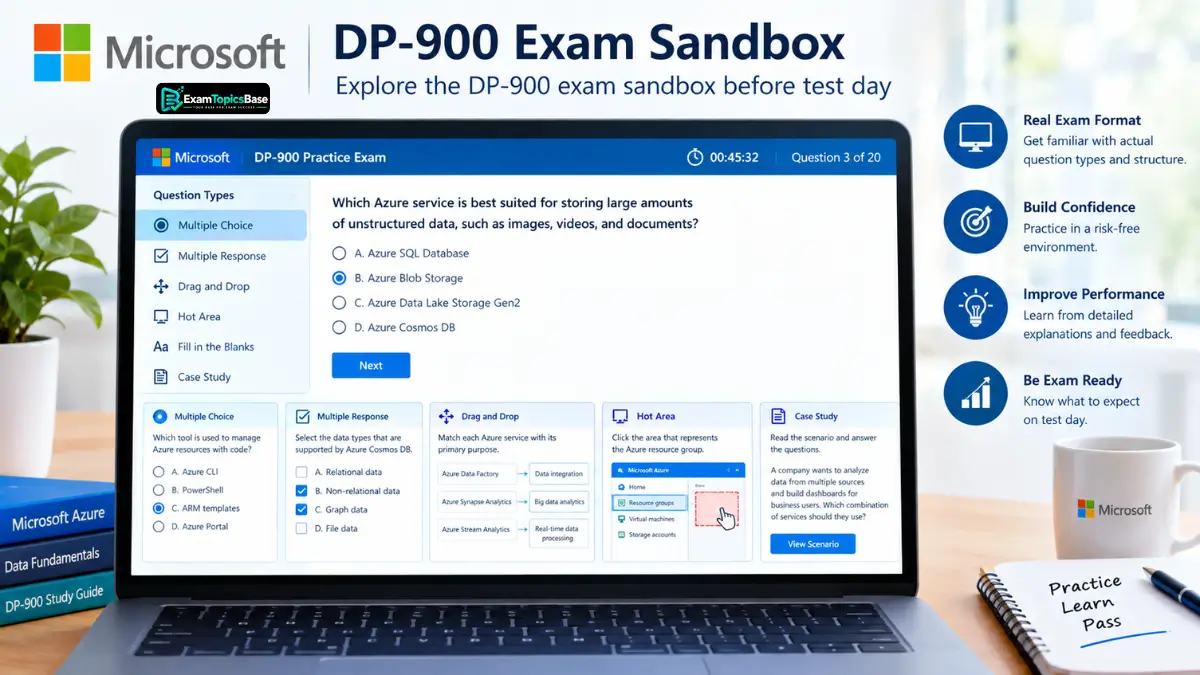
Finally, use the Exam Sandbox to become familiar with the exam interface and available question types. Microsoft describes the sandbox as a way to experience the look and feel of the exam before taking it.
How Do You Know When You Are Ready for the DP-900 Exam?
You are better prepared for DP-900 when you can explain the major objectives, distinguish common data workloads, identify appropriate Azure services, and apply concepts to unfamiliar scenarios. A practice score can provide useful feedback, but readiness should also include conceptual understanding and practical reasoning.
First, use this checklist before scheduling:
I can explain structured, semi-structured, and unstructured data.
I understand relational and non-relational data.
I can distinguish transactional and analytical workloads.
I understand batch and streaming data.
I can explain common Azure relational data services.
I understand Azure Cosmos DB and non-relational scenarios.
I understand Azure Blob Storage and object data.
I recognize Azure Databricks and Microsoft Fabric in analytics scenarios.
I understand basic Power BI data-model and visualization concepts.
I have completed hands-on learning exercises.
I have reviewed DP-900 practice questions.
I have used Microsoft's Practice Assessment and reviewed my weak areas.
Moreover, Microsoft currently provides the official Practice Assessment and Exam Sandbox through its DP-900 certification resources.
What Should You Do After Preparing for DP-900?
After completing DP-900 preparation, your next step should be to review weak objectives, complete a final practice assessment, and decide whether you are ready to schedule the exam. This approach turns preparation into a measurable process rather than a simple checklist of completed courses.
First, return to the current Microsoft study guide and review each of the four skill areas. The current guide was updated for skills measured as of July 21, 2026.
Finally, continue developing practical data skills after the exam. A certification provides a structured foundation, but working with datasets, databases, analytics platforms, and visualization tools helps turn foundational knowledge into useful technical capability.
Conclusion
DP-900 preparation is strongest when you combine current exam objectives, core data knowledge, Azure service understanding, practical scenarios, practice questions, and hands-on learning. The current Microsoft study guide covers four major areas: core data concepts, relational data on Azure, non-relational data on Azure, and analytics workloads.
Moreover, successful preparation does not require memorizing every Azure feature. Instead, focus on understanding why different data models and services exist, how transactional and analytical workloads differ, how batch and streaming data work, and how analytics tools such as Power BI support business decisions.
Finally, use the official Microsoft study guide, Microsoft Learn, Practice Assessment, and Exam Sandbox as the foundation of your preparation, then supplement them with practical exercises and additional resources such as ExamTopicsBase. By combining structured study with realistic data scenarios, you can build a stronger understanding of Azure Data Fundamentals and continue developing your Azure data skills beyond the DP-900 exam.
Frequently Asked Questions
1. What Is the DP-900 Exam?
DP-900 is Microsoft's Azure Data Fundamentals exam for demonstrating foundational knowledge of data concepts and Azure data services. It is designed for candidates beginning to work with data in the cloud.
2. Is DP-900 Suitable for Beginners?
DP-900 is specifically positioned as a beginner-level certification. Microsoft says the certification is intended for candidates beginning to work with data in the cloud.
3. What Are the Main DP-900 Exam Topics?
The current DP-900 exam covers core data concepts, relational data on Azure, non-relational data on Azure, and analytics workloads. The current skills measured were updated on July 21, 2026.
4. What Are the DP-900 Core Data Concepts?
DP-900 core data concepts include structured, semi-structured, and unstructured data, common data stores, transactional workloads, analytical workloads, and data-related roles. These concepts form one of the four major skill areas in the current exam.
5. Does DP-900 Cover Azure SQL Database?
DP-900 includes relational data concepts and considerations for relational data on Azure, making Azure SQL Database an important service to understand at a fundamentals level. Candidates should focus on the relationship between relational workloads and Azure data services.
6. Does DP-900 Cover Azure Cosmos DB?
DP-900 covers considerations for working with non-relational data on Azure, which makes Azure Cosmos DB a relevant service for study. Focus on understanding non-relational scenarios and why a flexible data model may be appropriate.
7. Does DP-900 Include Power BI?
Power BI is included in the current DP-900 analytics objectives. Microsoft specifically lists Power BI capabilities, data-model features, and appropriate visualizations among the skills measured.
8. How Long Does the DP-900 Exam Take?
Microsoft currently lists 45 minutes for the DP-900 assessment. Exam policies, delivery details, and regional conditions should be checked on Microsoft's current exam page before scheduling.
9. What Is the DP-900 Passing Score?
Microsoft currently states that a score of 700 or greater is required to pass DP-900. Candidates should verify the current scoring information in the official Microsoft study guide before taking the exam.
10. What Should You Use to Prepare for DP-900?
The strongest preparation approach combines Microsoft Learn, the current DP-900 study guide, hands-on practice, practice questions, Microsoft's Practice Assessment, and the Exam Sandbox. Microsoft explicitly recommends training and hands-on experience before taking the exam.
You may also like to read:
What Is the AZ-104 Exam and How Can You Prepare for It? | The Ultimate Guide
How Hard Is the AZ-400 Exam? | A Complete Preparation & Study Guide

Written by Julia Mercer
I’m Julia Mercer, a Microsoft Solutions Architect and technical contributor at ExamTopicsBase. Having navigated the evolving Microsoft certification roadmap throughout my career in enterprise IT, I focus on delivering accurate, scenario-tested practice questions and clear, blueprint-aligned explanations so you can walk into your test with total confidence.
Comments (0)
Leave a Reply
No comments yet. Be the first to share your thoughts!