
If you have been searching for Cisco 820-605, you have probably already discovered that it is connected to Cisco Customer Success Manager certification. However, knowing the exam code does not tell you exactly what to study or how the customer-success concepts fit together. In this guide, you will learn what the 820-605 exam covers, which concepts matter most, how to prepare, and how to build a practical study plan using Cisco's current resources.
What Is the Cisco 820-605 Exam?
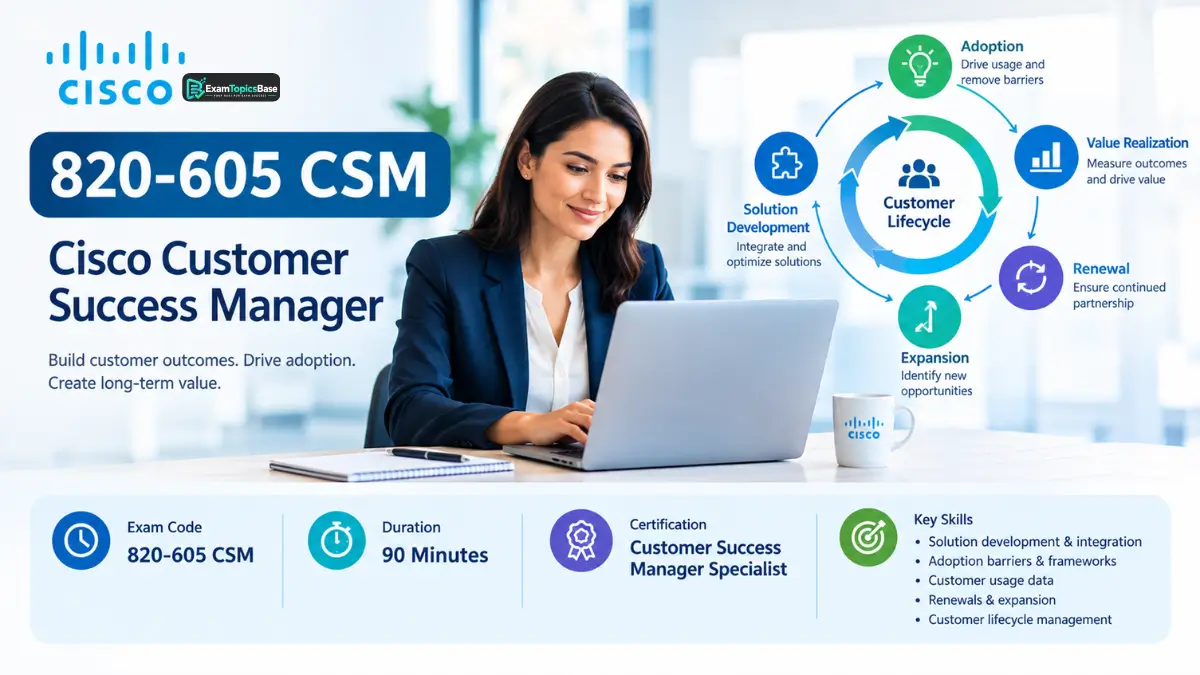
Cisco 820-605 is the Cisco Customer Success Manager exam that evaluates knowledge and skills related to developing and integrating solutions, identifying adoption barriers, implementing adoption frameworks, interpreting customer usage data, and supporting customers through the lifecycle. Cisco currently lists the exam as 90 minutes and associates it with the Cisco Customer Success Manager Specialist certification.
Moreover, the exam is not primarily a traditional network configuration test. Instead, it focuses on how customer-success professionals connect technology solutions with customer outcomes, improve adoption, interpret customer information, support renewals, and identify opportunities throughout the customer lifecycle.
For example, a customer may purchase a technology solution but fail to achieve its expected value because employees are not using it effectively. A Customer Success Manager needs to recognize the adoption barrier, understand the customer's desired outcome, and help coordinate appropriate actions.
Additionally, Cisco currently lists the exam price as US$250 or Cisco Learning Credits. Cisco states that exams are delivered in a secure environment through proctored online testing or testing centers.
Exam Detail | Current Information |
Exam code | 820-605 CSM |
Exam name | Cisco Customer Success Manager |
Certification | Cisco Customer Success Manager Specialist |
Duration | 90 minutes |
Current listed price | US$250 or Cisco Learning Credits |
Delivery | Online proctored or testing center |
Language | English |
Why Is the Cisco 820-605 Exam Important for Customer Success Professionals?
The Cisco 820-605 exam is important because it validates customer-success knowledge that connects technology solutions with customer outcomes throughout the customer lifecycle. Cisco describes the certification around developing and integrating solutions, removing adoption barriers, implementing adoption frameworks, interpreting usage data, leading customers to renewals, and cultivating new sales opportunities.
Furthermore, customer success extends beyond simply answering support questions. Customer success management focuses on helping customers realize value from technology solutions and achieve desired business outcomes. For example, a company may purchase a technology platform to improve productivity, but the CSM must also understand whether customers are adopting the platform and achieving the intended result.
In addition, the certification is relevant to professionals who work between technology providers and customers. Customer Success Managers may collaborate with sales teams, technical teams, account teams, and customers to understand requirements and coordinate activities.
Moreover, Cisco describes the Customer Success Manager certification as validating skills that help professionals drive business outcomes and act as trusted advisors to customers.
What Topics Are Covered in the Cisco 820-605 Exam?
The Cisco 820-605 exam covers customer-success concepts, customer lifecycle activities, adoption barriers, adoption frameworks, customer usage data, renewals, and customer opportunities. Cisco's published exam topics provide the main framework for understanding the exam scope.
What Customer Success Industry Concepts Should You Study?
Customer success industry concepts explain how organizations help customers achieve value from technology solutions. The Cisco exam blueprint includes customer-success drivers, expected and unexpected customer value, lifecycle journeys, customer success versus customer support and sales, purchasing and consumption models, customer-success metrics, and engagement models.
For example, a support team may focus on resolving a technical problem, while a Customer Success Manager may examine whether the broader solution is helping the customer achieve a desired business outcome.
The exam blueprint also includes leading and lagging indicators, churn, expansion, renewal, and customer engagement models such as high-touch, virtual-touch, and digital-touch approaches.
Why Are Customer Adoption and Adoption Barriers Important?
Customer adoption is the process of helping customers use a solution effectively so they can realize its intended value. Adoption barriers are obstacles that prevent customers from reaching the desired outcome through a technology or service.
For example, a company might purchase a collaboration platform but have low employee adoption because users lack training or managers have not established clear workflows.
Therefore, candidates should understand how to identify adoption problems rather than simply memorize the definition of adoption. Cisco specifically identifies adoption barriers and actions to remove them as part of the exam focus.
What Is a Customer Success Framework?
A customer success framework is a structured approach for guiding customers toward desired outcomes throughout their relationship with a provider. The framework helps organize customer engagement, adoption activities, value realization, and lifecycle milestones.
For example, a framework might begin by identifying the customer's desired outcome, continue through implementation and adoption, and then use customer information to determine whether additional action is needed.
Cisco's current CSM training includes foundational terminology and workflows, along with a framework for orchestrating the customer journey across the LAER lifecycle.
How Does Customer Usage Data Support Customer Success?
Customer usage data helps Customer Success Managers understand how customers are using a solution and identify potential adoption or value gaps. Cisco specifically identifies interpreting customer usage data as part of the 820-605 exam focus.
For example, if usage data shows that only a small portion of licensed users regularly use an important feature, the CSM can investigate the reason and develop an adoption plan.
As a result, candidates should understand the difference between collecting data and using data to guide customer-success decisions. Customer usage data becomes valuable when it supports a clear customer outcome or action.
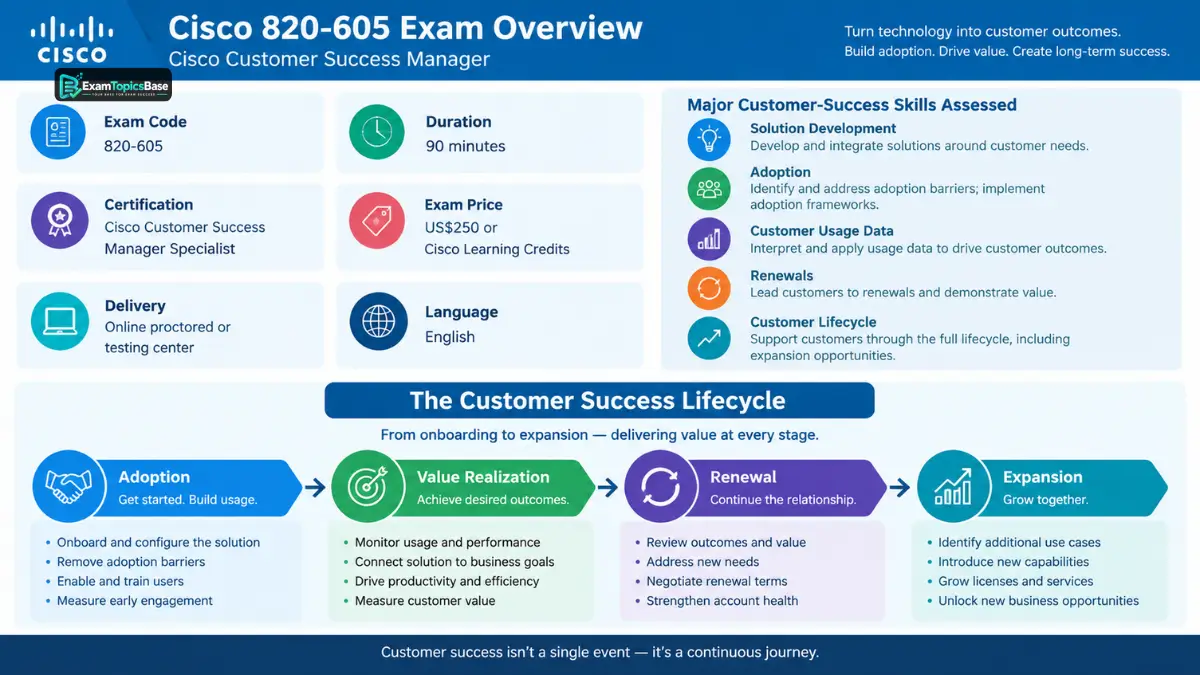
How Do Renewals and Expansion Fit Into Customer Success?
Renewals and expansion are customer lifecycle activities that can follow successful adoption and demonstrated customer value. Cisco specifically includes leading customers to renewals and cultivating new sales opportunities through the customer lifecycle in the exam description.
For example, a customer that consistently achieves its target outcomes may approach renewal with clear evidence of value. Another customer may identify additional requirements that create an opportunity to expand its use of an existing solution.
However, renewal should not be treated as an isolated sales event. Effective customer success connects renewal conversations with the customer's goals, adoption, usage, and realized value.
Source: 820-605 CSM Exam Topics and Study Guide
What Are the Main Cisco 820-605 Exam Objectives?
The Cisco 820-605 exam objectives describe the knowledge areas candidates should understand before taking the CSM exam. Cisco's published blueprint includes customer-success industry concepts and areas involving adoption, usage data, lifecycle activities, renewals, and customer opportunities.
What Should You Learn From the Cisco Exam Blueprint?
The exam blueprint should be treated as the foundation of an 820-605 study plan. Cisco states that the listed topics are general guidelines for content that may be included on the exam and that related topics may also appear.
For example, the published blueprint covers customer value, lifecycle journeys, purchasing models, customer-success metrics, churn, expansion, renewal, engagement models, and CSM objectives.
Study Area | What to Understand |
Customer success industry | Customer value, lifecycle, CSM role, support versus sales |
Customer metrics | Leading indicators, lagging indicators, churn, expansion, renewal |
Customer engagement | High-touch, virtual-touch, and digital-touch models |
Adoption | Adoption barriers and actions to remove them |
Customer usage | Interpreting usage information |
Lifecycle management | Adoption, value realization, renewal, and expansion |
Solution development | Developing and integrating solutions around customer needs |
Why Should You Study the Objectives Instead of Memorizing Terms?
The 820-605 exam requires understanding how customer-success concepts work together, so memorizing isolated definitions may not provide enough preparation. Cisco describes the exam around practical customer-success skills such as identifying barriers, implementing adoption frameworks, interpreting usage data, and guiding customers toward renewals.
For example, knowing what an adoption barrier means is different from recognizing a training gap as an adoption barrier in a customer scenario.
How Should Beginners Prepare for the Cisco 820-605 Exam?
Beginners should prepare for 820-605 by combining the official exam blueprint, customer-success concepts, practical scenarios, Cisco learning resources, and regular review. Cisco provides structured training and learning resources for candidates preparing for the certification.
Step 1: Start With the Official Exam Topics
First, review the official Cisco exam topics before creating your study schedule. The blueprint provides a structured view of the knowledge Cisco expects candidates to understand.
For example, create a checklist containing customer-success fundamentals, adoption, usage data, renewals, customer engagement, and lifecycle concepts.
Step 2: Learn the Customer Success Vocabulary
Second, learn the core vocabulary used throughout customer-success work. Important terms include customer value, adoption, churn, renewal, expansion, customer lifecycle, leading indicators, lagging indicators, and business outcomes.
For example, understanding the difference between leading and lagging indicators can help you recognize how customer-success teams monitor customer health and outcomes.
Step 3: Connect Each Concept to a Customer Scenario
Third, convert theoretical concepts into realistic scenarios. Scenario-based learning makes it easier to understand how a CSM responds to customer challenges.
For example, imagine that a customer has purchased a solution but only 30% of intended users are active. Ask what could be causing the adoption gap, what information you would collect, and what action could improve adoption.
Step 4: Review Your Weak Areas
Fourth, use your study results to identify weak concepts instead of repeatedly reviewing everything. Targeted review allows you to spend more time on subjects where your understanding is incomplete.
For example, if you understand customer lifecycle stages but struggle with usage-data interpretation, devote your next study session to customer metrics and usage scenarios.
Step 5: Practice Explaining Concepts in Your Own Words
Finally, explain important concepts without looking at your notes. If you can clearly explain why a customer might face an adoption barrier and how a CSM could respond, you are moving beyond simple memorization.
How Can You Build an Effective 820-605 Study Plan?
An effective 820-605 study plan divides the exam objectives into manageable learning stages and combines theory with customer scenarios. A structured schedule prevents candidates from spending all their preparation time on definitions while neglecting practical application.
A Practical Four-Week 820-605 Study Plan
A four-week study plan can provide a simple framework for candidates who have several weeks available before the exam. Adjust the schedule according to your previous customer-success experience and available study time.
Week | Main Focus | Suggested Activities |
Week 1 | Customer success fundamentals | Study lifecycle, value, CSM role, support versus sales, and engagement models |
Week 2 | Adoption and customer engagement | Study adoption barriers, frameworks, customer scenarios, and engagement approaches |
Week 3 | Usage, metrics, renewals | Review customer usage data, indicators, churn, renewal, and expansion |
Week 4 | Review and readiness | Practice scenarios, revisit weak areas, review objectives, and complete final preparation |
First, use Week 1 to establish terminology and the customer-success framework. Then use Week 2 to connect those concepts with customer adoption.
Next, use Week 3 to focus on customer data and lifecycle outcomes. Finally, use Week 4 for review and scenario-based practice rather than attempting to learn the entire syllabus from scratch.
Get Free Cisco Real Exam Questions & Answers of Here:
https://examtopicsbase.com/vendors/cisco
What Customer Success Concepts Should You Study for 820-605?
Customer-success concepts form the foundation of 820-605 preparation because the exam evaluates how professionals support customer outcomes throughout the lifecycle. Cisco's exam topics include customer value, lifecycle journeys, customer engagement, metrics, purchasing models, churn, expansion, and renewal.
Customer Value and Business Outcomes
Customer value represents the benefit a customer expects or realizes from a technology solution. A business outcome is the measurable result the customer wants to achieve through that solution.
For example, a company may purchase a technology platform because it wants to reduce manual work. The CSM should connect adoption activities to that desired outcome rather than focusing only on whether the software was installed.
Leading and Lagging Indicators
Leading indicators provide signals that can help teams understand future customer behavior, while lagging indicators reflect results that have already occurred. Cisco's published exam topics specifically include both types of customer-success metrics.
For example, declining product engagement may act as an early signal that a customer needs attention, while a completed renewal represents a later lifecycle result.
Churn, Renewal, and Expansion
Churn describes the loss of customer business, renewal represents continuation of the customer relationship, and expansion refers to additional business or usage within an existing customer relationship.
For example, a customer that reduces its subscription before renewal may show a potential retention concern, while a customer adopting additional capabilities may create an expansion opportunity.
High-Touch, Virtual-Touch, and Digital-Touch Engagement
Customer engagement models describe different ways organizations interact with customers based on customer needs and segmentation. Cisco's exam topics specifically identify high-touch, virtual-touch, and digital-touch approaches.
For example, a strategic enterprise customer might receive highly personalized engagement, while another customer may receive scalable digital resources and automated communications.
What Tools and Resources Can Help With 820-605 Preparation?
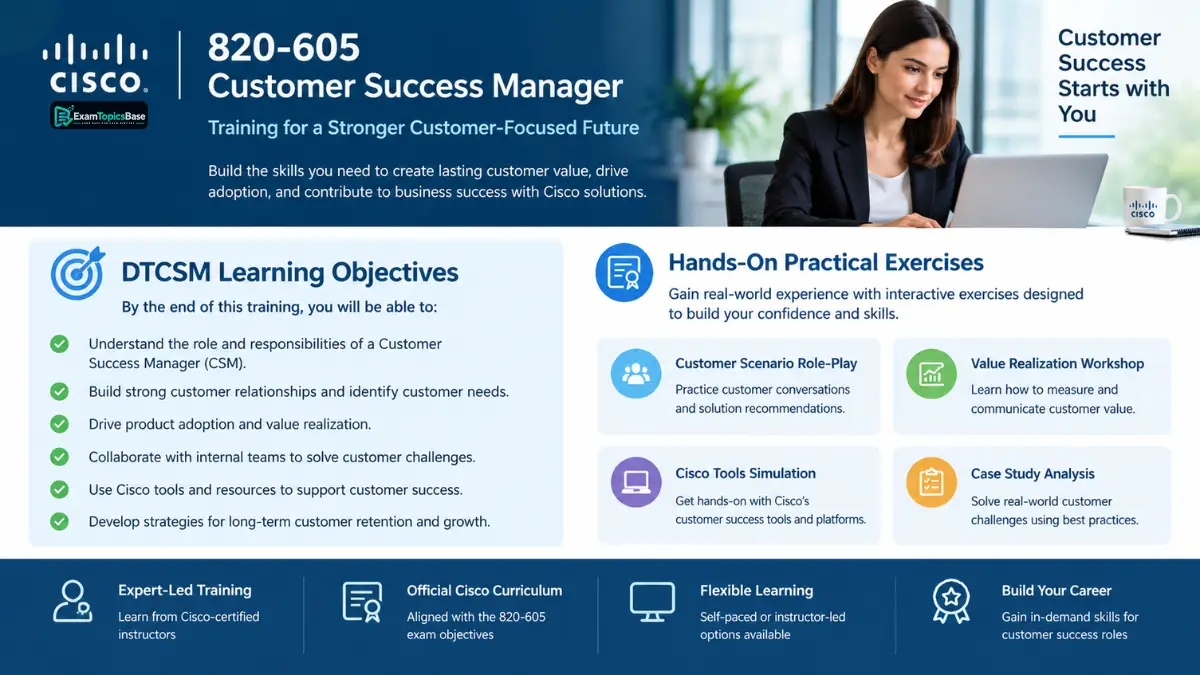
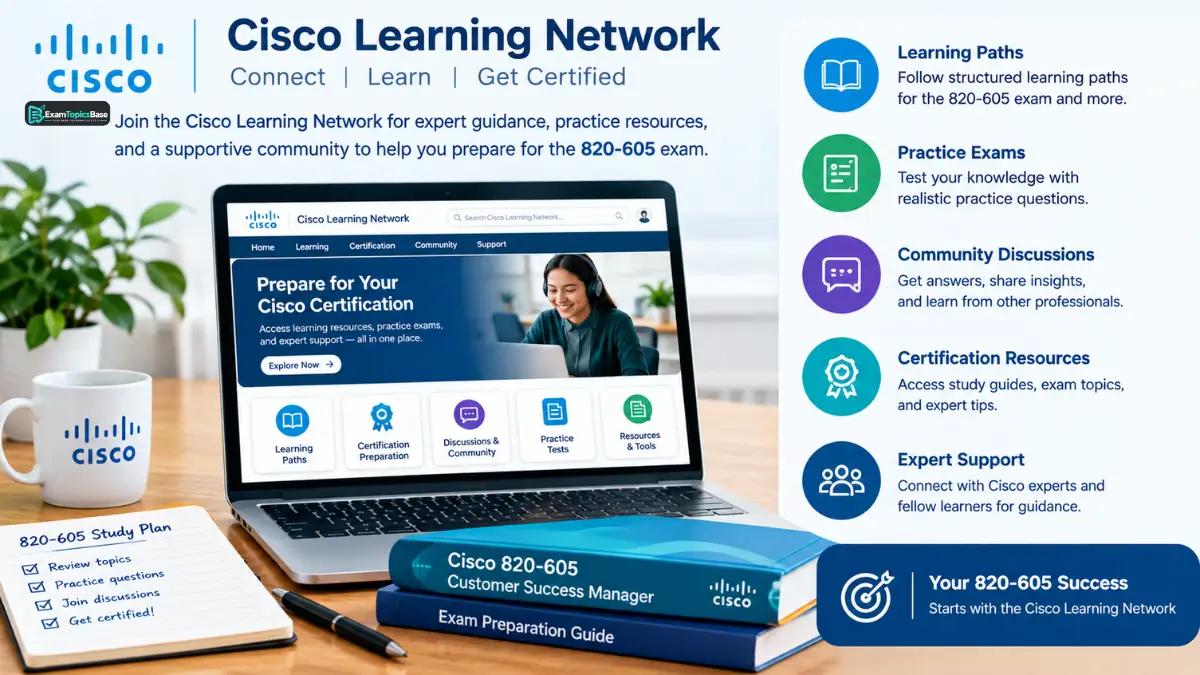
Cisco's official preparation resources include DTCSM training, Cisco U. learning paths, and the Cisco Learning Network. These resources can complement a study plan by providing structured learning, practical exercises, and opportunities to discuss certification topics.
Cisco Customer Success Manager Training
Cisco's DTCSM training is designed around the Customer Success Manager role and includes practical exercises, real-life use cases, and case studies. Cisco states that the training prepares candidates for the 820-605 CSM v2.0 exam.
For example, a case study can help you move from a theoretical definition of customer adoption to a realistic situation where you identify a barrier and determine an appropriate response.
Cisco U. Learning Path
Cisco U. provides a guided learning path for certification preparation. Cisco states that the CSM learning path includes pre- and post-assessments that help learners identify what they already know and focus on areas that need additional learning.
For example, a learner who already understands customer lifecycle concepts can use assessment results to spend more time on weaker areas instead of repeating familiar material.
Cisco Learning Network
Cisco Learning Network provides a community environment where candidates can ask questions, share ideas, and connect with other learners and experts while preparing for certification exams.
For example, you can use community discussions to clarify terminology or compare study approaches while still verifying important exam facts against Cisco's official documentation.
Practice Questions and Scenario Exercises
Practice questions can help identify gaps in your understanding, while scenario exercises can help you apply customer-success concepts. However, practice materials should supplement rather than replace the official Cisco exam blueprint and learning resources.
How Can Customer Success Scenarios Improve 820-605 Preparation?
Customer-success scenarios improve 820-605 preparation by connecting abstract concepts to decisions that a Customer Success Manager might make. Cisco's DTCSM training specifically uses practical exercises based on real-life use cases and case studies.
Scenario 1: Low Customer Adoption
First, imagine a customer has purchased a solution but usage remains below expectations. The customer says employees are struggling to understand the new workflow.
In this situation, identify the likely adoption barrier, determine what information you need, and consider an action that addresses the underlying problem.
Scenario 2: Customer Usage Data
Second, imagine usage data shows that several important features are rarely used. The customer believes the solution is underperforming.
In this situation, investigate whether the problem is awareness, training, workflow alignment, configuration, or another barrier. Then connect the response to the customer's desired business outcome.
Scenario 3: Renewal Discussion
Finally, imagine a customer is approaching renewal but has not clearly demonstrated the expected value of the solution.
In this situation, review adoption, usage, outcomes, and customer objectives before discussing renewal. This demonstrates how lifecycle activities can connect customer value with retention.
How Do You Know You Are Ready for the Cisco 820-605 Exam?
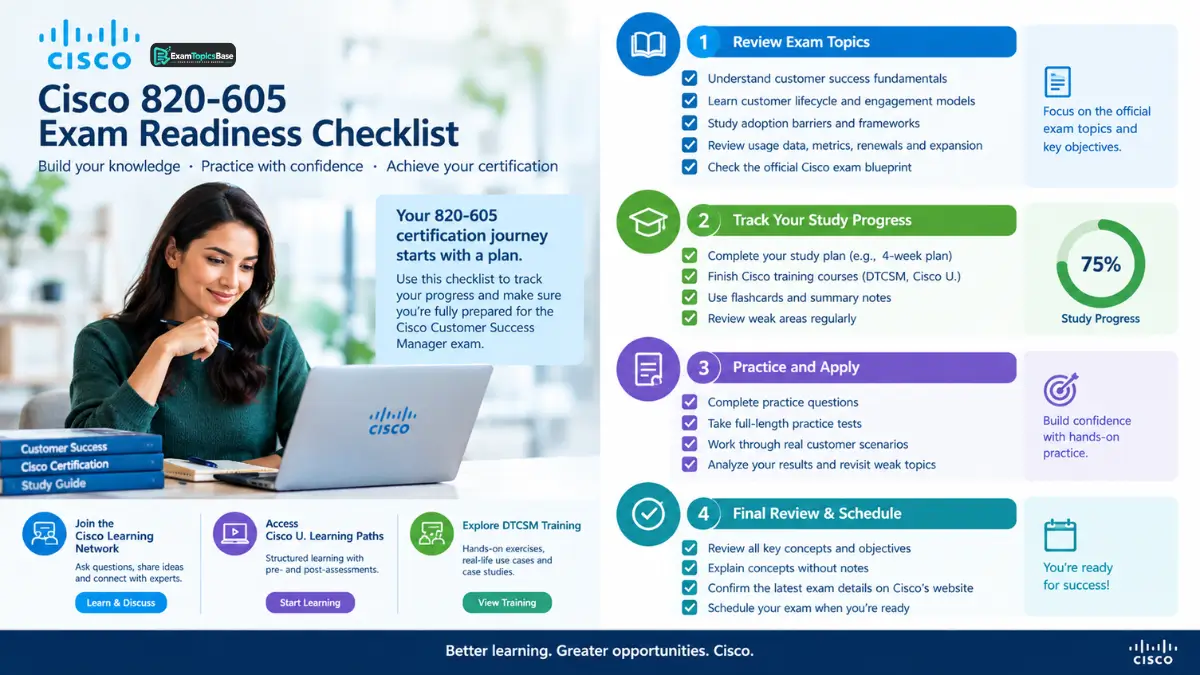
You are ready to consider the Cisco 820-605 exam when you can explain the major objectives, apply customer-success concepts to scenarios, and identify appropriate actions without relying entirely on notes. Readiness should be based on demonstrated understanding rather than simply counting study hours.
820-605 Readiness Checklist
Use the following checklist before scheduling or taking the exam:
Review the current Cisco exam topics.
Explain the Customer Success Manager role in your own words.
Understand the customer lifecycle.
Explain customer value and business outcomes.
Identify common adoption barriers.
Understand customer engagement models.
Distinguish leading and lagging indicators.
Explain churn, renewal, and expansion.
Interpret basic customer usage scenarios.
Practice applying concepts to realistic customer situations.
Review weak areas identified through assessments.
Verify current exam details on Cisco's official website.
For example, if you can explain why a customer has low adoption, identify evidence that supports your conclusion, and propose a logical customer-success action, you are demonstrating application rather than memorization.
Moreover, Cisco currently states that exams are graded pass/fail and results are usually available online within 48 hours.
What Should You Do Next to Prepare for Cisco 820-605?
The next step for Cisco 820-605 preparation is to compare your current knowledge with the official exam topics and build a focused study schedule around the gaps you identify. A practical preparation process is more useful than studying random customer-success material without connecting it to the exam objectives.
First, review the official Cisco exam page and blueprint. Second, organize your study material around customer success, adoption, usage data, lifecycle management, renewals, and solution development.
Next, work through realistic customer scenarios. For example, take one customer problem and identify the desired outcome, current adoption level, potential barriers, available usage information, and possible next actions.
Finally, use your final study period for targeted review. Avoid relying on unverified claims about exam content, and always check Cisco's official resources for the latest exam information before scheduling.
Conclusion
Cisco 820-605 is the Cisco Customer Success Manager exam associated with the Cisco Customer Success Manager Specialist certification, and its focus extends beyond traditional technical configuration. The exam assesses customer-success knowledge involving solution development, adoption barriers, adoption frameworks, usage data, renewals, and customer lifecycle activities.
Moreover, effective preparation starts with the official Cisco exam topics and continues with structured study, customer-success scenarios, and practical application. Cisco's DTCSM training, Cisco U. learning resources, and Cisco Learning Network can provide additional support during preparation.
Finally, if you are preparing through ExamTopicsBase, use your study material as a supplement to official Cisco resources rather than a replacement for the current exam blueprint. Build your understanding around customer outcomes, adoption, lifecycle management, usage data, and renewals, then verify the latest exam details directly with Cisco before scheduling.
Frequently Asked Questions
1. What Is the Cisco 820-605 Exam?
Cisco 820-605 is the Cisco Customer Success Manager exam associated with the Cisco Customer Success Manager Specialist certification. The exam evaluates customer-success knowledge related to solution development, adoption, customer usage, renewals, and the customer lifecycle.
2. What Certification Is Associated With 820-605?
The 820-605 CSM exam is associated with the Cisco Customer Success Manager Specialist certification. Cisco states that candidates earn the certification by passing the required core exam.
3. How Long Is the Cisco 820-605 Exam?
The current Cisco 820-605 exam duration is 90 minutes. Cisco lists 820-605 CSM as a 90-minute exam.
4. How Much Does the 820-605 Exam Cost?
Cisco currently lists the 820-605 exam price as US$250 or Cisco Learning Credits. Candidates should verify the current price and purchasing conditions with Cisco before scheduling.
5. What Topics Should I Study for 820-605?
Important areas include customer-success fundamentals, customer lifecycle management, customer value, adoption barriers, adoption frameworks, customer usage data, engagement models, metrics, renewals, and expansion opportunities. Cisco's official exam topics should be used as the primary study reference.
6. Is 820-605 a Networking Exam?
The 820-605 exam is focused on customer success rather than traditional network configuration. Cisco describes the exam around solution development and integration, adoption, customer usage data, renewals, and lifecycle activities.
7. What Training Does Cisco Recommend for 820-605?
Cisco provides DTCSM training for Customer Success Manager preparation, along with Cisco U. learning paths and access to the Cisco Learning Network. DTCSM includes practical exercises and real-life use cases.
8. Does Cisco 820-605 Require Previous Customer Success Experience?
Cisco's DTCSM training has no formal prerequisites, although Cisco recommends experience working with customers to determine, measure, and deliver business outcomes through technology implementation.
9. How Should Beginners Prepare for Cisco 820-605?
Beginners should start with the official Cisco exam topics, learn customer-success terminology, study lifecycle and adoption concepts, practice realistic customer scenarios, and review weak areas using structured learning resources.
10. How Can I Check Whether I Am Ready for 820-605?
You can assess readiness by reviewing every official exam objective, explaining customer-success concepts without notes, applying those concepts to realistic scenarios, and revisiting areas where practice results show gaps. You should also verify the latest Cisco exam information before scheduling.
You may also like to read:
CCNA 200-301 V2.0 | What’s Changing for the February 2027 Exam?
Cisco 200-201 Exam Topics | The Ultimate Study Guide for Smarter Preparation

Written by Marcus Vance
I’m Marcus Vance, a Cisco Solutions Architect and technical contributor at ExamTopicsBase. Having designed mission-critical enterprise backbones and navigated Cisco's certification tracks for over a decade, I focus on delivering accurate, real-world packet analyses and blueprint-aligned practice questions so you can pass your exam with total confidence.
Comments (0)
Leave a Reply
No comments yet. Be the first to share your thoughts!