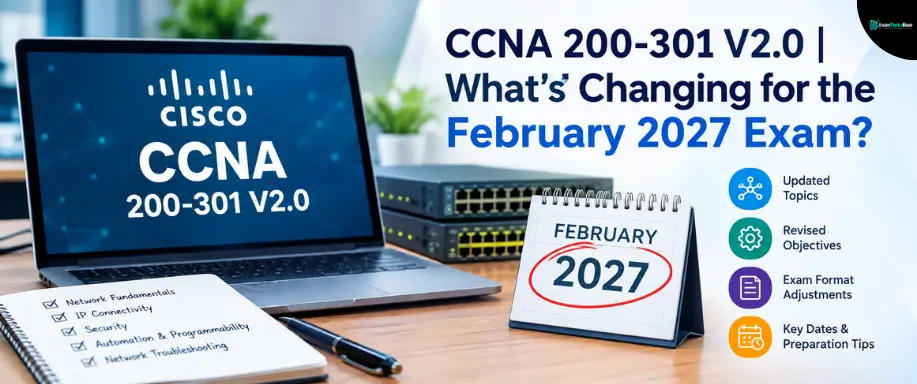
If you’ve been studying for the CCNA or planning to tackle it soon, you need to mark a date on your calendar: February 3, 2027.
That is the day Cisco officially pulls the plug on the CCNA 200-301 v1.1 blueprint and rolls out CCNA 200-301 v2.0.
This isn't a minor patch where Cisco merely rewards a couple of bullet points. It’s the most aggressive overhaul to the CCNA since the massive 2020 consolidation. The blueprint drops from six domains down to five, trims out a surprising amount of dated theoretical memorization, introduces a brand-new domain dedicated to artificial intelligence and day-to-day operations, and decisively shifts away from flashcard definitions toward real-world troubleshooting.
Here is what is actually changing, what you can safely stop studying, and how to decide whether to test now or wait for the update.
Key Timeline and Cutover Rules
Let’s get the logistics out of the way first:
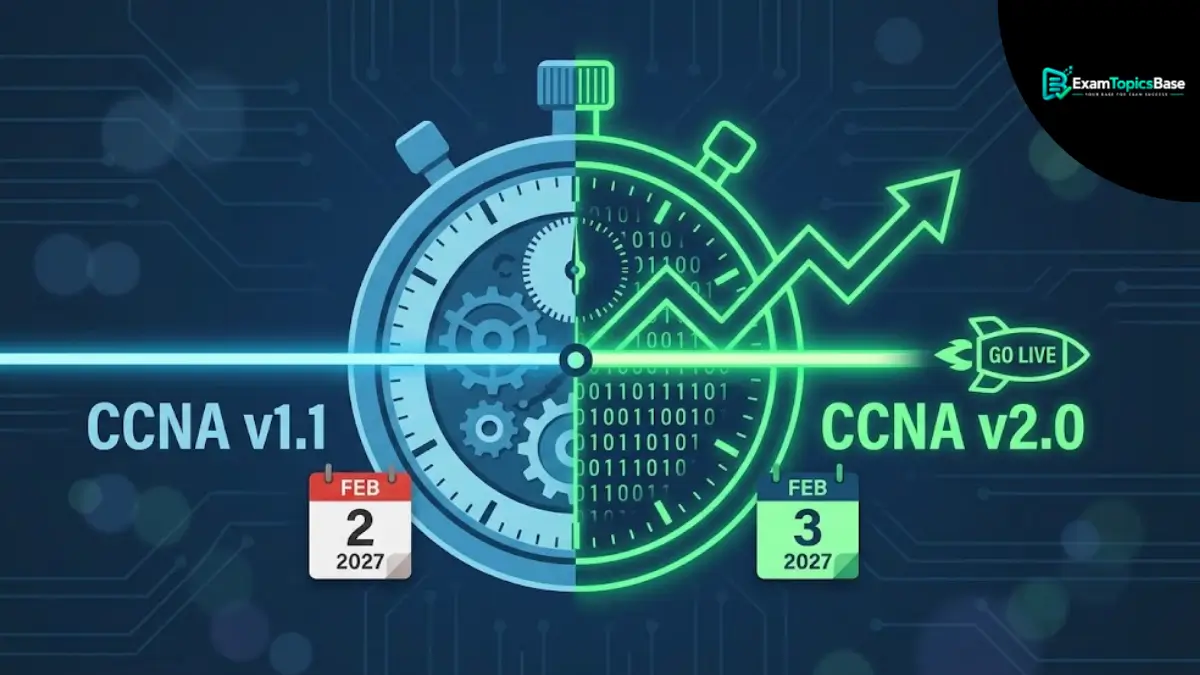
February 2, 2027: The absolute last day you can sit for CCNA 200-301 v1.1.
February 3, 2027: CCNA 200-301 v2.0 goes live. From this day forward, it is the only version available.
No Grace Period or Overlap: Cisco isn't running both versions simultaneously. If your test appointment is on February 2, you get v1.1. If it’s on February 3, you get v2.0.
The Exam Code Stays 200-301: The test code isn't changing. You still get 120 minutes, you still earn the exact same 3-year Cisco Certified Network Associate badge, and the credential on your resume looks identical.
The Structural Shift: 6 Domains Condensed to 5
The headline structural change is how Cisco organized the blueprint. They collapsed the previous six domains into five, shifting the weight distribution significantly:
CCNA v1.1 Domain | Weight | CCNA v2.0 Domain | Weight |
1.0 Network Fundamentals | 20% | 1.0 Network Infrastructure & Connectivity | 25% |
2.0 Network Access | 20% | 2.0 Switching & Network Access | 25% |
3.0 IP Connectivity | 25% | 3.0 IP Routing | 20% |
4.0 IP Services | 10% | 4.0 Network Services & Security | 20% |
5.0 Security Fundamentals | 15% | (Consolidated into Domain 4.0) | — |
6.0 Automation & Programmability | 10% | 5.0 AI, Network Operations & Management | 10% |
Source>>> 200-301 CCNA Exam Topics and Study Guide
Why This Rebalance Matters?
Half the exam is pure cabling, switching, and access layer: Domains 1.0 and 2.0 now make up a combined 50% of the entire test. Cisco is sending an unmistakable signal: an associate engineer's primary value is making sure packets can physically get from an endpoint, through a switch port, and across a trunk without dropping.
Security loses its standalone badge, but not its teeth: In v1.1, Security Fundamentals felt like an isolated theory module full of definitions. In v2.0, Cisco rolled it directly into Network Services (Domain 4.0). Instead of defining what a rogue DHCP server is in the abstract, you’re configuring DHCP snooping alongside standard DHCP relay setups.
IP Routing tightens up: IP Routing dropped from 25% to 20%. The fluff is gone, narrowing the scope to routing table evaluation, static routing triage, and single-area OSPF.
Automation evolves from coding theory to operations: The old programmability domain spent too much time quizzing candidates on raw JSON formatting and controller theory. That’s been replaced by a pragmatic operations domain that treats AI as a day-to-day assistant.
What’s Out: Retired and Trimmed Topics
Here’s the good news: Cisco stripped out a lot of theoretical trivia that candidates used to spend weeks memorizing:
Architecture Memorization: You no longer need to spit out textbook definitions comparing two-tier, three-tier, and spine-leaf architectures, or recall cable attenuation formulas.
Wireless GUI Click-Paths: You still need to understand RF bands, channels, and interference, but memorizing specific drop-down menus inside the Cisco Wireless LAN Controller (WLC) GUI or memorizing legacy AP operational modes is gone.
QoS Deep Dives: Detailed Quality of Service mechanisms—classification, marking, queuing, shaping, and policing—have been dropped from the associate scope.
Plain-Text File Transfers: Unencrypted protocols like legacy TFTP and FTP are out, replaced squarely with secure transfer standards like SFTP and SCP.
Abstract Automation & Terraform: You won’t be tested on Terraform syntax, deep REST API response code tables, or memorizing northbound vs. southbound SDN controller architectures.
What’s In: Major Additions and Real-World Focus
To replace the cut material, Cisco pulled in topics that match what modern junior engineers actually deal with on their first day in a NOC:
1. The New AI & Operations Domain (10%)
This is the headline addition. Cisco explicitly states that you will be required to evaluate outputs and recommendations from digital network assistants and agentic AI.
Agentic AI vs. Generative AI: Knowing the difference between an LLM that drafts a script (Generative) and an autonomous system that queries telemetry, correlates alerts, and recommends operational fixes (Agentic).
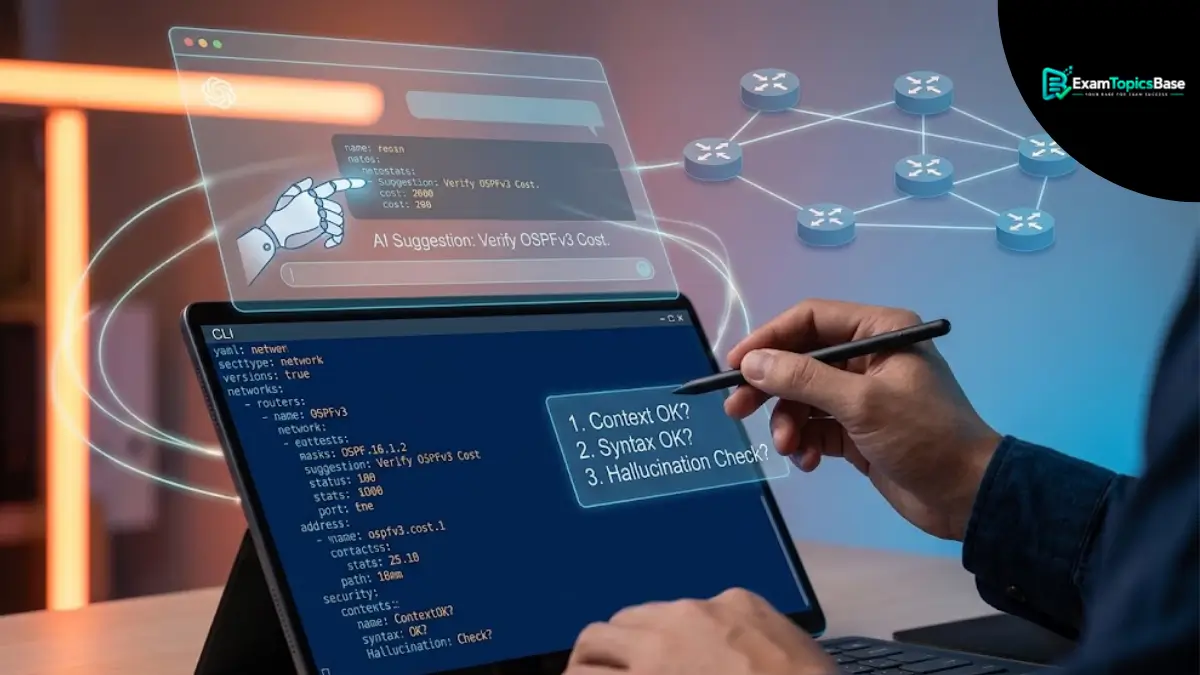
Prompt Construction: Knowing how to write prompts that actually work for network tasks—giving the model a persona, environment context, data classification rules, and strict output formatting (like requesting YAML or JSON).
Sanity-Checking AI Suggestions: AI models hallucinate. Cisco wants to test whether you have enough core networking knowledge to spot a bad subnet mask, a flawed route filter, or an insecure ACL proposed by an automated assistant.
Operational Tooling: Reading Syslog facilities/severity levels and understanding how configuration management tools like Ansible run commands across fleets.
2. Edge Device Port Profiles & PoE Budgeting
In Domain 2.0, switch ports aren't just generic access ports anymore. You need to know how to configure and verify ports specifically customized for:
Voice over IP (VoIP) phones (auxiliary voice VLANs).
Wireless Access Points (trunking or dedicated access).
IoT appliances and virtualized server hosts.
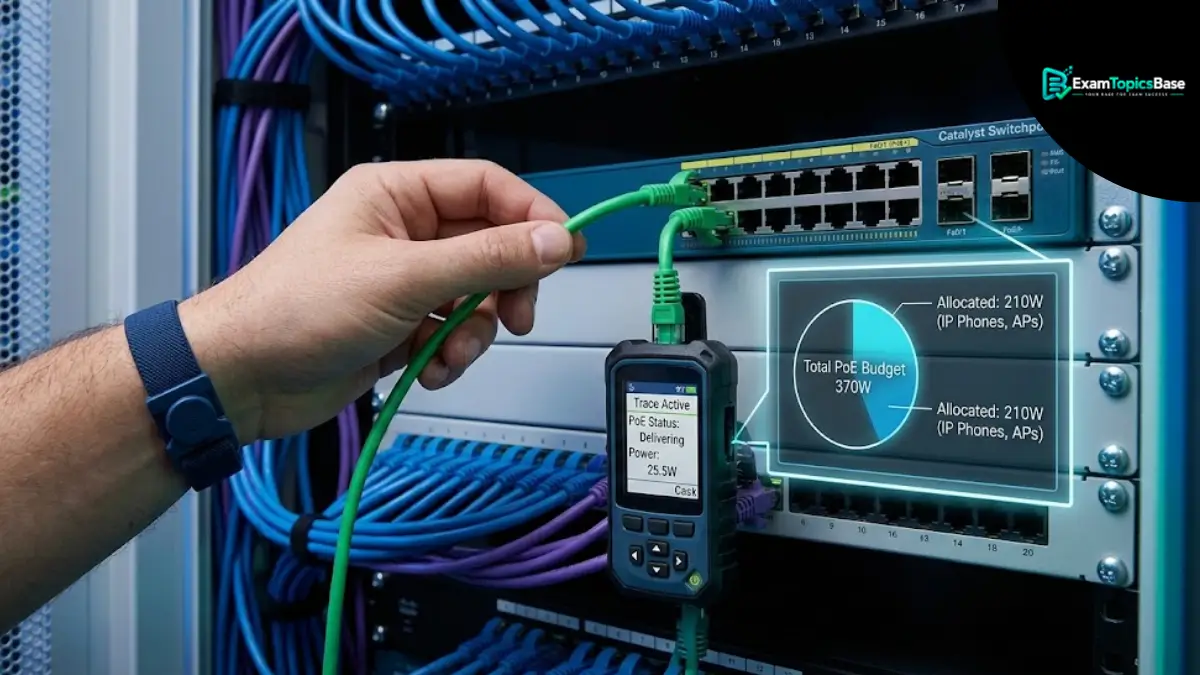
Power over Ethernet (PoE): Calculating power budgets, verifying wattage allocation, and figuring out why a powered device isn’t turning on.
3. Practical Dual-Stack & Service Troubleshooting
OSPFv3: Single-area OSPFv3 configuration and adjacency troubleshooting for IPv6 is explicitly on the blueprint.
DNS Record Diagnostics: Real-world triage of A, AAAA, CNAME, MX, NS, and PTR records.
Packet Capture & Physical Diagnostics: Reading basic packet captures, spotting duplex/speed mismatches, identifying CRC errors, and hunting down cable faults.
The "Cognitive Upgrade": Why Troubleshooting Changes the Game
If you look closely at the blueprint's wording, Cisco replaced passive verbs like "describe," "explain," and "compare" with active verbs: "diagnose," "troubleshoot," "interpret," and "validate".
Feature | CCNA v1.1 (Theoretical Recall) | CCNA v2.0 (Operational Application) |
Primary Action Verbs | Describe, explain, compare, identify | Diagnose, troubleshoot, interpret, validate |
Core Testing Method | Protocol definitions, feature lists, and architectural concepts | Scenario analysis, multi-device outputs, and live triage |
Lab & CLI Focus | Identifying correct GUI menus, basic command recall | Analyzing show run outputs, isolating configuration errors, resolving bugs |
Automation & Modern Tech | Memorizing theoretical API terms and controller models | Constructing structured prompts, auditing AI outputs for accuracy |
Typical Question Profile | Single-variable multiple choice (e.g., recalling timer values) | Multi-variable scenario prompts with topology diagrams and CLI logs |
In practical terms: you won't just be asked what an OSPF dead timer is. You’ll get a network topology, a snippet of show ip ospf neighbor showing an adjacency stuck in INIT or EXSTART, a fragment of show ip interface brief, and four plausible explanations for why the neighbor relationship broke.
Memorizing an Anki deck of flashcards will not get you across the finish line on this exam. You have to spend time breaking things in a lab.
The Big Decision: Should You Take v1.1 or Wait for v2.0?
You don’t have to panic, but you do need to make a calculated choice based on your current progress:
Strategy A: Take v1.1 Before February 2, 2027
Who this is for: Anyone who is already studying right now.
The Case for It: There are thousands of hours of mature video courses, lab workbooks, and practice exams available for v1.1. When you pass, your CCNA is valid for three years. Nobody hiring you is going to check whether you took v1.1 or v2.0; they just want to see a valid Cisco certification on your profile.
Strategy B: Target v2.0 in February 2027 and Beyond
Who this is for: People who are starting completely from scratch late in the cycle and cannot realistically finish before February.
The Case for It: You avoid rushing through study material just to beat an arbitrary deadline. Plus, the skills you learn—troubleshooting broken configs, validating AI scripts, working with dual-stack OSPFv3—are immediately useful in modern production networks.
How to Prepare for the v2.0 Blueprint?
If you’re targeting the new exam, structure your prep around these practical rules:
Don't ditch your core networking materials: Subnetting, VLANs, 802.1Q trunks, Spanning Tree, EtherChannel, and OSPFv2 haven’t changed. A packet still moves through a router the same way. The fundamentals carry straight over.
Focus on "Break-and-Fix" labs: Instead of following along with clean lab tutorials where everything works on the first try, download pre-broken lab scenarios or ask a study partner to secretly misconfigure MTUs, passive interfaces, or native VLANs. Learn how to find the root cause using only show and debug commands.
Practice writing and evaluating AI prompts: Fire up an LLM and ask it to build configurations for a small campus network. Read through the syntax critically. Can you spot where the AI messed up a wildcard mask, missed an explicit deny, or used deprecated IOS syntax? That exact evaluation skill will be tested.
Learn your show command outputs cold: Make sure you can read a routing table, an ARP table, an interface counter error log, and a Spanning Tree state diagram without hesitation.
Try Free Cisco Certifications Exam Questions At ExamTopicsBase
Frequently Asked Questions (FAQ)
1. When is the exact release date for CCNA 200-301 v2.0?
CCNA 200-301 v2.0 officially launches on February 3, 2027. The final date to take the older v1.1 version is February 2, 2027.
2. Does the exam code change from 200-301?
No. The exam code remains 200-301. Only the internal blueprint revision changes.
3. If I pass CCNA v1.1 right before the deadline, will my certification expire early?
Not at all. Your certification is good for the standard three-year period from the exact day you pass. Cisco does not penalize anyone for taking the earlier blueprint.
4. Will the v2.0 exam be harder than v1.1?
Yes, for most candidates. Because Cisco cut passive memorization questions in favor of troubleshooting CLI outputs and reading packet captures, you cannot pass simply by memorizing facts.
5. Why is AI included in a CCNA networking exam?
Network operations centers increasingly use AI digital assistants to summarize alerts and draft configurations. Cisco wants associate-level engineers who know how to prompt these systems properly and catch hallucinations before pasting suggestions into production hardware.
6. Do I need to learn how to code Python for CCNA v2.0?
No. You do not need to write software applications. You only need to know how to interpret structured data formats like JSON and YAML, understand how Ansible executes changes, and craft clear prompts for AI tools.
7. Can I still use my current books and video courses to study?
Yes, for about 75% to 80% of the material. Layer 2 switching, IPv4/IPv6 subnetting, static routing, and single-area OSPF carry straight over. You will just need supplemental material to cover OSPFv3, AI operations, and switch-port endpoint configurations.
8. How many domains are in the new blueprint?
The CCNA v2.0 blueprint condenses the material into 5 domains, down from the 6 domains found in v1.1.
9. Did Cisco remove network security from the CCNA?
No. Cisco removed the separate "Security Fundamentals" header and folded the practical security tasks—like ACLs, port security, and DHCP snooping—directly into Domain 4.0 alongside network services.
10. Does the exam duration or question count change?
The exam duration remains 120 minutes. The question count stays in the standard range of roughly 100 to 120 questions, including multiple-choice, drag-and-drop, and performance-based lab items.
You may also like to read:
What Is the Cisco 820-605 Exam? | Topics, Tips & Preparation Guide
Cisco 200-201 Exam Topics | The Ultimate Study Guide for Smarter Preparation

Written by Marcus Vance
I’m Marcus Vance, a Cisco Solutions Architect and technical contributor at ExamTopicsBase. Having designed mission-critical enterprise backbones and navigated Cisco's certification tracks for over a decade, I focus on delivering accurate, real-world packet analyses and blueprint-aligned practice questions so you can pass your exam with total confidence.
Comments (0)
Leave a Reply
No comments yet. Be the first to share your thoughts!